A Note on Mental Models and Perception
How can we sharpen our perception?
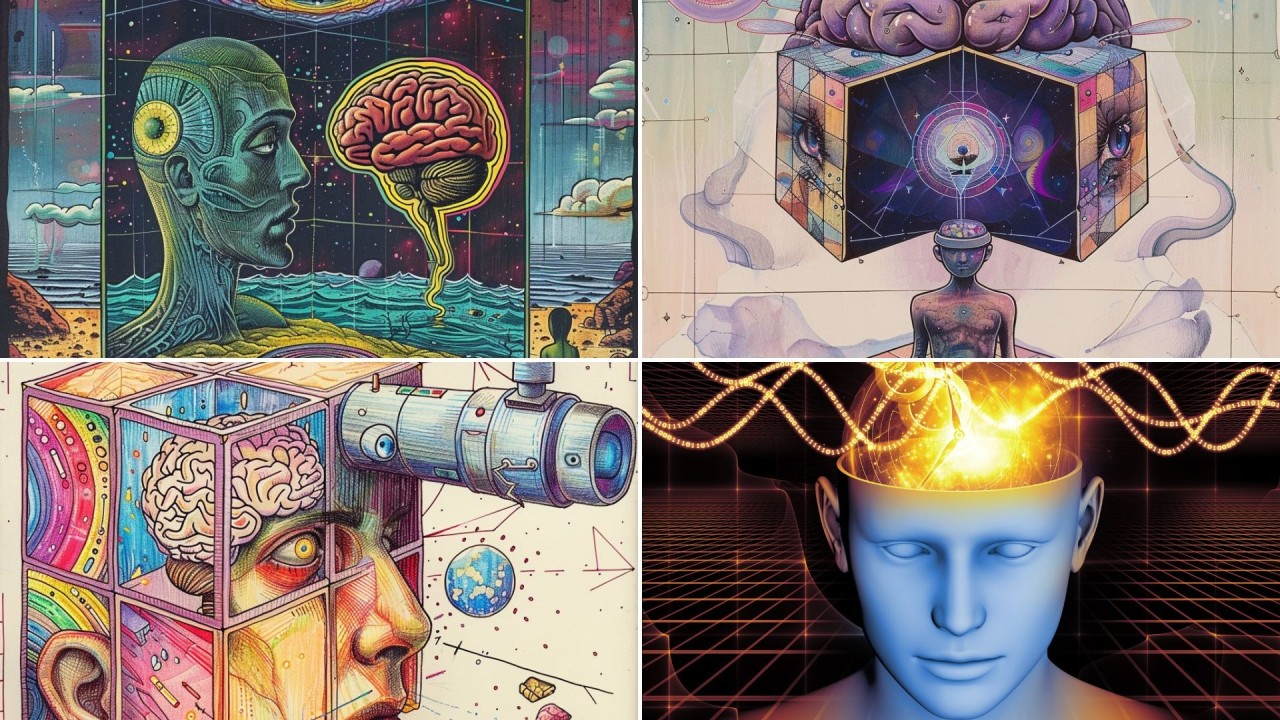
Your entire experience of life is determined by your mental models, which form the foundation for your perception of reality. These models, comprising your understanding of cause and effect, influence how you see the world—and how you see the world affects what you see. At the root, these mental models are made up of deeply ingrained assumptions, samskaras, and judgments.
Mental models are built up of assumptions. As Jung said, people don’t have time or motivation to think and so choose the easier route of judging. Mental shortcuts. There are some inborn beliefs and tendencies too which are justified by some or the other theory. There are deep samskaras from our many past lives. There is a tremendous force to see things in a particular way. People like to sleep with their front doors locked. So also, they like to go about life with their mind locked. They like to keep it closed – that feels safer and easier. Even if you live in a safe area, entertaining everyone who comes at your door is a big hassle. Who wants to spend the extra time and energy to think, analyze, investigate and arrive at the better view? It is easier to simply judge.
This judgement is colored and clouded. Stuff is seen through the mental lens. This lens is constructed by the taking bits and pieces of ideas, opinions, prejudices, superstitions and beliefs of parents, grandparents, aunts, uncles, teachers, classmates, friends, enemies, authors etc.
These are all floating around. Everyone will not pick up the same pieces but everyone in that environment will pick up enough of the same pieces. Mostly these assumptions are inserted into your mental spaces when you were not looking, when you were not on guard, when your mind did not even have a door or a filter. So, you did not question them.
However, you already have a container of a certain shape, and each person will have a different shaped container. Once you have held certain beliefs for long enough it becomes hard to let go of them. You now identify with your beliefs to such an extent that they have become you. The basic instincts of self-preservation and self-propagation kick in..
Growth lies in constantly examining your own mental models,
understanding them. Becoming aware of the bricks that went into building them. In listing and testing your assumptions against hard reality. When assumptions are rectified, mental models change. Unless mental models change no true learning takes place. It is better to have open mental models when compared to having closed ones. This is what I know today based on available evidence and tomorrow when life presents other facts or experiences, I am willing to update my mental models. In other words, I can choose to be open minded.
According to ancient yogic texts, these mental models are not standalone—they are influenced by the four functions of the Antahkarana. Antahkarana is a Sanskrit term that refers to the inner instrument or the internal faculties of the mind in Indian philosophy, particularly in Vedanta and Yoga. Antahkarana is considered the interface between the individual consciousness (Atman) and the external world.
The Antahkarana consists of:
- Manas – responsible for sensory processing, thought, desires.
- Buddhi –responsible for discernment and decision-making.
- Chitta –where the samskaras (impressions) and memories of the past lives reside.
- Ahamkara –the “I” sense which creates a sense of separateness, which attaches to experiences and shapes identity.
These components work together to create the lens through which you view the world.
Mental models are built from these layers. People take mental shortcuts, forming judgments based on past experiences and inherited beliefs. These shortcuts are not just a function of the mind’s surface processing (Manas), but are also shaped by deeper, karmic impressions (Chitta) and a sense of “I” (Ahamkara). This leads to a clouded or biased perception of reality, one where samskaras from previous lives or experiences color how you perceive the world today.
In many ways, people lock their minds, just as they lock their front doors for security. It feels easier and safer to operate with a closed mind, accepting judgments formed by the Ahamkara, rather than opening themselves up to new perspectives that challenge their established mental models. The struggle lies in identifying that this lock is self-imposed, and that growth comes from unlocking it by re-examining the assumptions and beliefs you hold.
The yogic view extends beyond modern neuroscience’s understanding of perception as a brain-based construct. In Indic / Yogic traditions, the brain is considered a physical organ of the mind, but the mind itself is subtler and tied to the Antahkarana. Neuroscience shows that perception is subjective and can vary between individuals – every individual sees the world differently. However, from a yogic standpoint, we can clean and refine this perception by working on all aspects of the Antahkarana. This involves purifying the Chitta through practices like Sadhana (spiritual practice) which in turn stabilizes the manas and reduces the constant stream of desires and the constant reactions to the sensory stimuli and turns it towards the divine, which then frees up the Buddhi (higher intellect) and allows it to develop viveka that is grounded in dharma, leading to clearer discernment, and ultimately minimizing the hold of the Ahamkara or reducing that strong sense of separateness from everything around. As Chitta becomes fully purified by erasing those past negative psychic impressions, and the manas dissolves in the divine, the “I” merges with the universal consciousness. That is why there is so much emphasis on erasing our past karmas through various means in Sanatani texts. This concept is actually operationalized in our Bharatiya culture – our ancestors did not leave it to sleep in the texts.
अविद्यास्मितारागद्वेषाभिनिवेशाः क्लेशाः॥ २॥
Avidyāsmitārāgadveṣābhiniveśāḥ kleśāḥ.
Meaning: Ignorance, I-feeling, liking, disliking and fear of death are the pains. Klesha is a kind of agony which is inside our very being.
The five kleshas (pains, afflictions) are : Avidya, Asmita, Raga, Dvesha, Abhinivesha.
Avidya: ignorance;
asmita: l-feeling;
raga: liking;
dvesa: repulsion, dislike;
abhinivesah: fear of death;
klesah: afflictions
As Maharshi Patanjali pointed out, ignorance (Avidya) is one of the primary afflictions of the mind (Klesha). This ignorance distorts our perception of reality, creating a mixed image—like trying to see a painting in a dark room with a projector running in the background. Your Chitta (the mental screen) reflects not only reality but also the projections of your karma, desires, and mental conditioning. To see the world as it truly is, rather than through the lens of Ahamkara or past impressions (Chitta), one must cleanse the doors of perception.
“Avidya is the source of asmita, raga, dwesha and abhinivesha. Just as the seed is the cause of the whole tree, so avidya is the source of the other four kleshas.”
Avidya is not just simple ignorance, it is the spiritual ignorance that causes one to misidentify the transient, impermanent, impure, and painful aspects of existence with the eternal, pure, and blissful self (atman), leading to a fundamental error in perception. It manifests as a veil or illusion (maya), creating duality and distorting reality, akin to mistaking a rope for a snake. Rooted in confusion between body and consciousness, avidya can only be overcome through viveka—the discriminative wisdom that distinguishes the eternal from the non-eternal. And that is the whole effort we are talking about.
“Asmita is the identity as it were of the purusha with the buddhi. The awareness of ‘I am’ is mixed with existence, with the body, actions and mind. It is as if a prince in the garb of a beggar is identifying with the role he is playing. This is asmita.”
Reference: Four chapters on freedom, commentary on the yoga sutras of Patanjali by Swami Satyananda Saraswati of the Bihar School of Yoga.
As Swami Sivananda explains, “Avidya is that portion of the primitive non-intelligent principle in which Sattva is subordinated to Rajas and Tamas. This is known as Malina Sattva, because it is impure on account of the predominance of Rajas and Tamas. It is the reflector of Jiva whereas Maya is the reflector of Isvara. Maya is called Suddha Sattva on account of the predominance of Sattva. This world of experience is due to the force of Avidya. It is the force of Avidya that plunges us into the ocean of Samsara. It is a negative power which makes us forget our divine nature. Avidya operates through the mind, and the mind functions through the time, space and causation. Avidya is an illusory power that disintegrates the Divine into a million different fragments. Pleasure, pain, desire, Karma, attraction, repulsion, delusion, pride, lust, egoism, anger, jealousy, the three bodies, five sheaths, are all effects of Avidya. Avidya is the source of all ignorance, sin and misery. Avidya is beginningless (Anadi) but it has an end. As soon as one gets knowledge of the Self, Avidya terminates. Brahman appears as the world on account of Avidya, just as the rope appears as snake in the dusk. If we bring a lamp, the snake disappears, but the rope alone remains. Even so, when we get knowledge of Brahman, the appearance of the world will vanish. Avidya is not negative but is positive (Bhavarupa). It is absence of Knowledge. It is erroneous knowledge. Avidya or Ajnana which constitutes the causal body is the cause for the two bodies, gross and subtle.It is impossible to define the nature of Avidya. It is Anirvachaniya. It is not real, because it vanishes when knowledge of the Self dawns. It is not unreal, because we experience it unlike the horn of a hare or a barren woman’s son. It is not a non-entity as it is destroyed by Atma Jnana. It is through the force of Avidya that the ignorant Jiva has mistaken the impure mortal body for the pure immortal Self and says I am a Pandit, I am a householder, I am beautiful, I am lean, I am a doctor, etc.”
Avidya can lead you to think in terms of binaries* which do not allow you to see the whole truth.
T. Krsna Dasa writes on the Krishna Bhakti site,
“The definition of avidyā
Mahaṛṣi Patañjali defines avidyā as follows:
anityāśuci-duḥkhānātmasu nitya-śuci-sukhātma-khyātir avidyā
To consider
1) the impermanent (anitya) to be eternal (nitya),
2) the impure (aśuci) as pure (śuci),
3) the painful (duḥkha) as blissful (sukha) and
4) the inert (anātmā) as conscious (ātmā),
is called avidyā.
(Yoga-sūtra 2.5)
Note that the four types of avidyā are only potentials, in that they only become enacted when one becomes identified with a body and mind. This actualization is described below.
The consequences of avidyā
avidyā results in a chain reaction that brings suffering, which are listed below.
avidyā –> asmitā –> rāga, dveśa –> abhiniveśa
We now examine the definitions of the additional four terms.
The word asmitā is made by adding the suffix tā to the word asmi, which is the first person singular present tense form of the verbal root as, to be. Asmi means “I am”, and asmitā is “(I am)-ness”.
In this context, the definition of asmitā in the Yoga-sūtras is as follows:
dṛg-darśana-śaktyor-ekātmatevāsmitā
considering the seer (dṛk-śakti) and the instrument for seeing (darśana-śakti, i.e. the mind) to be one and the same.
Yoga-sūtra 2.6
Once there is strong asmitā related to a particular mind and body, then the next steps are rāga and dveśa. Their definitions are below:
sukhānuśayi rāgaḥ: rāga or attachment arises as a consequence of pleasure
duḥkhānuśayi dvesaḥ: dveśa or aversion arises as a consequence of suffering
Yoga-sūtra 2.7-8
rāga gives rise to greed, and dveśa to anger and fear. Because of rāga and dveśa, one becomes entangled in the body, that is, one is constantly engaged in protecting the body from threats, which results in the fear of death or abhiniveśa.
svarasa-vāhi viduṣo’pi tathāruḍho’bhiniveśaḥ
Even amongst the learned (viduṣo’pi), the fear of death (abhiniveśaḥ) is naturally (svarasavāhī) established or found (āruḍhaḥ) just as in the ignorant (tathā).
Yoga-sūtra 2.9
Below, we give examples of the four types of avidyā taken from Anuccheda 10 of the Bhagavat Sandarbha.
Considering anitya as nitya. Everything in the material world is temporary, including our own mind and body. And yet, most of us go through life forgetting this fact, and act as if the body will last forever. As one gets older, the realization that the body will end beings to inevitably creep onto our consciousness, although the solution generally is to try and forget it by absorbing oneself in some activity or the other. To consider the body permanent is the first step of avidyā.
Considering aśuci as śuci. A simple example of this is the fact that we forget that our bodies are full of impure things that we would generally recoil at if they were presented to us. This includes stool, urine, blood, mucus and so on. And yet, we are terribly attached to our body, take tremendous efforts to protect it, make it comfortable, try to beautify it, scent it with perfumes, and cover it with expensive clothes and so on.
Considering duḥkha as sukha. Śri Kṛṣṇa states that the body is a reservoir of suffering (duhkhālayam, Gītā 8.15) and devoid of happiness (asukham, Gītā 9.33). Even so, people mistakenly take this body as an instrument of pleasure. They strive to seek pleasure in it, and to seek pleasure in others’ bodies, but in vain. The body inevitably gives more suffering than pleasure.
Considering the inert as conscious. The body is made of inert atoms, the mind is material, and neither are conscious by themselves. Identifying oneself with them makes it impossible to understand that the self is distinct from the gross and subtle material bodies.”
William Blake wrote, “If the doors of perception were cleansed, everything would appear to man as it is, Infinite.” This cleansing process is the journey of Sadhana, where you refine your mind’s instrument, the Antahkarana, to align with the truth, transcending the false realities your mental models have constructed. The realization of “Brahma Satyam, Jagat Mithya” (Brahman is truth, the world is illusory – attributed to Adi Shankaracharya) becomes evident when you shift your identification away from the transient Ahamkara and see through the infinite lens of pure consciousness.
Mental models are hidden, and they are stubborn. We tend to reject any information that conflicts with our mental models and celebrate information that aligns with our mental models. Therefore, unless we are open to changing our mental models, no true learning takes place regardless of experiences. Ultimately, mental models must be examined deeply and exposed to be corrected, but the journey doesn’t stop there. The transcendence of mind occurs when one is in the state of Turiya—the state of pure awareness, where the Antahkarana is fully aligned with the truth. This happens when you are no longer identified with the body or mental constructs and is rooted in the universal consciousness. In this state of mind, asking yourself, “Who am I?” can yield the answers you have been searching for all your life. To be fully established in truth, advidya will need to be completely transcended.
Ahamkara (the sense of separateness) can be said to be one of the root causes of the friction that exists between individuals and erodes the cohesive working of organizations. As the Ahamkara in individuals is weakened through the purification of the chitta, the stabilization of the manas and realigning its focus on the collective as opposed to the merely selfish desires and aspirations, and the tempering of the buddhi (intellect) with Dharmic dristi and logic, the sense of oneness arises and strengthens the cohesive bonds between people. Such organizations then become capable of accomplishing what would normally be considered impossible while staying withing the framework of dharma.“Dharayati Iti Dharmaha” – that which sustains is Dharma. Also, dharma is that which creates harmony and removes disharmony.
Sadhana, Seva (selfless service), Sankeertana (meditative chanting / singing), and deep meditation cleanse the mind, removing the distortions and allowing you to directly perceive the truth. The Anthahkarana then becomes an instrument to serve the higher self and align it with Dharma. In this process, you learn to dissolve mental models entirely, allowing perception to reveal the infinite truth.