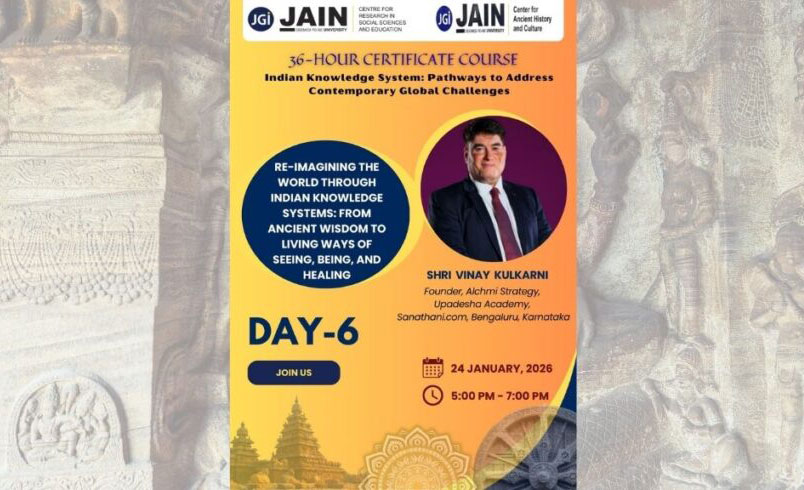
36-Hour Certificate Course on Indian Knowledge Systems
A course Report
Viewing the World Through the lens of Indian Knowledge Systems
From Ancient Wisdom to Living Ways of Seeing, Being, and Healing
Taught by Vinay P. Kulkarni
JAIN (Deemed-to-be University) | 24th January, 2026
A note of gratitude to Dr. Avanish Kumar, Assistant Professor of Political Science and International Relations Centre for Research in Social Sciences and Education (CeRSSE)
Some experiences stay with you. Not because they were perfect, but because they were real. This course was one of them.
I want to begin by placing on record my deep gratitude to JAIN (Deemed-to-be University) for creating the space for this kind of conversation — one that goes well beyond the conventional boundaries of academic instruction. And a very special thanks to Dr. Avanish Kumar, Assistant Professor of Political Science and International Relations.
Teaching this course was, quite honestly, one of the most fulfilling things I have done in recent times. The students brought energy, curiosity, and an openness that is rare. There were moments in that classroom where something genuinely shifted — not just in what people were thinking, but in how they were thinking. And for that, I am deeply grateful.
What the Course Was About
The full title of this course — Viewing the World Through Indian Knowledge Systems: From Ancient Wisdom to Living Ways of Seeing, Being, and Healing — is itself a kind of manifesto. This was not a history lesson. It was not a survey of ancient texts. It was, at its heart, an invitation to examine the lens through which we see the world.
We began with a deceptively simple question: What if everything we thought we knew about success, progress, happiness, and even health was built upon borrowed assumptions — mental constructs we never consciously chose? What if the very framework through which we perceive reality was shaped not by cosmic truth, but by historical accidents and colonial legacies?
That question opened a door. And once open, we walked through it together.
The Invisible Architecture of Our Minds
We rarely pause to examine the mental models that govern our lives. Yet these models determine everything — what we consider valuable, what we pursue, how we measure success, and ultimately, who we become. The course was structured to surface these invisible architectures and hold them up to the light.
We explored the contrast between Western and Bharatiya worldviews — not to romanticize one over the other, but to understand that the questions we ask shape the answers available to us. Is happiness an individual pursuit or a collective one? Is time linear, marching toward some future destination, or cyclical, breathing through the eternal rhythms of creation and dissolution? Is death an ending or a doorway?
The Dharmic framework — the Bhāratīya operating system, if you will — does not separate the secular from the sacred, the material from the spiritual, the individual from the collective. Dharma is not religion in the Western sense. It is based on the cosmic principles that sustains life at every level, from the movement of galaxies to the beating of a human heart.
Decolonizing the Mind: The Heart of the Matter
Perhaps the most charged territory we entered was the question of epistemic colonization — how colonial history has reshaped not just our institutions, but our very sense of ourselves.
Indians have internalized colonial descriptions of their own society — descriptions that portray Indian culture as irrational, religiously fragmented, caste-ridden and morally regressive. These portrayals, originally produced within Western theological and philosophical debates, continue to shape Indian self-understanding through modern social sciences, constitutional law and public discourse. As a result, indigenous experiences and narratives are treated with suspicion, while Western analytical categories are accepted as neutral and universally valid.
— Prof. S. N. Balagangadhara, Seeing Ourselves as the Colonizer Saw Us
Prof. Balagangadhara’s observation cuts deep. When asked what it means to be Indian, many respond either with silence or with borrowed clichés drawn from Western political or sociological vocabularies. This epistemic alienation — this estrangement from one’s own inheritance — is not a small thing. It contributes to persistent struggles with social cohesion and institutional legitimacy, despite formal political independence.
The task we took up in this course was not political in any partisan sense. It was something more fundamental: the recovery of an independent, rooted way of seeing. Not a return to some idealized past, but the conscious reclamation of a shastric dṛṣṭi — a way of seeing grounded in the profound understanding of prakṛti and puruṣa, of the manifest and the unmanifest.
The Sustainability Crisis — and Its Inner Roots
The course gave significant attention to our current ecological and civilizational crisis — not as an external policy problem, but as a direct consequence of inner disconnection.
When an entire civilization operates exclusively in the Artha-Kāma plane — driven by desire and accumulation — and forgets Dharma (the harmonizing principle) and Mokṣa (the liberating principle), the results are predictable. Unlimited desires pressing against limited natural resources. One planet is simply not enough to satisfy the untenable demands of a humanity operating without the counterweights of inner restraint and ecological wisdom.
The antidote, we explored together, is not more regulation or technology. It is Chitta Shuddhi — the purification of consciousness. Viveka — the capacity to discriminate between the ephemeral and the eternal. Without this inner work, no external solution holds.
Purifying the Antaḥkaraṇa: The Inner Technology
Patañjali’s definition still reverberates across millennia: Yogaḥ citta vṛtti nirodhaḥ — yoga is the cessation of the fluctuations of the mind-stuff. Not a gym class. Not a wellness trend. The complete technology of inner transformation that our ṛṣis developed and refined over generations.
We explored the four faculties of the antaḥkaraṇa — the inner instrument: manas (the processing mind), buddhi (the discriminating intellect), ahaṅkāra (the sense of individual identity), and chitta (the storehouse of impressions). Each requires specific attention. Each is a field of practice. And together, they constitute the terrain on which the whole of inner life unfolds.
The Pañcakoṣa Paradigm and Mokṣic Design
One of the most illuminating frameworks we worked with was the Pañcakoṣa model — the understanding that the human being exists simultaneously across five sheaths, from the gross physical body (Annamaya Koṣa) to the bliss body (Ānandamaya Koṣa).
What became clear — and this visibly moved many students — was the breathtaking intentionality embedded in traditional Bharatiya culture. The food we ate, how it was prepared. The temples we built, the mūrtis we worshipped. The houses we lived in, the clothes we wore, the professions we chose, the cities we designed. Every aspect of life was carefully crafted so that even the most ordinary person, going about the most ordinary tasks, was being slowly, gently moved from the Annamaya toward the Ānandamaya koṣa. Day by day. Hour by hour. Task by task.
Such compassion. Such karuṇā. Such love for every living being.
We also explored Mokṣic Design as an economic and civilizational principle — the understanding that true material prosperity cannot be achieved through material goals alone. Design oriented toward liberation and expanded consciousness naturally generates material well-being as a byproduct.
The Pedagogy: How We Taught
I have always believed that the most important thing a teacher can do is make the student want to think — not tell them what to think. This course was built on that conviction.
Rather than delivering information, we created conditions for inquiry. Every session began with a provocation — a question designed to destabilize comfortable assumptions. Students were invited to notice their own reactions: What surprises you? What depresses you? What elevates you? These emotional responses, we discovered together, are doorways into the unconscious architecture of one’s worldview.
The pedagogy was explicitly participatory. Interactive discussions, reflective pauses, real-time examples drawn from contemporary life — these were woven throughout. Sanskrit terminology was introduced not as jargon but as precision tools: words that do not have adequate English equivalents, concepts that open new cognitive spaces when encountered directly.
The Pañcakoṣa framework, for instance, became a live taxonomy through which students began re-examining their own daily routines, relationships, and choices. The antaḥkaraṇa model gave them language for inner experiences they had always had but never been able to name.
One student described it beautifully: an innovative way of teaching — a participatory teaching method applied intelligently. That, honestly, is the highest praise a teacher can receive.
What the Students Said
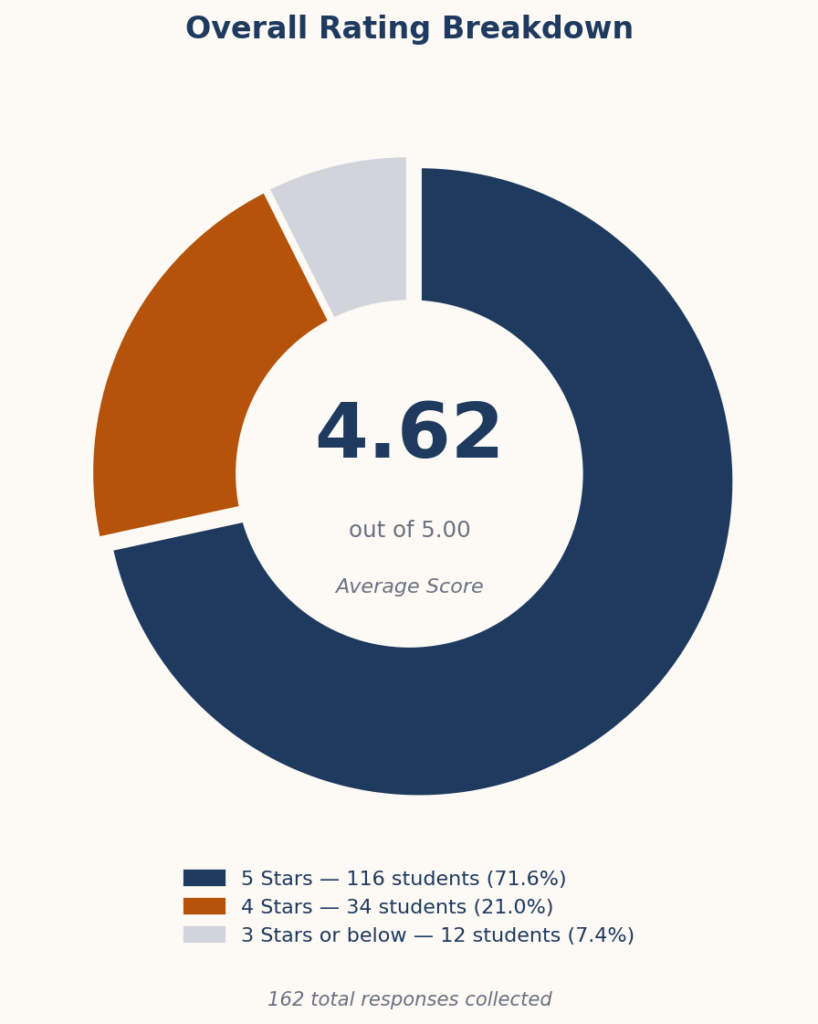
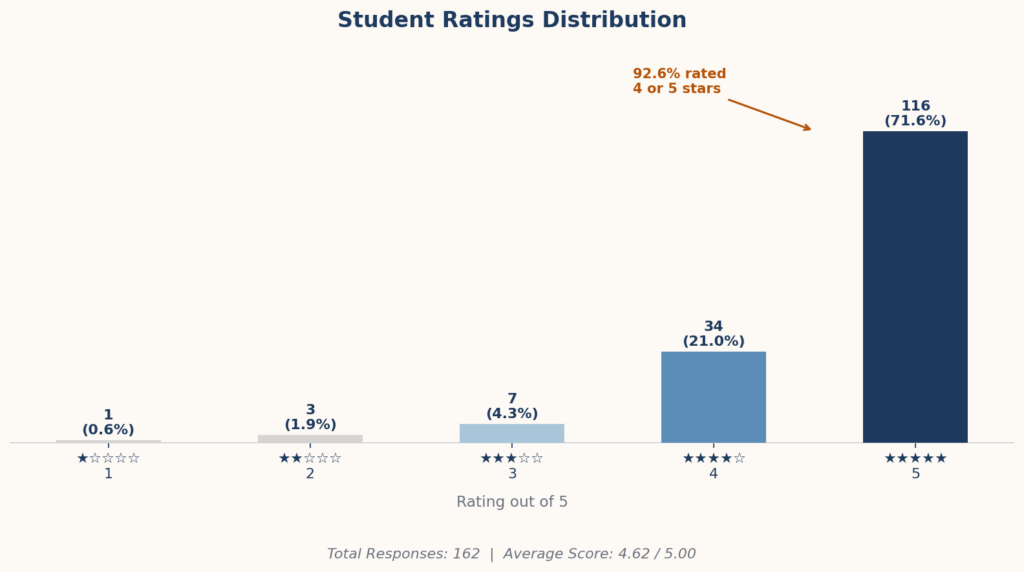
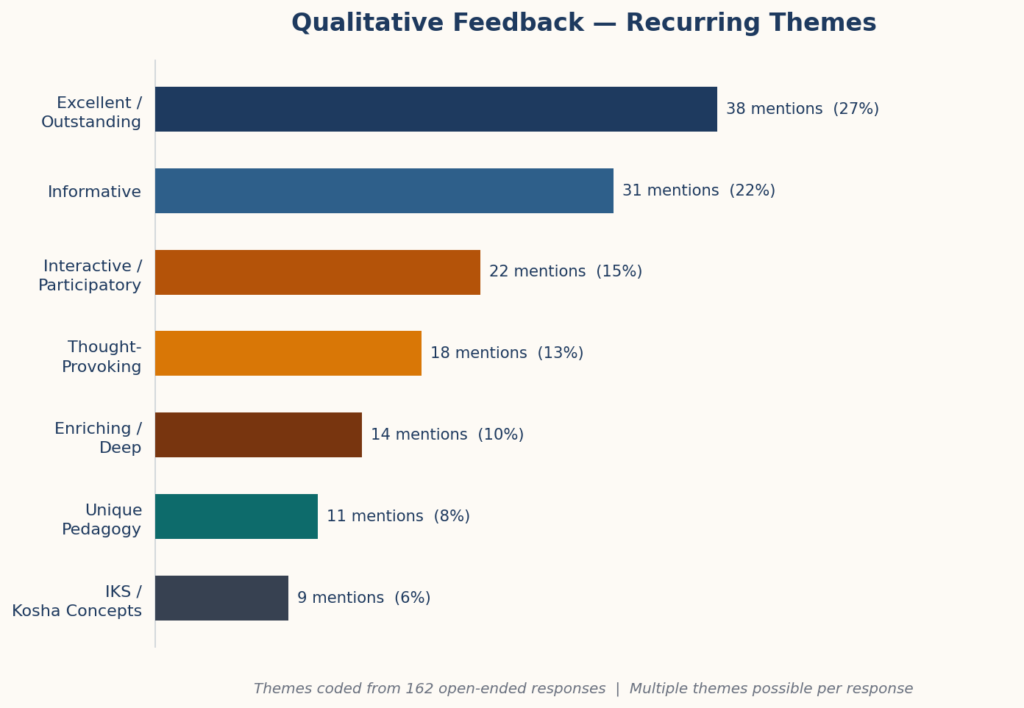
162 students completed the course feedback. The numbers tell one part of the story. The words tell a richer one.
At a Glance — 162 responses, average score 4.62 out of 5.00
Rating Distribution — 116 students (71.6%) awarded a perfect 5 out of 5
Score Summary — 92.6% of students rated the course 4 stars or above
Qualitative Feedback Themes — coded from 162 open-ended responses
Selected Voices
“Thought provoking and wonderful session.”
“Innovative way of teaching. Participatory teaching method applied intelligently.”
“Knowing the real meaning of sustainability — nothing else needed.”
“Lot of inputs involving the kosha concept was too informative.”
“The session was awesome. Interactive and thought provoking. Thank you sir.”
“Very erudite presentation.”
“Learned to stabilize the mental health through yoga etc.”
“Amazing content integrating IKS concepts.”
“Most Informative, Inspiring, Enlightening, Excellent — Crystal Clear Wonderful Session.”
“Very informative and extensive.”
“Many activities were suggested by the expert which provoked reflective thinking.”
“Wonderfully organised.”
“Very informative and reflective.”
“Fantastic session. Learnt a lot.”
“Today’s session was very enriching and deep.”
“This was really amazing.”
The feedback was not solicited in a closed environment. These were genuine, uncoached responses from students encountering many of these ideas for the very first time. And they landed.
Closing Reflections
The world does not need more information. It needs transformed minds. It needs people who have done the inner work required to see clearly — without the distorting filters of borrowed assumptions and colonial conditioning.
That is what this course was attempting to do. Not to give students a new ideology to replace the old one, but to give them the tools to think for themselves. My attempt here was to replace colonized lenses we were born with decolonized Indianized lens. Activate that Bharatiya Dristi. Of course in short course we can only give students a taste of it.
Did we succeed? The students themselves seem to suggest we took meaningful steps in that direction. But more than the ratings and the kind words, what stays with me is the quality of attention in that room — the feeling that something real was being touched, that minds were genuinely opening.
The ancient wisdom has always been here. Patiently waiting. The question is never whether these teachings are relevant — their relevance only grows with each passing crisis. The question is whether there are minds ready to receive them, and hearts open to their transformative power.
I left this course believing, more deeply than before, that there are. IKS is not something new. It is our culture, our history, our civilization, our traditions, our way of life, our worldview. We just need to recollect and restore! Kudos to universities like JAIN for their efforts in this direction.
Here is a more detailed article on based on the course:
Viewing the World Through Indian Knowledge Systems: From Ancient Wisdom to Living Ways of Seeing, Being, and Healing
— Vinay P. Kulkarni, January 2026
You can write to me at vkulkarni@vedikzen.com / Whatsapp: 9945731953