
The Vanishing Art and Culture of Oral Storytelling
Why Stories Are the Lifeblood of Families, Businesses, and Civilizations
Once upon a time, storytelling was not a luxury or a hobby. It was survival. It was transmission. It was how human beings remembered who they were, how they belonged, what they believed, and how they overcame adversity. Today, in the race for speed, scale, and spectacle, we are losing that ancient art. The consequence? We are slowly becoming a civilization without a soul.
Let me explain why storytelling is not a pastime, but the fundamental daily work of a great civilization.
Why Stories Matter More Than Ever
At the heart of every strong culture—whether it is a family, a company, a country, or a civilization—you will find stories. Stories recount situations encountered and how people in those situations responded. They teach us that we are bigger than any situation and that adversity can be overcome with grit, courage, belief in self, belief in the divine, creativity, and hard work.
Stories nourish the human spirit long before food nourishes the body. Temples tell stories. So do books, epics, sculptures, festivals, and even recipes passed down generations. Gurus, elders, and parents are our original storytellers. And that’s how civilizations are raised: not on information, but on imagination.
The truth is, we’re wired for stories. Our brains don’t just process narratives—they crave them. When someone tells us a story, something magical happens. Neural coupling occurs, synchronizing the brain activity between storyteller and listener. We don’t just hear the story; we live it. Mirror neurons fire, allowing us to emotionally experience what the characters experience. Oxytocin floods our system, creating bonds of empathy and trust.
This isn’t just poetry—it’s biology. And it’s why stories have been humanity’s primary technology for transmitting wisdom across millennia.
The Crisis of Modern Storytelling
Somewhere along the way, we have forgotten how to tell stories. People have forgotten how to have long, leisurely conversations. Grandparents, once the repositories of wisdom and tales, no longer know how to tell stories. They often don’t have anything to pass on to their grandchildren anymore.
The statistics are sobering. Children today spend an average of seven hours daily on screens. Family dinner conversations have shrunk from an hour to barely fifteen minutes. The art of oral storytelling, practiced for thousands of years, is dying in a single generation.
Perhaps it’s time to not only teach Indian Knowledge Systems (IKS) to children, but also create courses and camps for grandparents—to help them rediscover the art of storytelling, to learn the stories and their meanings, and to relive their role as living libraries.
There is nothing quite like story time with grandparents. For many of us, summer vacation meant a fun train ride to Ajji Mane (Grandma’s house) in Dharwad. And enjoying “Beladingala Oota” on the terrace with Ajji Kai Tuthu—dinner under the moonlight with Grandma feeding us tasty food and captivating us with Mahabharata stories.
We read Amar Chitra Katha, listened wide-eyed to legends, and slowly imbibed values we didn’t even know we were learning. Each story was a seed, planted deep in our consciousness, blooming years later into principles that guided our lives.
The Digital Disruption of Human Connection
Recently, I conducted a 3-day children’s camp focused on developing the capabilities of the mind. I noticed that children today are so distracted that their observation skills have weakened. Schools have conditioned them to focus only on taking notes. So, we worked on unlearning these habits and cultivating good mental practices.
But the goal is not just to tell stories to children—it is to make them into storytellers. In that process, they become ambassadors of Sanatana Dharma and Indian Knowledge Systems. They carry forward not just knowledge, but a living, breathing tradition.
Most importantly, we have forgotten the art of conversations. When we were kids, there were no phones. Aunts and uncles would show up unexpectedly. Then we would have so much fun! Mom would rush to make something nice in the kitchen. Kids would bring out the chess boards and carom boards and start playing. But the party would never be complete without some good, real, old-fashioned storytelling by grandparents, parents, and older kids.
But now, everyone is glued to their phones. Storytelling is happening on reels and shorts. No one cares about human storytelling anymore. The heart-to-heart connection that stories used to build is being replaced by scrolls and swipes. And that is a loss we must consciously reverse.
The irony is palpable. We have more ways to communicate than ever before, yet we’ve never been more disconnected. We consume more stories through Netflix and Instagram than any generation in history, yet we’ve forgotten how to tell our own.
The Art and Science of Storytelling
Humor is an essential ingredient in storytelling—it disarms, connects, and makes even the most profound truths digestible. I really appreciate the way Upanishad Ganga was produced. The presence of a Sutradhar who acts as a bridge between the audience and the story and its characters transforms each episode into an intimate conversation. This narrative device, deeply rooted in Indian storytelling traditions, reminds us that stories must be told with rasa—with flavor, emotion, and life—not just recited like facts.
The Sutradhar doesn’t just narrate; he interprets, comments, and occasionally winks at the audience, creating a multi-layered experience. This ancient technique makes complex philosophical concepts accessible while maintaining their depth. It’s storytelling that respects both the story and the listener.
Beyond Listening: The Power of Writing Stories
We must go beyond just consuming stories—everyone should try their hand at writing them. Writing stories is an act that requires tremendous concentration, imagination, and creativity. It utilizes all parts of the brain simultaneously. When you write, you’re not just recording words; you’re architecting worlds, breathing life into characters, and weaving meaning into existence.
The process is transformative. As you struggle to find the right word, visualize a scene, or capture an emotion, your neural networks fire in ways that no passive activity can match. Writing is meditation in motion, therapy without a couch, and education without a classroom.
The science backs this up. Stories with clear narrative structure naturally appeal to our brains.
Reviving Storytelling in Every Sphere
We need to host storytelling nights everywhere—at restaurants and hotels, in schools and colleges, and especially in corporate establishments. Imagine walking into your favorite restaurant to find not just good food, but a corner where stories are being shared. Picture hotels hosting weekly story circles where travelers exchange tales from their journeys. Envision corporate boardrooms transformed into narrative spaces where employees share not just quarterly reports, but the stories behind the numbers.
The Theater of Life: Beyond Passive Listening
But we shouldn’t stop at storytelling. We must embrace the full spectrum of narrative arts—writing, directing, and enacting plays in both social and corporate settings. When people don’t just tell stories but embody them, transformation happens. The shy employee discovers confidence playing a king. The rigid manager learns flexibility through comedy. The disconnected team finds unity in shared performance.
I’ve experimented with this extensively through my summer camps at Sanskritishaala, and the results have been nothing short of magical. In one session, we had children create, write, and perform their own interpretations of ancient stories.
Kids are natural-born actors and storytellers. Their imagination hasn’t yet been constrained by the “proper” way to do things. They don’t need to be taught much—just given permission to explore and express. They instinctively understand that stories aren’t meant to be perfect; they’re meant to be lived.
The biggest challenge? Keeping them away from gadgets. But that’s easier said than done.
Storytelling in Families
In a family, storytelling is how values, identity, and resilience are passed down. Grandparents who share tales of struggle, migration, devotion, or transformation do more than entertain. They encode within the next generation a sense of where they come from, what matters, and what is possible.
History gives us powerful examples of this transformative power. Consider how Jijabai shaped the mind and character of Shivaji Maharaj through storytelling. She didn’t just tell him bedtime stories—she strategically narrated tales from the Ramayana and Mahabharata, stories of valor from Rajput heroes, and accounts of their own ancestors’ bravery. Each story was carefully chosen to instill courage, dharma, and a vision of Swarajya. Through her narratives, she sculpted not just a son, but a leader who would change the course of Indian history. Jijabai understood what modern neuroscience now confirms: stories shape neural pathways, build character, and inspire action.
Without storytelling, families raise children who know facts but not meaning. They grow up with gadgets but not grounding. But tell a child stories of their ancestors, or mythological figures who wrestled with their dharma, and you raise a different human being altogether.
Every family has its epic tales—the grandfather who walked miles to school, the grandmother who started a business with nothing, the uncle who chose principle over profit. These aren’t just anecdotes; they’re the DNA of family identity.
Storytelling in Business
In a business, storytelling is the keeper of culture. Every founding story, customer testimonial, early failure, and big win has to be told, retold, and woven into the fabric of the organization. It builds emotional connection, preserves hard-won insights, and passes on cultural DNA to new employees.
When a company loses its stories, it becomes a transaction machine, not a living entity. Stories create belonging. They explain why things are done a certain way. They show what the company stands for.
The most successful companies understand this. Apple doesn’t sell computers; it tells stories of creative rebels. Nike doesn’t sell shoes; it narrates tales of human potential. Every brand that touches hearts does so through story.
Storytelling in Civilization
For a civilization, storytelling is food. Gross food comes later. If you want to build a 1000-year society, you must feed it the stories of its gods, its heroes, its founders, its scientists, its saints, its rebels, and its poets.
Stories are the seeds of civilizational consciousness. Lose the stories, and you lose the civilization.
Take India, for example. Every major cultural practice—from temple architecture to dance forms—is steeped in narrative. Our deities are not abstract symbols; they are characters in elaborate stories. And the way they act, decide, bless, punish, or transform becomes the map by which generations orient themselves.
India’s Treasure Trove of Storytelling Traditions
India has a breathtaking range of storytelling forms, each a universe unto itself:
Harikatha Kalakshepam – Philosophical storytelling with music and drama
Villu Pattu – Tamil and Malayalam bow-based folk music tales
Kaavad – Rajasthani box-shrine storytelling
Pandavani – Mahabharata retellings from Chhattisgarh
Burra Katha – South Indian three-person storytelling combining music, satire, and social commentary.
Karnataka for example, boasts an extraordinary array of traditions that deserve special mention:
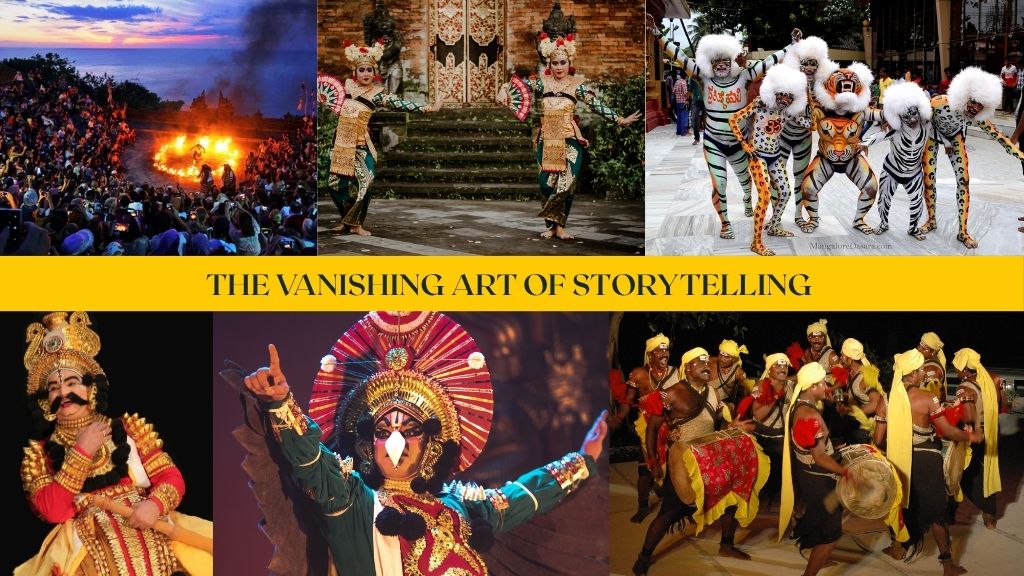
Yakshagana – A spectacular folk theater combining dance, music, dialogue, and elaborate costumes to present stories from Hindu epics. Performers spend entire nights bringing mythological characters to life.
Dasapadas – Songs in Kannada narrating stories from Puranas and real-life events, carrying both emotional depth and spiritual wisdom
Katha/Kathe – An umbrella term for various narrative traditions including Kamsale, Chaudike, Jogi, and Tatva—all performed through recitation and music
Jogi Kathe – Jogi performers use the kinnari (stick zither) while singing stories interspersed with relevant songs
Kamsale – Ancient dance form where performers create bell-like sounds with disc-shaped instruments while singing about Lord Male Mahadeshwara
Chitrakathi – Picture storytelling using painted scrolls, particularly popular in the Pinguli area
Each form carries centuries of refinement, audience engagement techniques, and cultural wisdom. They blend music and metaphysics, entertainment and enlightenment, creating experiences that transform both performer and audience.
Our literary traditions are equally profound. The Upanishads use stories to express the inexpressible—philosophical and spiritual truths that transcend logical explanation. The Panchatantra teaches strategy and ethics through animal tales that have traveled the world. The Kathasaritsagara is a vast ocean of nested legends, romance, and wonder.
The Global Language of Story
Storytelling isn’t unique to India—it’s humanity’s shared heritage:
Bali: Kechak, Barong, and Legong transform dance into narrative
France: Medieval troubadours sang tales of love and chivalry
Japan: Noh and Kabuki preserve ancient narratives through stylized performance
Africa: Griots serve as living libraries, memorizing generations of their people’s history
Across the globe, storytelling is survival, memory, and identity. Every culture that has survived has done so by telling its stories.
Stories as Medicine: The Psychological Healing Power of Puranas
I believe our Puranas and Itihasa-Puranas are not just stories but profound tools for psychological healing. They function as mirrors that reflect our consciousness, revealing truths about ourselves we might otherwise never see.
Take the Mahabharata, for instance. It’s more than a story; it’s a psychic and psychological mirror. How you respond to it—whom you idolize or despise, whom you worship or condemn, which characters confuse or amaze you, or who feels utterly transparent—reveals profound truths about your state of consciousness. These reflections uncover your deepest fears, prejudices, vices, and aspirations—your samskaras and vasanas.
This is why our ancestors insisted on regular exposure to these stories. They weren’t entertainment—they were medicine for the soul, therapy for the psyche, and maps for spiritual evolution. Each hearing reveals new layers, not because the story changes, but because you do.
Bridging the Urban-Rural Storytelling Divide
In villages, storytelling remains communal, participative, and organic – shared over fires, in fields, or at temples. The audience isn’t passive; they respond, interject, and shape the narrative. The story breathes with collective life.
In cities, storytelling has become digital, fragmented, and performance based. We consume stories alone, on screens, without the warmth of human presence. Both forms have their place, but we must ensure village-style oral traditions don’t vanish in the urban rush.
The Transformative Power of Stories
In health communication, storytelling is emerging as a game-changer. WHO’s Communication for Health framework uses personal narratives to promote health behaviors. Real stories—like that of Mildred, a TB survivor, or Roy, the “Mangrove Man” from Papua New Guinea—humanize statistics and inspire action.
These stories don’t just inform—they transform. They change not just what people know, but how they feel and what they do. A single well-told story can shift behavior more effectively than a thousand facts.
The Path Forward: Practical Steps
So how do we revive this lost art? Here are concrete steps we can take:
Start Story Circles: Gather friends and family monthly for dedicated storytelling sessions. No phones allowed.
Document Family Stories: Interview elders. Record their voices. Transcribe their memories before they’re lost forever.
Integrate Stories in Education: Every subject can be taught through narrative. History is already stories—but so are science, mathematics, and even coding.
Corporate Story Initiatives: Create “Story Fridays” where employees share founding myths, customer victories, and lessons learned.
Write Your Stories: Start a journal. Write one story from your life each week. You’ll be amazed at what emerges.
Support Traditional Storytellers: Attend performances. Invite them to schools. Ensure these art forms don’t die with their practitioners.
Create Modern Formats: Podcasts, video essays, and interactive narratives can carry ancient wisdom in contemporary vessels.
The Urgency of Now
We stand at a crossroads. We can either become the first civilization to abandon its stories, or we can consciously choose to revive, preserve, and evolve our narrative traditions.
The stakes couldn’t be higher. Without stories, we raise a generation that knows everything but understands nothing. That has information but lacks wisdom. That can code but cannot connect.
Final Reflections
In a world obsessed with data, productivity, and speed, let us return to story.
Because story is where the human soul lives.
As parents, teachers, leaders, or citizens, our primary responsibility is not just to pass on wealth or information—but stories.
Because only stories can awaken the next generation to who they really are—and what they must become.
Let us bring storytelling back—not as performance, but as practice.
Not as nostalgia, but as nourishment.
Because the future of our families, our companies, and our civilization depends on it.
The next time you’re with family, put away the phones. Light a candle if you must, to mark the moment as sacred. And begin with those three magical words that have launched a thousand journeys:
“Once upon a time…”
Because every time we tell a story, we keep civilization alive. One narrative at a time.




mon71n
Join our affiliate program and start earning commissions today—sign up now! https://shorturl.fm/WpCdE
Earn passive income on autopilot—become our affiliate! https://shorturl.fm/nwTsn
Monetize your audience with our high-converting offers—apply today! https://shorturl.fm/31XDo
Monetize your audience—become an affiliate partner now! https://shorturl.fm/5XEb6
Partner with us for generous payouts—sign up today! https://shorturl.fm/fUMrx
Promote, refer, earn—join our affiliate program now! https://shorturl.fm/pZTpZ
Start earning passive income—become our affiliate partner! https://shorturl.fm/yN0Ic
Join our affiliate program and start earning today—sign up now! https://shorturl.fm/yw3yu
Share our products and watch your earnings grow—join our affiliate program! https://shorturl.fm/shOru
Start earning passive income—become our affiliate partner! https://shorturl.fm/RC4uN
Promote our products—get paid for every sale you generate! https://shorturl.fm/EIoSC
Join our affiliate community and start earning instantly! https://shorturl.fm/qBQrz
Tap into unlimited earning potential—become our affiliate partner! https://shorturl.fm/YVELL
Become our partner now and start turning referrals into revenue! https://shorturl.fm/QcCwP
Join our affiliate community and maximize your profits—sign up now! https://shorturl.fm/IHgN6
Partner with us and enjoy recurring commission payouts! https://shorturl.fm/jTV31
Partner with us for high-paying affiliate deals—join now! https://shorturl.fm/vFTNe
Partner with us and earn recurring commissions—join the affiliate program! https://shorturl.fm/sP7Gm
Turn your network into income—apply to our affiliate program! https://shorturl.fm/EIdCe
Get started instantly—earn on every referral you make! https://shorturl.fm/OyRzJ
Share our link, earn real money—signup for our affiliate program! https://shorturl.fm/ntXh2
Partner with us and enjoy recurring commission payouts! https://shorturl.fm/dab9Q
Unlock exclusive rewards with every referral—enroll now! https://shorturl.fm/7u8YD
Get started instantly—earn on every referral you make! https://shorturl.fm/9sYsJ
Boost your profits with our affiliate program—apply today! https://shorturl.fm/fMgXa
Refer friends, earn cash—sign up now! https://shorturl.fm/da04F
Become our partner and turn referrals into revenue—join now! https://shorturl.fm/ryv45
Join our affiliate program today and start earning up to 30% commission—sign up now! https://shorturl.fm/Fb89R
Turn referrals into revenue—sign up for our affiliate program today! https://shorturl.fm/ahDrD
Share your link, earn rewards—sign up for our affiliate program! https://shorturl.fm/h9Hq6
Start sharing, start earning—become our affiliate today! https://shorturl.fm/gDk1G
Join our affiliate program and start earning commissions today—sign up now! https://shorturl.fm/asitA
Maximize your income with our high-converting offers—join as an affiliate! https://shorturl.fm/pNrQA
Drive sales, earn commissions—apply now! https://shorturl.fm/ZLi3v
Share your link and rake in rewards—join our affiliate team! https://shorturl.fm/mIe1t
8gm8m1
https://shorturl.fm/jDpSJ
https://shorturl.fm/175m4
https://shorturl.fm/X7D5t
https://shorturl.fm/KMhKa
https://shorturl.fm/wIkvn
https://shorturl.fm/TF4Kg
https://shorturl.fm/xCd03
https://shorturl.fm/w2oyt
https://shorturl.fm/oQrpg
https://shorturl.fm/aNMET
https://shorturl.fm/AKFl3
https://shorturl.fm/gB5dJ
https://shorturl.fm/gLRJ0
https://shorturl.fm/to8oX
https://shorturl.fm/PzoMg
https://shorturl.fm/1cUER
https://shorturl.fm/mPFDs
https://shorturl.fm/F8E1a
https://shorturl.fm/I1Q2N
https://shorturl.fm/gKJju
https://shorturl.fm/uckyF
https://shorturl.fm/WtOGJ
https://shorturl.fm/xmJwG
https://shorturl.fm/5wPf7
https://shorturl.fm/T8NMh
https://shorturl.fm/hnOFm
https://shorturl.fm/yHsEH
https://shorturl.fm/2eWyg
https://shorturl.fm/DLdyx
https://shorturl.fm/IVyJ2
https://shorturl.fm/bgX6C
https://shorturl.fm/ToFjH
https://shorturl.fm/Pn3gF
https://shorturl.fm/Y4oM4
https://shorturl.fm/Ge56k
https://shorturl.fm/WOAzF
https://shorturl.fm/ybhcx
https://shorturl.fm/Ldhos
https://shorturl.fm/PyNWP
https://shorturl.fm/8s62C
https://shorturl.fm/gtPX7
https://shorturl.fm/3RCDc
https://shorturl.fm/MUDT4
https://shorturl.fm/9FHK6
https://shorturl.fm/6OBP1
https://shorturl.fm/PK93u
https://shorturl.fm/BsxVk
https://shorturl.fm/KspTA
https://shorturl.fm/QGzi4
https://shorturl.fm/5ndGF
https://shorturl.fm/CkPKy
https://shorturl.fm/wFoFR
https://shorturl.fm/X4NB8
https://shorturl.fm/Ul8gS
https://shorturl.fm/JSjH8
https://shorturl.fm/l703d
https://shorturl.fm/qK5I2
https://shorturl.fm/Cmh6j
https://shorturl.fm/xR5NY
pt3i3k
https://shorturl.fm/Toxxa
https://shorturl.fm/40OBG
https://shorturl.fm/81NAl
https://shorturl.fm/csH8h
https://shorturl.fm/96hoh
https://shorturl.fm/7LMwb
https://shorturl.fm/Xx1tu
https://shorturl.fm/WVWSQ
https://shorturl.fm/uwjmk
https://shorturl.fm/Zw8p1
https://shorturl.fm/hoQRo
https://shorturl.fm/Bh1lq
https://shorturl.fm/d1Hht
https://shorturl.fm/6jPca
https://shorturl.fm/4oBT0
https://shorturl.fm/Tiz2O
https://shorturl.fm/Kco9s
https://shorturl.fm/43tyy
https://shorturl.fm/vwZTI
https://shorturl.fm/emZ1P
7hf76m
https://shorturl.fm/2u2wj
https://shorturl.fm/blxIQ
https://shorturl.fm/kRSxa
https://shorturl.fm/f6KFb
https://shorturl.fm/q6QJ9
https://shorturl.fm/aQL8M
https://shorturl.fm/NXwds
https://shorturl.fm/rZ4b3
https://shorturl.fm/b96uy
https://shorturl.fm/rfS5x
https://shorturl.fm/8or3L
https://shorturl.fm/lxeJZ
https://shorturl.fm/gApA3
https://shorturl.fm/zspNC
https://shorturl.fm/utx9l
https://shorturl.fm/HtCWK
https://shorturl.fm/sVuQ7
https://shorturl.fm/OyOdW
https://shorturl.fm/DSH5q
https://shorturl.fm/qP1jI
https://shorturl.fm/dKpEu
https://shorturl.fm/8eBOr
https://shorturl.fm/pRcdk
https://shorturl.fm/bB32e
https://shorturl.fm/oORLs
https://shorturl.fm/cwOAR
https://shorturl.fm/f0EDd
f2cge5
https://shorturl.fm/QywY6
https://shorturl.fm/QzCKT
https://shorturl.fm/vYEfc
https://shorturl.fm/RbBLX
https://shorturl.fm/zF3YN
https://shorturl.fm/nJqOu
https://shorturl.fm/m5sHQ
https://shorturl.fm/b1pPj
https://shorturl.fm/pXiWr
https://shorturl.fm/0mLzT
https://shorturl.fm/Al5vx
https://shorturl.fm/aO7V1
https://shorturl.fm/D8EwV
https://shorturl.fm/zvdTx
https://shorturl.fm/Gbacq
https://shorturl.fm/ZD2TB
https://shorturl.fm/At7bG
https://shorturl.fm/IcgiA
https://shorturl.fm/ypfOd
https://shorturl.fm/ujYrD
https://shorturl.fm/1PCn9
https://shorturl.fm/qvJbQ
https://shorturl.fm/FnFNP
https://shorturl.fm/60eIq
https://shorturl.fm/07ZK2
https://shorturl.fm/dDuPw
https://shorturl.fm/6FKmI
https://shorturl.fm/VQ84G
https://shorturl.fm/xaq6p
https://shorturl.fm/06J7F
https://shorturl.fm/ArlHQ
https://shorturl.fm/7GvdM
https://shorturl.fm/9UvHP
Okay, let me tell you about win757net. I tried them out and I was not dissapointed!. The site is so easy and you’ll find yourself using it all the time!. Check em out at win757net.
https://shorturl.fm/Gtgii
https://shorturl.fm/30EGl
https://shorturl.fm/q5RWf
https://shorturl.fm/vOjd8
https://shorturl.fm/kapWj
https://shorturl.fm/M26rp
https://shorturl.fm/aYsop
https://shorturl.fm/BjHlK
https://shorturl.fm/kLs16
https://shorturl.fm/RlxYd
https://shorturl.fm/CXI3Q
It’s fascinating how easily we fall into patterns when gambling – confirmation bias is real! Seeing platforms like ph365 vip slot emphasize security (like 2FA) & RTP is a smart move, building trust when chasing those wins. Interesting data on mobile load times too!
Alright Jordan crew! Anyone rocking with gk88jordan? Looking for a reliable spot with some good bonuses. What’s the verdict? gk88jordan
Gave superspin1 a whirl the other day. Graphics are decent, and the gameplay is pretty smooth. Might be worth a shot if you’re looking for something new. Find out more at: superspin1
https://shorturl.fm/bkP4O
https://shorturl.fm/RyYSY
AIGO Tools is a game-changer for finding top AI tools quickly. Their curation saves time and effort-especially when exploring unique solutions like AI Girlfriend. Definitely a go-to resource!
https://shorturl.fm/75asl
Interesting read! Seeing more platforms like KKKKPH catering to the Philippine market is great-instant GCash deposits are a game changer. Check out the kkkkph app download apk for a seamless experience, especially on mobile. Solid analysis of basic strategy here too!
https://shorturl.fm/lA7yT
https://shorturl.fm/5by0X
https://shorturl.fm/LGNTZ
https://shorturl.fm/ZjnDa
https://shorturl.fm/lT1fm
https://shorturl.fm/dFo3C
https://shorturl.fm/tgzTC
https://shorturl.fm/2BgBz
https://shorturl.fm/BAFI1
https://shorturl.fm/suAvz
hufvi1
This piece beautifully captures how storytelling transcends mere entertainment—it’s the connective tissue of human experience. In gaming, we see similar principles: narrative immersion creates community and belonging. Much like oral traditions preserved wisdom across generations, today’s digital platforms, including the j77 casino app, foster shared experiences that bind people together through interactive storytelling.