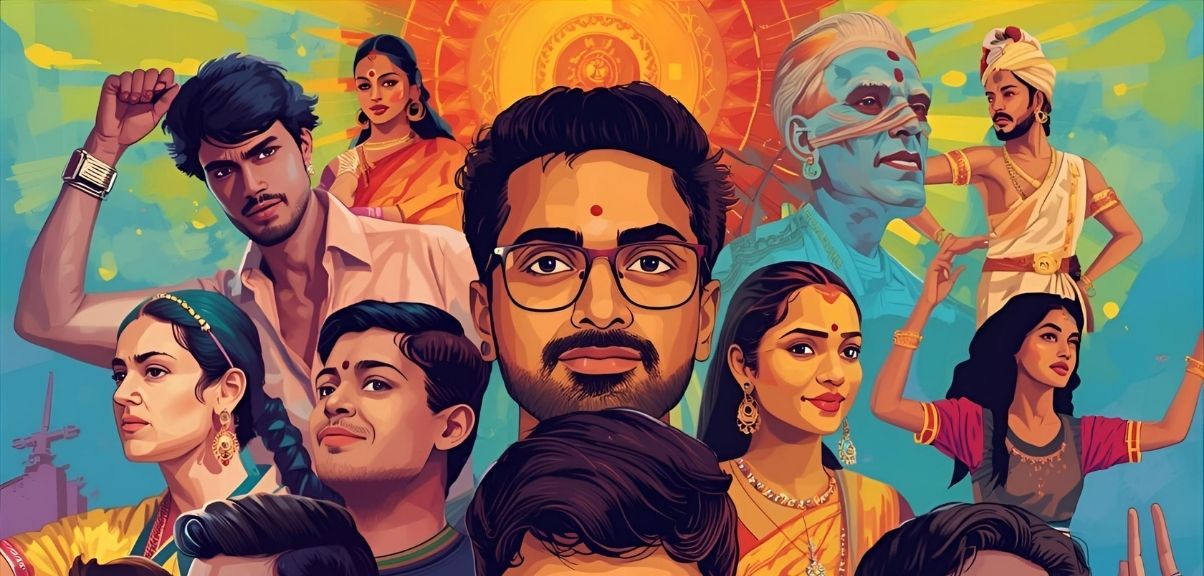
Tapping The Yuva Shakti
For Bharat and The World!
The Great Awakening: Why India’s Young Students Hold the Key to Our Civilizational Renaissance
Just a cursory search on Gemini yielded some interesting numbers. This is neither 100% accurate nor is it a comprehensive survey. But that is not my point.
Crores of young people, let us say 10 crore (a random number) spend 16 years of their lives going through our current education system. Let us take high school onwards for our calculation – that is 9 years. Assuming they spend 100 hrs per month on homework, projects, assignments etc it comes to 1200 hrs per year and over the 9 years it comes to 10,800 hours. Now multiply this with that 10 crore and you get a mindboggling number!
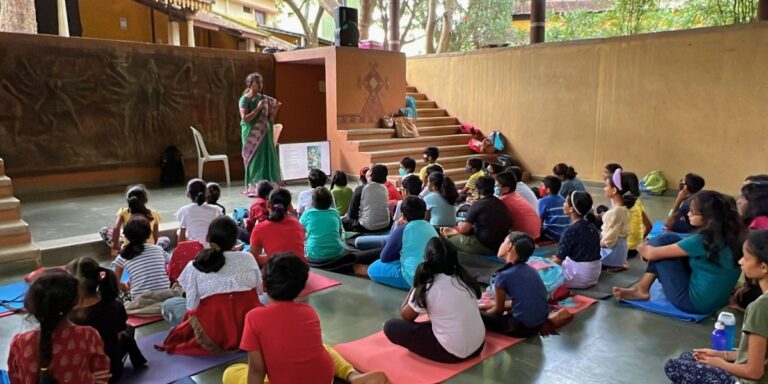
One wonders how much of that homework, project work, assignments etc results in actual skill development, learning and intellectual growth. I am sure some of it is helpful. But having interviewed hundreds of students over the years, this work is mostly boring drudgery, and the students do not enjoy it. Yet, they simply must go through the grind in order to get that piece of paper at the end.
Have we lost all our intelligence and imagination? And have we lost our compassion? And commonsense?
Two Critical Questions
(1) Why are thousands of successful, smart and intelligent parents okay to make their kids go through this senseless grind?
(2) And there is a great opportunity (a beautiful silver lining) in all this – why is no one is seeing it!
The Buffalo Watching Itself Being Eaten Alive!
Now, take a city like Bengaluru. You have a mini-India there and probably the highest number of tech millionaires, engineers, doctors and professionals of every kind. Some of the smartest people in India live in Bengaluru.
Yet, no one has been able to solve the problems of a modern metropolis bursting at the seams and growing without any plan, sense or direction. Worst is no one cares other than offloading their frustration on X! We have become so immune to it.
Have you seen videos of lions eating a buffalo alive starting from its rump – the buffalo helplessly watches as the lions have their fill. We are doing the same.
How About We Marry the Two Problems?
Instead of letting our kids waste precious years of their lives just to get their grades, why not put that energy, imagination and intelligence to work – on solving key and critical problems plaguing the country?
I have been making this point in every forum or platform where I am invited to speak and also in various conversations with kindred spirits who are interested in doing something about our education system, our infrastructure governance, public policy etc.
Also, our educational system was designed to create workers for the factories. And while we have made significant changes to the curriculum and much more is being done, we still need to address four important things:
First, the Pedagogy. I keep harping on this and recently I conducted a retreat where I got a chance to test out a pedagogical method I have developed.
Second, giving direction, purpose and meaning to the curriculum and the whole educational effort of 16 + years.
Third, marry that purpose with the needs, aspirations and goals of the nation.
Fourth, align both the goals of the nation and the educational system with the ideals of Rta, Satya and Dharma (and Nyaya).
Education as Defense Expenditure
Another idea is to bracket the spend on education as part of our defense expenditure. Defending our culture through providing the right kind of education is an important part of defending the sovereignty of the country. You let the culture slip away and the whole nation becomes weak.
Only when the education is focused on preserving, propagating and enriching the ancient culture of our nation will we have the possibility of developing leaders who are civilizationally grounded, know their history, live their culture and understand the value of the freedom we fought so hard to earn.
Also, if you look at what is happening all over the world, it is even more important for us Indians to realize, understand and appreciate our own ancient culture and civilization and to protect it against all attempts to appropriate it, damage it and sully its reputation.
Dharmic Innovation: Not Innovation That Creates New Problems
All things considered it is very important for India to install and develop a culture of creativity and innovation that will help us become self-reliant. But not innovation of the kind that solves one problem and creates a hundred others.
I have discussed this earlier in my article titled, “The Dharmic Dilemma in Tech.” Our method and process must be aligned with Satya, Rta and Dharma. It must be Dharmic Innovation that:
1. Does no harm
2. Does positive tangible and large scale good
3. Does not give birth to new problems
4. Does not exploit the vulnerabilities of people or planet
5. Does not disturb the natural balance between different aspects of nature
What Can Dharmic Innovation Do for Our Education System?
By introducing a focus on dharmic innovation from the school level we can rejig our educational system:
(1) We produce generations of critical thinkers, problem solvers and inventors.
(2) We groom dharmic innovators who bring a new approach to science and technology.
(3) We enrich science itself by incorporating ideas from other streams of knowledge such as Alankara Shastra, Natya Shastra, Nyaya and Yoga.
(4) We reorient a significant portion of the energy of our demographic dividend towards creative problem solving, innovation and nation building.
(5) We teach whole generations of young Indians from diverse fields of study to work together, collaborate in interdisciplinary teams and innovate to create products, services, methods, systems and processes that help India advance, become resilient and contribute positively not only to the country but to the whole world – we have always thought of the whole world.
(6) We combine the creative energies of the engineering, arts, science, commerce and humanities students to create explosive, exponential possibilities that the human mind has not even thought of.
Imagine This…
Engineers who are exposed to art, linguistics and commerce.
Commerce students who are exposed to engineering, science and tech.
Science students who are trained in Shastras.
Gurukula students who are working on the cutting edge of dharmic AI.
Some of this is already beginning to happen. More is yet to come.
The Question I Hear a Lot –
“Why has India not produced a Meta, a Microsoft or a Google?”
I have some detailed thoughts on this which I will share at a future time. I am happy we did not create Meta. I am happy we did not create products that exploit the vulnerabilities of the human mind and land young children in the loony bin.
Let me put it simply: the only way to sustain an unsustainable idea and drive for consumption is to jack up human desire to unsustainable levels and keep it going that way. That is exploiting the vulnerability of the human mind which associates and conflates sense gratification with the true and permanent state of bliss which one already is but is being constantly led away from it in a wild goose chase.
Dharma stands in stark and direct opposition to this exploitative paradigm.
Anyone who understands the basics of human psychology as explained through IKS will naturally and easily and necessarily arrive at the same realization.
That is why we need dharmic enterprises which see their own good and growth and sustenance and thriving in the good, growth, sustenance and thriving of human beings, society and the planet. Which requires a dharmic Rajya or state and state policy which is dharma compatible, dharma oriented and dharma based. Consequently a dharmic economy with dharmic economic—ashtalakshmi based metrics and indicators for a holistic economic system whose objective is to allow every human being to achieve Purushartha.
The Indian mind is fundamentally dharmika—to a large extent. The consumption driven behaviors we see are externally engineered with great effort and expense. So marketing has to become dharmic.
First culture and cultural knowledge has to define a sustainable lifestyle for individual, family and society and the industry has to create products and services that support and sustain that sustainable lifestyle. Current industry is focused on disrupting an otherwise sustainable culture and lifestyle.
Venkatesha Murthy, Founder and Chief Mentor of Youth for Seva, puts it beautifully:
“Responsible consumption is not just about buying what’s on sale or what looks appealing. It demands a deeper awareness, a practice rooted in the Dharma, that guides us to live in harmony. Before acquiring anything, ask yourself four questions:
(1) Is this good for me as an individual, nourishing my health and well-being?
(2) Is this good for my family and the society around me, nurturing relationships and community bonds?
(3) Is this good for nature, respecting where it comes from and where it will go after use?
(4) And finally, does this choice support my spiritual growth, connecting me to a higher purpose and the greater whole?”
This is the kind of framework we need. Not just for consumption, but for innovation itself.
We already had an Ayurveda informed sustainable lifestyle. Eat what is local and seasonal. And follow the circadian rhythm. Modern economy and lifestyle is at odds with the knowledge of Ayurveda. Which is based on Rta.
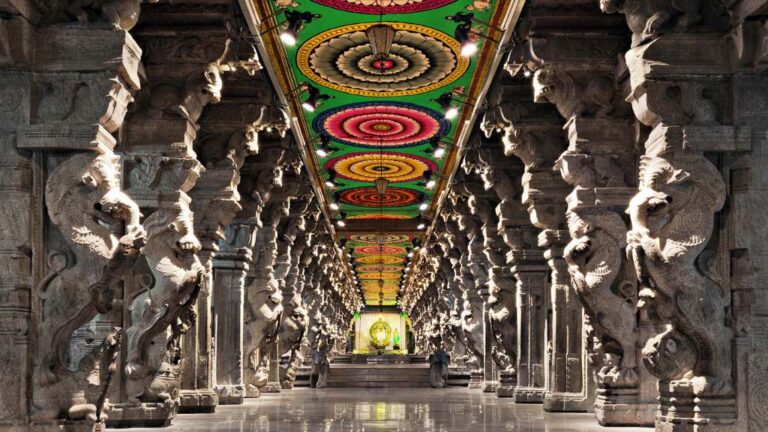
How many take pride in the thousands of beautiful, thoughtfully designed and built ancient temples (some of them 1000+ years old) which continue to fulfill their purpose today long after the original builders are gone? Thousands may visit these temples but very few understand the technology, the impact and the implication of such grand temples still standing today and fewer even understand how they can be used for raising human consciousness. These are too advanced for even the current scientific minds to understand.
But What About Real Innovation?
And consider this: isn’t yoga itself an innovation? A technology?
Yoga is something so vast, so powerful, so deep that the world hasn’t even scratched its surface. Billions practice asanas, yet this represents perhaps one percent of what yoga actually is. The technology of consciousness transformation. The science of inner exploration and knowledge. A complete system for human evolution that works across cultures, across centuries, across every possible human condition.
What about Ayurveda? A medical system that treats not symptoms but root causes. That sees the human body as inseparable from mind and consciousness. That recognizes individual constitution rather than applying one-size-fits-all solutions. Modern medicine is only now beginning to understand what Ayurveda has known for millennia.
The nature, purpose, and quality of Indian innovation cannot be understood through the lens of modern day tech. We measure innovation by market cap and user growth. Bharat measured innovation by how many generations it would serve. By whether it elevated consciousness. By whether it created harmony rather than disruption.
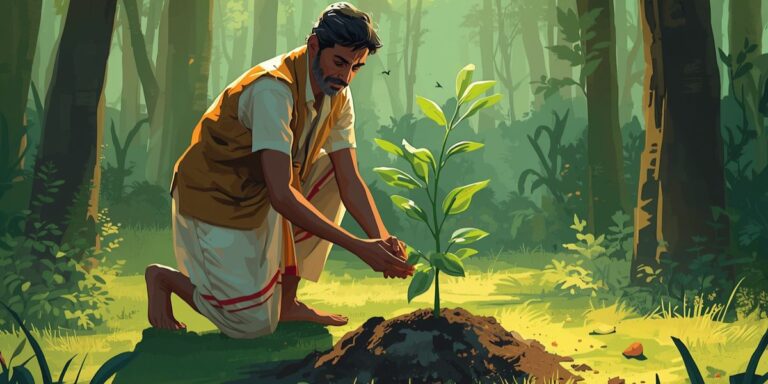
But here’s what excites me: Bharat has the potential to create tech, modern tech that will be powerful, benefit mankind and yet be dharmic. Tech that doesn’t exploit but empowers. That doesn’t extract but enriches.
And it’s beginning to happen. Right now. In pockets across the country. Young innovators who understand both their civilizational roots and cutting-edge technology. Who see no contradiction between ancient wisdom and modern capability. Who are building the future on foundations laid thousands of years ago.
The Time Is Coming Soon
India’s knowledge, science, mathematics, art, spirituality and so on continue to provide work to modern scholars, scientists and inventors (whether they acknowledge it or not).
But Bharat is not done. It is just getting started.
The time is coming soon – when India will once again give mind-blowing innovations, inventions and discoveries to the world. India’s contributions won’t be innovations that create billionaires while destroying societies. They’ll be dharmic innovations. Innovations that heal. That balance. That elevate.
This transformation begins with education. With recognizing that crores young minds spending 10,800 hours on meaningless work represents the greatest waste of our most precious resource. With choosing to redirect that energy toward problems that matter. Toward solutions that last. Toward innovations that serve not just profit but purpose.
Do read and share your thoughts and reactions. I am eager to hear them.