The Great Inversion
Why Sustainable Lifestyles Must Come Before Sustainable Products — I Make a Case for Dharmic Innovation
Walk through any modern shopping district and observe what is actually happening. A new beverage arrives, and the lifestyle is built around it. A new gadget launches, and the lifestyle bends to accommodate it. A new fabric, a new device, a new convenience — and slowly, almost without anyone noticing, the rhythms of an entire generation reshape themselves to fit whatever was just engineered in a factory and pushed through a marketing funnel.
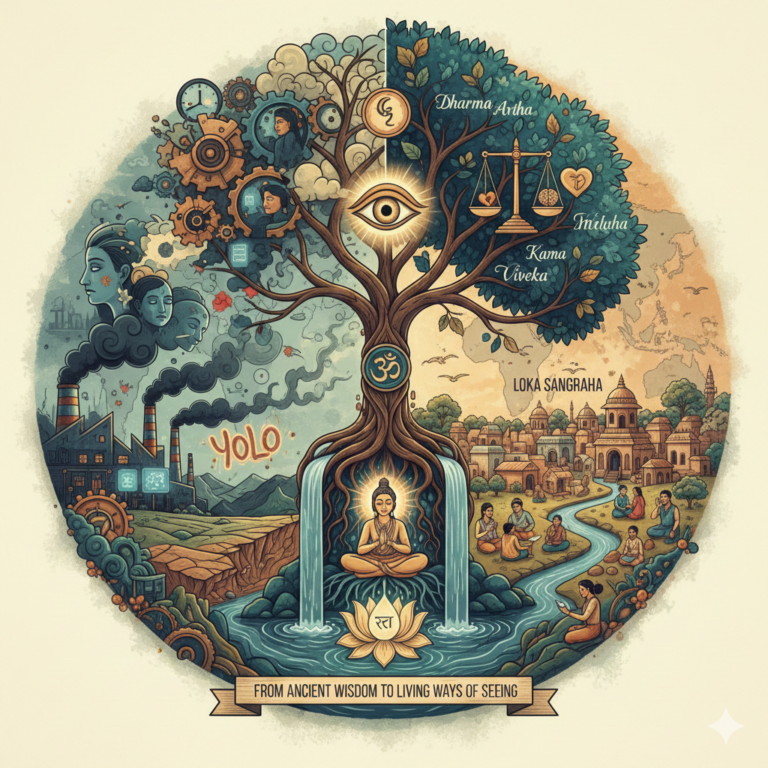
We have not stopped to notice what has happened. The product is now driving the lifestyle. Industry decides what to make, and millions of people quietly reorganise their lives — their food, their clothing, their homes, their leisure, even their inner sense of who they are — around objects that were never designed with their actual life in mind.
This is the inversion at the heart of our crisis. It is also the precise reason why decades of work on “sustainable products” has failed to make the world sustainable.
The Inversion We Must Reverse
The honest sequence is the opposite of what we practice. Lifestyle must come first. Lifestyle must be sustainable. And then — and only then — industry’s job is to design products that support and maintain that sustainable lifestyle.
A “sustainable product” sold inside an unsustainable lifestyle is a contradiction. An electric car parked outside a six-thousand-square-foot home heated to twenty-two degrees in the middle of winter, owned by someone who flies twelve times a year, is not sustainability. It is the appearance of sustainability layered onto a way of living that prakṛti cannot underwrite. The product is innocent. The lifestyle is the problem. Not that anyone of us is free of this contradiction. But unless we begin to see the illusion, we will not do anything to solve the problem.
When we keep designing greener versions of the wrong things, we do not solve anything. We simply extend the life of an arrangement that was never built to last.
What Civilisations Knew About Place
Long before sustainability became a corporate vocabulary, our civilisations knew something subtler. The way human beings live cannot be separated from the land on which they live.
Consider the deserts of Rajasthan. Walk through any old village in Marwar or Jaisalmer and you will find an entire civilisation built around the scarcity of water. Stepwells. Johads. Khadins. Lime-plastered homes that breathe. Jharokhā windows positioned for cross-ventilation. Garments woven loose and light to reflect the sun. A cuisine built around millet because millet asks little of the soil. Festivals that mark the monsoon as something sacred. None of this was an accident. It was lifestyle as a careful, multi-generational answer to what the land could give.
Now travel north. In Himachal, in Uttarakhand, in the high villages of Kinnaur, homes are built of deodar and slate, oriented to the sun, with low ceilings to hold warmth. The diet is dense, fermented, slow-cooked. Terraced fields follow the contours of the slope rather than fighting them. Forests are woven into ritual life — a particular grove belongs to a particular devatā and cannot be cut. Streams are protected because the village’s drinking water depends on them.
These are not “lifestyles” in the magazine sense. These are intelligent, embodied responses to ecology, refined over centuries. The clothes, the food, the architecture, the rituals, the calendar, the festivals — every element exists in conversation with the kṣetra, the field of land it belongs to.
What did industry do in such a society? It served. The potter, the weaver, the metalsmith, the carpenter, the dyer — each took from prakṛti only what their craft required, returned the byproducts to the soil, and produced objects that fit a lifestyle already in equilibrium with the land. Industry was the hand. Lifestyle was the body. Land was the breath.
We have severed all three.
The Five Conditions of a Dharmic Enterprise
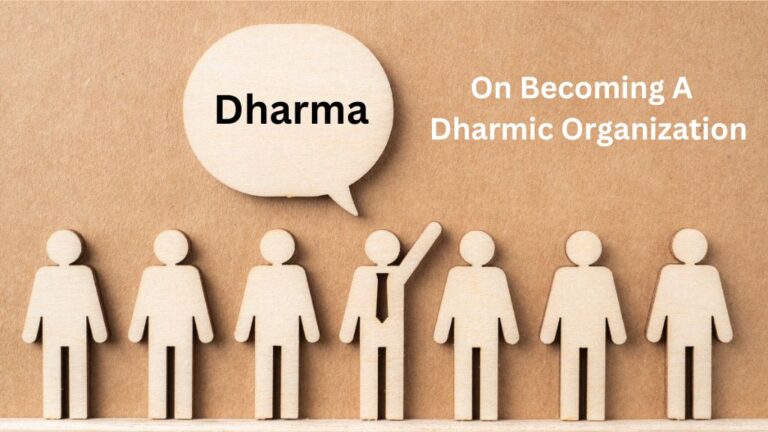
Before any company can produce a single sustainable product, it must first become a particular kind of organisation. Not a “responsible” company in the ESG-checklist sense, but something deeper. At least Five conditions must be present (this is by no means exhaustive).
One: A holistic, systems-level understanding of society. A dharmic enterprise must see the society it serves as a living organism — not a market, not a demographic, not a target segment. It must understand the structure and make-up of that society, the purpose of its customs, the meaning of its rituals, the function of its festivals. A company that does not understand why a Rajasthani woman keeps a particular vrata or why a Coorgi family worships a particular ancestor cannot truly serve either of them. It can only sell to them.
Two: The intention to do good and to do no harm. This is the dharmic version of the Hippocratic oath, applied to industry. Behind every product decision, there must be a sincere intention — not a marketing claim — to benefit the society and to sustain it across generations. Intention is not soft. It is upstream of every operational choice that follows from it.
Three: A self-conception as an integral part of the society and of nature. Most companies see themselves as actors upon a society and upon nature — extracting, producing, selling, externalising. A dharmic enterprise sees itself as a part of both. It is one organ in a larger body. The health of the body and the health of the organ are not separable propositions.
Four: An understanding that the relationship is symbiotic. Symbiosis is not partnership. Partnership is a contract; symbiosis is biology. The company breathes what the society and nature exhale. The society and nature breathe what the company exhales. If the company exhales only carbon, microplastic, and addiction, the body will eventually expel the organ.
Five: A radically expanded definition of stakeholders. Stakeholders are not only shareholders, employees, customers, and regulators. The stakeholders of a dharmic enterprise include the society it operates within, the culture it draws from, the civilization it inherits, the rivers that pass through its supply chain, the mountains it mines or spares, the forests that surround its factories, and every living being that depends on those rivers, mountains and forests. The river is at the table. The forest votes. The generation yet unborn has a seat.
These five conditions are not idealism. They are the prerequisite intelligence of an enterprise that intends to last.
The Five Tests Every Product Must Pass
Once such a company exists, every product it puts into the world must pass through five filters. These are simple. They are also unforgiving.
One: Does it do no harm? Not “less harm than the alternative.” Not “harm offset by carbon credits.” No harm — to soil, water, air, body, mind, family, or community. If a product cannot pass this first test, no amount of clever positioning will save it downstream.
Two: Does it support a regional lifestyle as it actually is? What can help someone in the Rajasthani desert live better — better, not differently — without breaking the cultural fabric that has kept them well for centuries? What can help a family in Kinnaur, in Coorg, on the Konkan coast, strengthen the wisdom they already carry, rather than replacing it with an imported template? A product that requires the customer to abandon their tradition in order to use it has failed before it ever shipped.
Three: Does it refuse to exploit natural resources? Aparigraha — non-grasping — is not only a personal virtue. It is also an industrial principle. Take what is necessary. Take it slowly. Take it where it can be replaced. Refuse the logic of extraction-as-default.
Four: Does it leave the natural environment intact? No deforestation upstream. No microplastic downstream. No toxic effluent in the river the village drinks from. No noise pollution that drives birds from the orchard. The product’s full life-cycle, from mine to landfill, must leave the land able to do what it was already doing before the product arrived.
Five: Does it give back at least double of what it takes? This is the Yajña principle. In the Vedic worldview, every act of taking from prakṛti must be answered with a greater offering back. A tree felled meant ten planted. A bull worked meant a temple festival in its honour. A river drawn from meant a tank desilted. A truly dharmic product is regenerative by design — it returns to the soil, the water, the community and the culture more than it ever extracted from them.
This last test is the one that separates dharmic innovation from every other kind of green-washed effort. Net-zero is the floor, not the ceiling. The ceiling is regeneration.
Yajña: The Logic of Reciprocity Industry Has Forgotten
The Bhagavad Gītā describes a beautiful cycle.
अन्नाद्भवन्ति भूतानि पर्जन्यादन्नसम्भव: | यज्ञाद्भवति पर्जन्यो यज्ञ: कर्मसमुद्भव: || 14||
annād bhavanti bhūtāni parjanyād anna-sambhavaḥ yajñād bhavati parjanyo yajñaḥ karma-samudbhavaḥ
All living beings subsist on food, and food is produced by rains. Rains come from the performance of sacrifice, and sacrifice is produced by the performance of prescribed duties.
Annāt bhavanti bhūtāni — from food, beings come into existence. Parjanyāt anna sambhavaḥ — from rain, food is born. Yajñāt bhavati parjanyaḥ — from yajña, rain comes. Yajñaḥ karma samudbhavaḥ — yajña arises from action.
Read in industrial terms, this is a complete circular economy described two and a half millennia before the phrase was ever coined. Action that includes offering — yajña — keeps the cycle of nourishment turning. Action that takes without offering — what we today call extraction — breaks the cycle.
The modern industrial mind treats prakṛti as inventory. The dharmic mind treats prakṛti as a relationship. One can be drawn down to zero. The other is renewed precisely by being honoured.
Every product that leaves a dharmic enterprise must carry within it some quiet trace of this logic. A textile that returns to the earth as compost. A piece of architecture that cools without electricity. A food that rebuilds the soil it grew in. A device whose end-of-life is a ritual of return, not a problem of waste.
What Dharmic Innovation Actually Looks Like
This is where our innovation, our brainpower, our research budgets, our engineering talent, our capital and our ambition must now turn.
Not toward making the next clever product whose lifestyle we then have to invent.
Toward studying — patiently, humbly, deeply — the lifestyles that have already been refined by communities living inside their landscapes for centuries. Toward asking: what would help this Rajasthani family carry water more easily without abandoning the well? What would help this Kinnauri household stay warmer in February without burning more deodar? What would help this Coorgi farmer keep her coffee profitable without poisoning the stream her village drinks from? What would help this fisherwoman in coastal Karnataka preserve her catch without plastic refrigeration she cannot afford and the sea cannot absorb? Of course, the questions of feasibility, profitability etc will come and we need to address that. But it is still a design problem. Make it a dharmic design problem. Add the dharmic boundaries, constraints and requirements. And see what you get. Try.
These are the questions that should occupy our R&D laboratories. These are the briefs that should sit in our design studios. These are the problem statements that should guide our venture capital.
This is dharmic innovation: innovation that respects the natural boundaries of prakṛti, understands the limits of what she can provide, and aims to regenerate whenever something is taken. It is innovation in service of life, not in service of growth alone.
It is also, incidentally, the only kind of innovation that has any future.
The Industry We Have Yet to Build
We do not need more sustainable products inside an unsustainable civilisation. We need an industry whose entire purpose is to support sustainable lifestyles inside a regenerating civilisation.
The companies that understand this — and choose to reorganise themselves around it — will build the next great industries of this century. They will build them not by chasing markets, but by serving life. Not by extracting from nature, but by partnering with her. Not by inventing new desires, but by honouring old wisdom and improving it gently, where improvement is genuinely needed. A lot of people immediately respond – but this is too idealistic. Is it really practical? etc. It is like making holes in your boat to access the water from the sea!
The shift is not technological. The shift is in the orientation of the human being who runs the company, who designs the product, who funds the venture. When that orientation turns toward dharma, everything downstream of that turn — the supply chain, the product specification, the marketing language, the after-sales relationship — begins to align of its own accord.
Industry can return to its rightful place. Not as the driver of lifestyle, but as its quiet, skilful, reverent servant. The hand that serves the body that breathes the land.
That is the industry our civilisation knew how to build.
That is the industry our planet is now asking us to remember.
Dharayati Iti Dharmaha. And Dharmo Rakshati Rakshitaha!