Acharya Devo Bhava
The Sacred Role of the Teacher in Rebuilding Bhārat
Session 3 — IKS Certificate Course
Integrating Indian Knowledge Systems in Academia through NEP 2020:
A Vision for Civilizational Reclamation
Resource Person: Śrī Vinay Ji Kulkarni
Moderated by: Nidhi Ji (NLD Platform)
Collaborating Institution: Śrī Guru Teg Bahadur Khalsa College, Śrī Anandpur Sāhib, Punjab
10-Day IKS Certificate Course
Welcome and Introduction
Recap of Previous Sessions
The last two sessions that all of us participated in — we sincerely hope those were fruitful for you. We started with a session on Patañjali Yoga Sūtra, which was extremely experiential, where all of us as a collective, as a group, participated in meditation, reflection, and expression of gratitude. Yesterday, our discussion went into Śrī Aurobindo’s idea of nation and nationalism, , wherein the lecturer wonderfully explained the ideas, philosophies, and values that Śrī Aurobindo envisioned for Bhārat.
Today, Vinay Ji -ji is going to speak on a very important topic: Acharya Devo Bhava — The Sacred Role of the Teacher in Rebuilding Bhārat. We had some discussion on what an appropriate topic could be, and all the ideas Vinay Ji -ji shared with me were very interesting in terms of discussions on pedagogy, discussions on the role of the teacher, and I’m glad he has chosen to speak on this topic.
Master’s Thesis and the Roots of Pedagogy
Out of all the areas where I’ve had some thinking done, I think teaching, pedagogy, and learning are the areas closest to my heart. My master’s thesis at the University of Arizona, where I was doing my master’s in systems and industrial engineering, was on teaching, learning, systems thinking, and mental models. My research committee was four professors who each had forty years of teaching experience, and I was presenting to them how it should be done. That was kind of ironical, but they really appreciated it.
I realized these thoughts and insights were also coming from IKS. In fact, one of the greatest teachers the world has ever seen is Śrī Krishna himself, and one of the greatest examples of amazing pedagogy is the Bhagavad Gītā itself — the Krishna-Arjuna Samvāda.
Diagnosis — The Current State of Education
Interactive Discussion: How Did We Get Here?
What do we want to talk about today? I want to try and make it interactive. Just to set context — why are we having to discuss this? Why are we in this state? Think of it as a diagnosis, etiology, prognosis, and cure. The current state of education — how did we get here?
Nidhi Ji: Vinay Ji -ji is asking: how did we get to today’s state of education? Any quick responses?
Participant Responses
• Prachi: Education is student centric.
• Participant: There is influence of western thoughts in the current state of education.
• Pallavi: English education — that’s the current state of education.
• Rajni: It is not skill-based education.
• Chandra Mohan-ji: Only subjects are taught; personalities are not groomed.
• Pallavi: Values are missing in today’s education.
• Umesh: Education is just for getting service — it has become too transactional in nature.
• Rajni: Curriculum is not revised on a timely basis.
Root Cause: Colonial Education and the Content-Container Gap
I think one of the core issues we are having today is that the person is not worked upon — only the content is the focus. The root cause is not merely a western influence; it is western education itself, put in place by our colonial masters. We got infected with it and rarely is an infected person able to cure himself. We had the methods, but we were in deep slumber, and slowly we’re waking up.
We are at the cusp where, while we’re going in the right direction, a lot of effort and attention is going into creating content. What’s happening is we’re replacing westernized content with Indian content. But our education system was not only about the content. It was also about the container — the person.
If I’m the teacher, my main concern is: what kind of seed or sapling do I have in front of me? Is it a sapling of a mango tree, a neem tree, or a banyan tree? Based on that, my dharma would be different, because each one has a different purpose, different potential. My purpose would be to help each of those saplings realize their full potential.
The purpose of the western education system was to create workers for the factories. Totally different. That is why we are not producing those Vivekānandas or Śrī Aurobindos anymore. But anybody born in this land — that potential is there, that ṛṣhi tattva is there.
Vidyā versus Śilpa
We always made a distinction between vidyā and śailpa. Śilpa is skill, but vidyā — sā vidyā yā vimuktaye — vidyā is that which leads to liberation- let’s just say liberation from false notions, ideas, beliefs and identities. In a typical western educational context, if you talk about mokṣa, it’s treated as a nonsensical idea. That happens because in the western model there’s a separation between the purpose of life and the purpose of education.
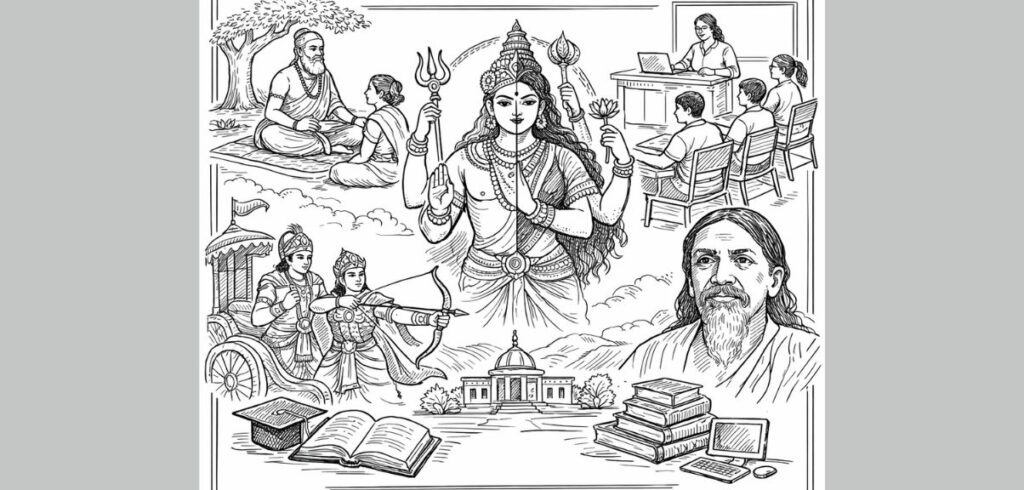
There’s a dichotomy between nature and man, life and nature, nature and divinity. A tripartite struggle is going on. To become truly Bhāratīya, we must drop the colonial lens and transcend those binaries. We must understand the concept of Ardhanarishvara — go beyond the duality, transcend and integrate the two opposing parts.
The Colonized Mind
What is the condition of a colonized mind? We think in binaries. When you think in binaries you observe that it is always pitting one part of nature against another. How can you pit one against the other? That’s why we have Ardhanarishvara. In nature, there is design. Everything has a very important role — even that squirrel in the Rāmāyaṇa had an important role. It is a beautiful creation, and everything has a role.
There is a separation between life purpose and purpose of education. Our culture is built on dharma, artha, kāma, mokṣa. The goal is mokṣa, but we don’t demonize desire. We don’t say desire is the root cause of suffering. We need to know how to handle desire and how to have sāttvic desires. First, we learn what is dharma. Once the buddhi is trained through dharma, then you generate artha through dharmic ways, and then kāma can be fulfilled through the artha generated through dharmic ways.
The “Transactionalization” of the Guru-Śiṣya Relationship
Another important thing that has happened is the transactionalization of the guru-śiṣya relationship. This is the biggest thing that has happened. It has become a transaction. The teacher is considered a service provider, and the student is a consumer. That is the biggest problem.
The Purpose of Education — Insights from Śrī Aurobindo and Avatāras
The Mind Must Be Consulted in Its Own Growth
Śrī Aurobindo offers an important idea: The mind must be consulted in its own growth. The idea of hammering the child into a shape desired by the parent or teacher is an outdated and less enlightened practice. Every person has within them something divine, something uniquely their own — a chance for strength and perfection in however small a sphere, which they can choose to embrace or reject. The task of education is to help the growing soul draw out that which is best within and make it perfect for a noble use.
Avatāras and Their Gurus: A Message for Teachers
Take the example of our avatāras. Śrī Rāma — who was Rāma’s guru? Vasiṣṭha. And we have the Yoga Vāsiṣṭha coming out of the dialogue between Vasiṣṭha and Rāma. Now, one question is: if he was an avatāra, why does he need a guru? Śrī Krishna also had Maharṣi Sāndīpani; he also had to go to gurukula. Why?
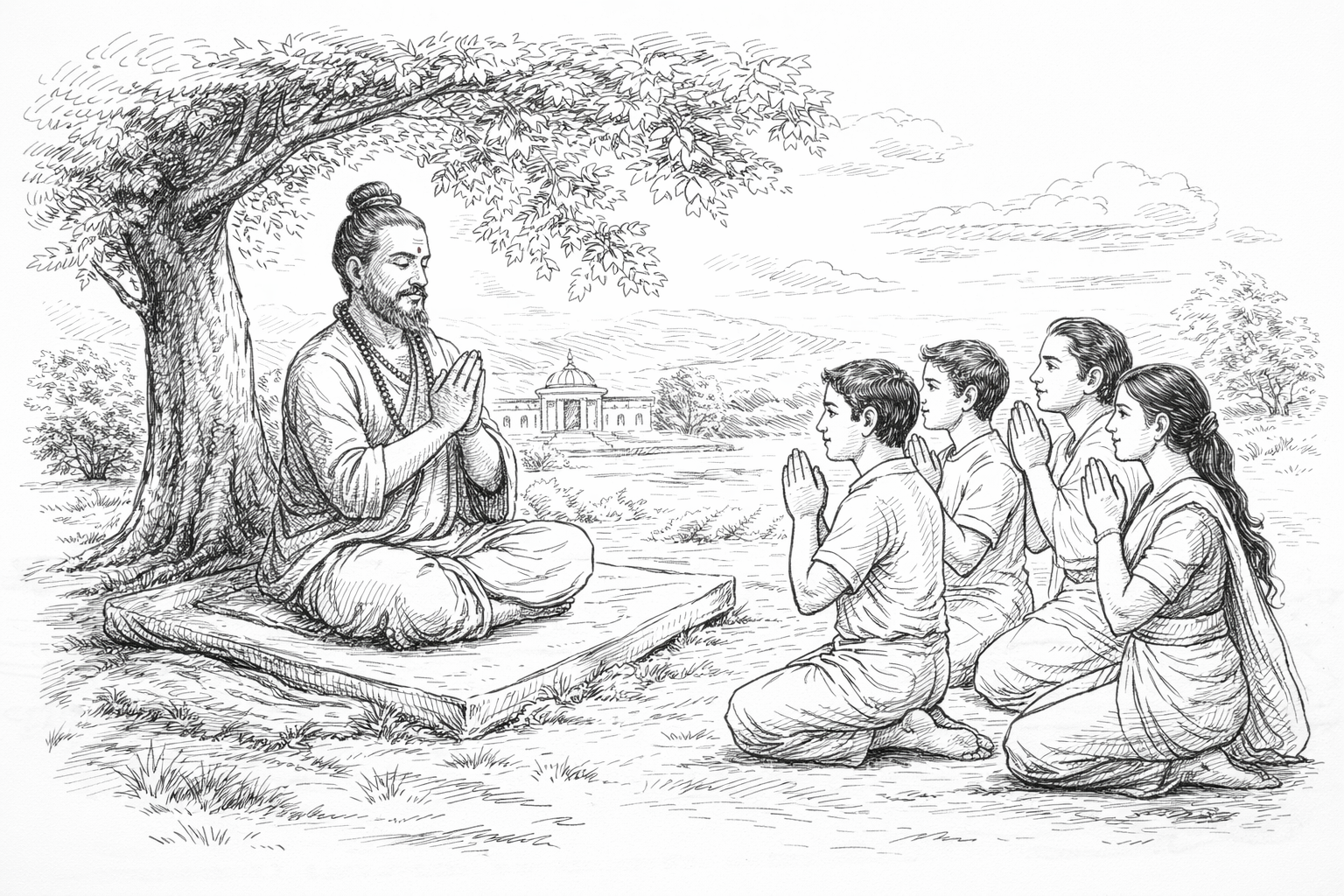
They come to show how to live through their own life. And secondly, it is also a message to teachers: see each student as an avatāra, a potential Rāma or Krishna. See the divine in the student. Don’t see the student as a stupid, lowly creature that you’re going to educate and enlighten.
The beauty of the relationship between Vasiṣṭha and Rāma — knowing that Rāma is an avatāra, knowing the divinity, Vasiṣṭha still executes his role as a teacher, only to awaken the divinity that is already there. Think of each student as a Rāma. The divinity is already there. How are you going to awaken it? For that, certain sādhanā is needed for the teacher. If the transformation has not happened in you, how are you going to bring it about in somebody else?
The Teacher as the Eternal Student
The attitude with which you teach matters. While teaching, you are also learning. I’m going to reference a book which is not from India or by an Indian author, but it’s interesting: Illusions by Richard Bach. Inside that book, there is a section called the Messiah’s Handbook. It says: you teach best what you most need to learn.
Even Dattātreya, the guru of gurus, said: be a śiṣya all the time. That is what my guru also said. When there is a class going on, you are taking on the role and executing that role, but don’t be locked into the idea that you’re the guru. Let there be a two-way flow of knowledge.
Elements of Pedagogy
Interactive Discussion: Who Is a Teacher?
What is a teacher? What is a teacher’s role? Who is a student? What is the relationship? What is knowledge? What is teaching? What is pedagogy?
Participant Responses on the Teacher’s Role
• Sheetal: Teacher is a torchbearer.
• Sunman: Teacher is one who inspires the students to learn, to gather knowledge. More than a person who gives skill, a teacher is a person who inspires students to learn.
• Pragi: Teacher is a person who makes learning possible and has a capacity to change behavior of the student.
• Pallavi: A gandhār — a guide.
• Rajni: Teacher is someone who imparts knowledge with learners.
• Chandra Mohan: Teacher is a friend, philosopher, guide.
• Murugal: Teacher should be a holistic guide.
• Arpit: Teacher kindles and nurtures curiosity of the child and guides them in a proper direction.
• Kalpana: Teacher is a facilitator.
• Dr. Mudita Agnihotri: Teacher is a person who transforms someone.
• Dr. Shailaja: Teacher is a medium.
The Transformation Question
Those are all beautiful responses. Now I want you to think: if a teacher is going to be one who transforms, then what should be the quality? What should be the level of consciousness of such a teacher? How many teachers are there in India? Out of the total number, what percentage are the type that actually help to transform students?
• Participant: 25%.
• Dr. Shailaja: 0.1% only.
How many of you can honestly say you have been able to transform your students?
Two or three teachers raised their hands. Dr. Sadvi responded: not much.
The US Study: Why Teachers Don’t Teach the Way They Know They Should
There was a study done in the US. They studied 4,000 teachers and professors. These professors were asked: how should students be taught? What is the correct way of teaching? They all said it should be experiential, nonlinear, and so on — all the things we normally tend to say about how to make it easy for students to understand.
Then the researchers went and sat in their classrooms and observed how they were teaching. They found that a very small percentage — or probably none — were teaching the way they said students should be taught.
They tried to find out why. The conclusion: people tend to teach the way they were taught. Even when you’re going through your studies and somebody’s teaching you and you’re already feeling they’re not doing it the right way, and you tell yourself, ‘When I get an opportunity, I’ll teach differently’ — when the time comes, people end up teaching the way they were taught.
This cycle has to be broken. We need a whole generation of teachers who are taught the way they need to teach.
Mental Models and Perception
What Is a Mental Model?
When I ask the same question to ten different people, there’s some processing that happens in their mind, and out comes an answer. More often than not, the ten answers are going to be different. Why is that?
• Suman: Mental model means perspective.
• Arpit: It’s a sort of framework on how we solve problems.
• Abhishek: Nature and mindset.
I’m using it in the sense of your combination of samskāras, your svabhāva, and so many different things that make up the lens through which you see the world. Nature and nurture, both.
From an Indian perspective, your life did not begin when you were born in this lifetime. It has been going on, and you’re carrying samskāras and vāsanās from so many lifetimes. This worldview has been taking shape over a long time. But then when you’re born, your parents, grandparents, teachers, and everyone around you pass on certain ideas, thoughts, views of the world — what is safe, what is not safe, cause and effect, this is friendly, that is not, this is good to eat, that is not — all these things go on to shape your mental model.
By the time a person begins to think, there is a whole layer upon layer of thought that is undigested, ill-formed — in whatever shape — that’s been passed on from different people. So, when you start thinking, your first thought is built on those layers. As you grow, you never examine this layer. It’s like the basement — the door is always closed. You never evaluate the contents of that basement, but it’s always there and it’s influencing your thought.
The Teacher’s Role in Mental Model Transformation
Part of the role of the teacher is to expose these mental models and bring out the assumptions on which they are based. When you hold those assumptions side by side with facts and reality, the person holding those mental models is more likely to be willing to adapt and change.
Unless the mental model changes, no true learning takes place. It is all just surface learning, and that is exactly what is happening with our current education system. You can go through sixteen or twenty years of education, but it still has no impact on your thought process. Even after all that education, if somebody came from a regressive thinking family, they still carry the same thought process. The education had no effect.
You Become the Object of Your Meditation
One other idea I want to share: you become the object of your meditation. If you understand this, you can apply this construct to understand most of what we call sanātanī culture and civilization. I become that which I meditate upon.
Knowing this, so many systems were built to keep on elevating our consciousness. The whole objective of the civilizational system we created is the elevation of human consciousness. Nārāyaṇa-tattva — that’s what it is. And then śravanā, manana, Nidhi Jidhyāsana — the fundamental process of learning in our culture.
Reimagining the Classroom, Subject, and Textbook
The classroom: Space, Shape, and Energy
Teaching and education must be made free of the dependence on a classroom—not bound by a classroom.
But I know you all work for a school and must teach inside a classroom. So, think about how the classroom setting can be made more interesting. I have experimented when doing workshops — with small kids, teenagers, young adults, middle-aged people, CEOs, senior executives — no matter who it is: when people sit in a square, typical classroom format, it creates a particular kind of learning atmosphere. When you make people sit in a circle, it’s different. A semicircle, it’s different. A triangle, it’s different.
I looked at the shapes of the homakuṇḍas. You have different shapes for homakuṇḍas, and what is the effect of those shapes? I found a correlation. I generally prefer a circular format where there’s no rows of people one behind the other — more of a 360-degree view or a semicircle.
Also consider what kind of pictures are on the wall, how you can create the right environment.
The Subject: Reconnecting Knowledge to Life
Nature, existence, and reality are a continuum. They are not broken up into subjects. As we are speaking right now, biology is happening, chemistry is happening, physics is happening, mathematics — everything is happening. But in a mathematics class, the teacher says ‘don’t talk biology here,’ and in a physics class, the teacher says ‘don’t talk civics here.’ It’s all bifurcated.
Because of this conditioning, when people come out, they’re not able to look at life as a whole. They’re not able to think at a systems level. That is the biggest problem. Indians were masters of systems thinking. When I was doing my research in the US on systems thinking, I told my professor that I don’t think Forrester, who is credited with systems thinking, was the real creator of this — it comes from India. And he agreed with me.
They’ve taken very essential branches of knowledge and removed the prāṇa from them, made them dry and disconnected from real life. That’s why students feel that going to school is drudgery, a pain, and they ask: what is the use of all these things in my life? Your job is to reconnect the subject to life before you start teaching it. Teach your curriculum, follow the structure your school has given you, but initially have an orientation — set the context, put the prāṇa back into the subject, connect it back to life, and then teach.
Define the role and use of the textbook
Our modern education is fixated on the textbook. Students are learning entire textbooks by heart. Somewhere in the beginning of the course, during your orientation, you must set the context: what is going to be the role of the textbook in this course? How much importance are you going to give it? How are you going to use it?
If your school is autonomous and gives you some freedom, prescribe other reading materials from our own sources in addition to the prescribed textbook.
The Process: Mapping the Learning Journey Through Mental Models
What is going to be the learning journey of students through your course? You must map it out — from where to where? At the beginning, you must capture their existing mental models. It might be the same course you teach every year, but every batch of students is going to be different. Every time, it’s a new experience.
Based on your understanding of the mental models of the current set of students, you’ve got to map out a journey that evaluates their mental models, helps them evaluate their own mental models, helps them evaluate the mental models of their classmates, and your mental models. You’re all learning from each other. You must map out that journey of mental model transformation. For that, your concepts, your ideas, your basics must be rock solid.
Developing Your Own Creative Teaching Methods
If you want to develop your own creative, innovative teaching methods — because that is where the innovation really needs to happen — this could be like a three-day workshop. If somebody’s interested, we can conduct one where everybody can walk out with their own manual of innovative teaching methods. But I’ll go through the key elements very quickly.
Key Elements for Innovative Pedagogy
First, write down for yourself your definition and understanding of knowledge and its purpose. Be able to clarify the context of education and knowledge for your students. Differentiate between content and knowledge. When we say jñāna, it is basically knowledge of the self. Knowledge of the world is vijñāna. For us, both were important. As Ādi Shankarāchārya said, we’re interested in both material and spiritual progress of a human being — ābhyudaya and niḥśreyāsa. Pravṛtti and Nivṛtti both. You must have clarity on what is vidyā and what is śilpa. You can think of it as the meta concept and its application.
Activation of the Learner
This is the most important concept I want to leave you with. Just because fifty students are sitting in your class physically doesn’t mean fifty students are there. You must do a check-in every time: how many of them are mentally present? You need a process that brings them completely into the class, paying full attention to what you’re going to teach.
I call it the activation of the learner. You may find that you came to teach something, but the students cannot receive it. Then you must drop whatever your plan is and work on the student — relieve them of whatever is causing distress and bring them back into a state of high receptivity. And then, only then, teach. The same thing applies for meditation: they say don’t meditate when your mind is very disturbed. Get into a calm, peaceful state first.
You also must establish the sacred relationship between teacher and student. Spend some time with them early on. Read up on neuroscience, which is proving a lot of things we already knew. Work on identifying, exposing, and exploring mental models. Matching teaching and learning styles is another element — but in general, if you make it very interactive and experiential, you’ll cover most learning styles.
Personalize the lessons for the learners
Whether you have a mango tree, a neem tree, or a banyan tree — the svabhāva of people are different. The challenge for the teacher is: you are teaching the same subject to all fifty students. Think about how are you going to make it meaningful for each person who is so different?
Know Your Learner Exercise
My suggestion: do a ‘Know Your Learner’ exercise at the beginning of the class. Ask them: Tell me about yourself. Where were you born? Where did you grow up? Tell me about your parents, how they raised you, what they taught you. Tell me about the environment in which you grew up. How would you describe your life up to this point? What have been the major highs and lows? What have been your greatest achievements?
Has anybody here been part of a course where they were asked these kinds of questions?
Nidhi Ji: Probably not.
And has any teacher here done this kind of exercise with their students?
Shubhangi: Yes, ma’am. I have done this exercise with my students before starting my class. Any new session, I interact with them first to know their minds — what kind of thought process they carry — and then I start my lecture.
That’s wonderful. What is the class size?
Shubhangi: Approximately 60 to 80 students.
So, you would need two or three sessions just to get to know people and go through everything.
Chandra Mohan: Namaskar. I am involved in competitive coaching. First, I do it not orally. I introduce myself and ask them in writing — where they have been born, their educational qualifications, their parents’ background, whether they come from a rural or urban background, their interested areas, their favorite hobbies. First, I keep those things written on paper. Later, after five or six days of the course, whoever is lacking something, I personally contact and interact with them. This is my model, very humbly and honestly, I’m saying.
That’s good. I think you can take it up one notch further — have office hours where each student can come and meet you one-on-one. Not directly going into counseling and teaching. Just creating a safe space where the student feels safe to come and discuss anything with you.
The Upadeśa-śravanā-Manana- Nidhidhyāsana Model
A Two-Way Framework for Teacher and Student by Vinay Kulkarni
Everybody knows about śravanā, manana, Nidhi Jidhyāsana. I have slightly modified it. There’s a two-way model: what the teacher does and what the student does.
1. Upadeśa-śravanā (Teaching and Listening)
First is Upadeśa — the teacher’s essential teaching. śravanā here is listening. Not simply listening but we want full body listening listening deeply, intently, and with śraddhā.
You may have any kind of material, but you must boil it down to: what is the ultimate truth of this subject? What is the boiled essence? What is the thing I can be sure every student will walk away with? Boil it down to the most essential part and convert that into your upadeśa. Meditate on it and test it out in your own consciousness — do you honestly believe that? Do you understand it? Bring it to that level.
2. Manana and Chintanā (Reflection and Contemplation)
This is deep reflection and contemplation. This is the most powerful faculty we have, and it doesn’t get developed in the modern education system. Structure every classroom so that after the upadeśa, there is time for manana and chintanā. Students should be able to reflect and contemplate: Is this true in my own life? Can I find examples? Can I find illustrations? How can I put prāṇa back into this subject? How can I find correlations in my real life?
3. Samvāda-Satsaṅga (Dialogue and Sacred Association)
Everybody thinks satsaṅga means going to some temple and hanging out with saffron-clad people. But Ādi Shankarāchārya explained in Vivekachūḍāmaṇi: it is evident that a student silently sitting like a statue, even before the greatest of teachers and for an endless period, can have no benefit of any spiritual evolution. The student must rub his ideas and thoughts against the experienced head and heart of the teacher and gain for himself a polish, a fragrance, at once divine and perfect. Discussion is the heart of satsaṅga.
There is a format, a way it is done. Even Śrī Krishna is not simply saying ‘Here is the deal, just take it and follow.’ There are no commandments. Arjuna can go on asking as many questions as he wants. It takes eighteen chapters to clarify his doubts. Krishna is demonstrating how to be a teacher with lot of patience, lot of empathy, showing different aspects of the same thing, teaching the same truth in different ways, but finally leaving the decision to the person.
For this to happen, the teacher needs to be very secure in his own knowledge. The teacher also needs to honestly be able to say what he knows, what he doesn’t know, and demonstrate that kind of honesty to the students.
4. Sādhanā-Nidhi Jidhyāsana (Practice and Internalization)
Normally it is just Nidhidhyāsana. But Nidhidhyāsana is not possible if you don’t have a sādhanā practice. Incorporating sādhanā into your own life and into the teaching itself is very important, and it’s possible.
The purpose of the teacher is not to make the student dependent on the teacher, the textbook, the exams, or the school. The purpose is to make the student independent, dependent only on his own mind, on his own self. For that, you must become that. If you’re not at that level, this is where the gap is.
Nidhidhyāsana is meditating on the teaching and internalizing it, making it a living truth. Unless that happens, the subject has no meaning in my life and it’s a waste. How can you convert that into something in the student’s life? Incorporate it into their dinachāryā. Find a way where at least one part of your course, one element, becomes part of their dinachāryā — then it has something to offer in their life.
Summary of the Framework
Upadeśa → śravanā → Manana → Chintanā → Samvāda-Satsaṅga → Sādhanā-Nidhi Jidhyāsana
You can take any subject and apply this framework. First, the teacher boils the material down to its essential truth and delivers the upadeśa. Then students listen with śraddhā, reflect and contemplate, engage in structured dialogue with peers and teacher, and finally internalize it through sādhanā, making it a living truth in their daily life.
Questions and Discussion
Question 1: Is This Practical in the Modern Era?
Participant: You are talking about all these things. These are the old things. Now, in the modern era, is it possible to follow all these things? The students follow social media and technology. Practically, this is not happening. Teachers and students rely mostly on the textbook.
That is what we started off with — it’s not happening, and it needs to happen. In my own personal experience, because I’ve taught kids of various ages, you’ll be amazed — even six-year-old kids are so self-aware and perceptive. When we opened up samvāda, the groups were age 6 to 14, and six-year-olds were having samvāda with 14-year-olds. We have prejudged and misjudged them.
Nidhi Ji: I would just like to add: all that Vinay Ji has suggested is quite feasible and possible in the so-called modern era. Maybe we are not trying enough. If we put in systematic efforts based on the ideas Vinay Ji has shared about mental models, making the classroom more engaging, and bringing Indic approaches — it does work. We just have to make it more consistent, as Vinay Ji rightly said, ensuring that at least some idea or practice becomes part of the students’ dinachāryā.
When I was teaching IKS to my students, by the end of the semester they were really interested. They were so self-motivated that they wanted to explore the subject on their own — architecture, Nāṭyaśāstra, Bhagavad Gītā, urban planning from an Indic perspective. I think even in the modern system with all its constraints, there are opportunities to make a difference. We just have to plan our time well.
Me: During COVID, I used to sit in Zoom classes with my daughter. I noticed that teachers were under pressure to cover the curriculum. They had fifty slides and felt they had to rush through all of them. The focus was on ‘I need to finish my thing and get the tick’ rather than on what was happening to the students. But if they could boil the fifty slides down to one slide — what is the fundamental, essential truth of this? — and cover that first, then spend more time on the two or three fundamental truths about the subject, you can do śravanā, manana, Nidhi Jidhyāsana, you can go deep. Twenty-five percent of it you can do in class; the rest you can do in other ways.
Question 2: How to Get Students Away from Mobile Games?
Prachi: How can we get rid from the mobile game habit among students during free time, even in the gap of two lectures? How can we motivate them to read books rather than engage in mobile surfing?
A lot of this is also the parents. First, parents are giving them the phone. I had to give a phone to my daughter because she’s always going to dance classes and going far away, and we needed to have a way to stay in touch. But you must find ways of regulating that and making other things more attractive, which means parents must be very involved. This problem happened because the phone became a babysitter. The phone became the only way the child would eat. Parents started relying on it when the child was a baby, and now to fix it is very hard.
Question 3: Teachers, AI, and Undisciplined Students
Abhishek Namo: New students are very influenced by AI. What character and image must a teacher have at this point? And when we teach in institutions where multiple students are undisciplined, what should be the teacher’s attitude?
First, look at the students as each of them being a potential avatāra. Let me give a real-life example.
I went to a business school for a whole day of presentations. The students were making a lot of commotion, throwing darts — it looked like a rowdy high-school crowd. The teachers looked as if these were totally useless characters. Everybody was using PowerPoint and was more interested in their own slides and how much time was left.
When my turn came, I said I would not use the PowerPoint. Let’s just have a conversation. I took up one topic, and we started having a dialogue. I asked them, ‘What do you think about this?’ We just started talking. The same group of people — they were engaged for 30 to 45 minutes, all of them. They wanted to keep talking after the event. Night and day difference.
The biggest problem is that what you’re teaching and what they’re facing in their life — there’s no connection. I started with asking them: tell me about your life. What is going on? What is bothering you right now? Four or five people started opening up. ‘I’m worried about what’s going to happen after I graduate.’ ‘Why are you worried?’ ‘I’m worried I might not get a job.’ ‘Why do you think you won’t get a job?’ We went on talking like this. Everybody got pulled in. After some time, there is reason to bring in a structured element too. It’s just a matter of how you engage with them.
Nidhi Ji: Rapport building and helping them be part of the safe space — that’s also very important. It may seem challenging initially, but over time it works. Each teacher has their own unique approach and style.
Closing
Nidhi Ji: It’s been a wonderful session, very interactive, fruitful dialogues we have engaged in. Through Vinay Ji -ji’s vast experience in the field of education and his multifaceted experience in business, entrepreneurship, and running so many successful dharmic initiatives, we were able to procure insights we can take to our classrooms and probably do a better job as teachers — especially in the process of decolonization, in the process of integrating Indic traditions, and in the preservation of our civilizational heritage.
I am deeply grateful to Vinay Ji -ji. You can follow Vinay Ji on LinkedIn. I would urge everyone to please subscribe to his newsletter on LinkedIn. If you are able to read what he’s writing in the newsletter, I think a lot of us can use that as a tool in the classroom — discuss these aspects and take IKS forward into the classroom, because IKS in action in the classroom is what we are all looking at.
Closing Remarks
Thank you so much. Really great audience. And I must say, Nidhi Ji-ji, you’re a fantastic moderator — from what I’ve seen so far, one of the best.
Nidhi Ji: Thank you so much, Vinay Ji -ji. Thank you, everyone. You are a wonderful group, wonderful audience, and great learners. We are so happy to be together through this platform.