Jala-Brahma: The Sacred Intelligence of Water
A Contemplation on the Seven Streams Within
Before anything was, there was water.
The oldest hymn of the Ṛgveda, the Nāsadīya Sūkta, describes that moment — or rather, that moment before moments:
tama āsīt tamasā gūḷham agre
praketaṁ salilaṁ sarvam ā idam
Darkness was concealed within darkness; all this was undifferentiated water — salilam — unillumined, unmanifest, yet pregnant with everything that was to come.
Before the sun. Before the word. Before even the gods. Only water.
And when the cosmos finally took form, what does the Vedic imagination offer us as its foundational image? Nārāyaṇa — reclining upon the serpent Śeṣa, afloat on the infinite ocean, Lakṣmī pressing his feet, the lotus rising from his navel, and Brahmā seated on that lotus beginning the work of creation. The universe is not born on solid ground. It is born on, and in, and through water.
The Agni Purāṇa explains the name Nārāyaṇa itself with an etymology that stops the heart. The waters are called nārāḥ because they are born of the Supreme Being, and because his first motion was in them, he is known as Nārāyaṇa — “he whose resting-place is the waters.”
Let me sit with this. Nārāyaṇa. Nārā-ayana. He who moves in the waters. He whose home is the waters. He who is, in some ultimate sense, the waters themselves.
Begin not with an argument but with this image. The Blue Lord asleep on the cosmic ocean, dreaming the universe into being. Not as mythology. Not as metaphor. But as revelation. After many years of sitting with the Veda, the Purāṇas, and the quiet daily rituals of our tradition, I have come to believe the ṛṣis were telling us something our modern minds have almost completely forgotten — that water is not a substance. Water is a mode of chaitanya itself, wearing the veil of liquidity.
A Pradakṣiṇā Around the Word Jala
What follows is not an argument but a pradakṣiṇā. We will walk, circumambulation-style, seven times around this one word — jala — and on each round see a different face of it.
First, water as cosmos — the primordial ocean from which creation emerges and into which it dissolves.
Second, water as civilization — how the geography of a people shapes the temperament of their mind, and why our dharmic tradition is, at its heart, a river-bank tradition.
Third, water as chaitanya — of rivers as living beings, not metaphors of life but life itself — and of the gulf that opens between the English word “consciousness” and the Sanskrit word chaitanya.
Fourth, water as sacrament — arghyam at the three sandhyās, and the full architecture of the Vedic homa, in which every one of the pañca-mahābhūtas is given its own role.
Fifth, the Sapta-Sa — seven Sanskrit words that together form the inner map of jala-tattva. A mnemonic for your pocket.
Sixth, what it actually means to “be like water” — a phrase the modern world has received in fragments and forgotten the depth of.
And finally, a short jala-dhyāna — a water meditation. Because understanding is one thing. Tasting is another.
I. Water as Cosmos: The Primordial Ocean of the Ṛgveda
The Vedic mind was not primitive. It was seeing. And what it saw was that the outer and the inner are one continuous landscape.
When the ṛṣi Vasiṣṭha sang to the āpo devīḥ — the divine waters — he was not composing poetry about the Indus or the Sarasvatī alone. He was singing to something vaster. Listen to the opening of his great hymn in the seventh maṇḍala:
āpo asmān mātaraḥ śundhayantu
“May the waters, our mothers, purify us.”
Not “may the rivers cleanse our bodies.” Not “may the rain nourish our crops.” Mothers. The waters are called our mothers. Read this slowly. The ṛṣi is saying something ontological. He is saying we come out of the waters, we are made of the waters, and we return into the waters.
Sri Aurobindo, in his luminous essay The Seven Rivers, reminds us that the sapta sindhavaḥ of the Veda are not the geographical rivers of the Punjab. They are, he says, the seven streams of one conscious existence — what he calls the floods of the higher consciousness pouring on the mortal mind from the plane of immortality. They are the same waters the ṛṣis knew as madhumān ūrmiḥ — the honeyed wave — and ghṛtasya dhārāḥ — the streams of clarity. They carry within them soma, the nectar of bliss. They are, he tells us plainly, the waters of the vast Truth, ṛtaṁ bṛhat, and they establish for man the supreme good, which is the felicity of the divine existence.
Seven. Always seven. Seven rivers, seven oceans, seven islands, seven lokas, seven chakras, seven sages, seven vāṇīs — the seven creative Words of the goddess Vāk. The Garuḍa Purāṇa describes the earth floating like a boat upon water, ringed by seven continents, each continent girdled by its own ocean, each ocean twice as vast as the land it enfolds. This is not geography. This is cosmology dressed as geography. Seven is the rhythm of completion in the Vedic imagination, and water is the element that keeps repeating itself in that rhythm.
The whole spiritual work, in the Vedic vision, is to open a passage through which these higher waters may flow — to become, as the ṛṣis put it, one in whom the rivers flow downward from the heavens. Indra’s cosmic task, the slaying of Vṛtra, is precisely this: to break the coverer, the hoarder, the one who holds the waters back, so that the seven rivers may come down to water the earth-consciousness of mortals.
Every drop of water you have ever touched is, in its deepest nature, a descending stream of the infinite. The rain that falls on your rooftop in Bengaluru. The tumbler on your bedside table. The Gaṅgā-jala in your family’s pūjā room. The tears that came unbidden at your grandmother’s funeral. All of it — all of it — is the same water upon which Nārāyaṇa sleeps.
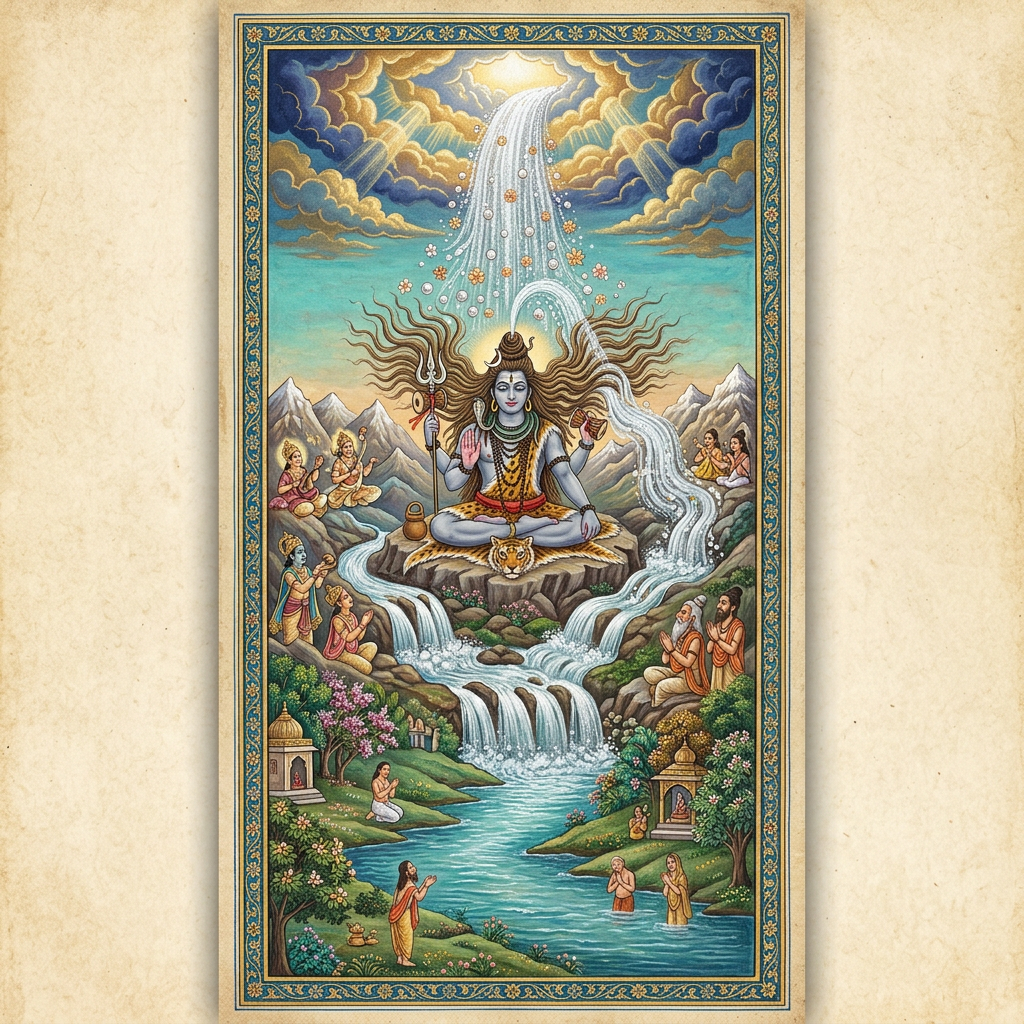
When our Purāṇas tell us that Gaṅgā flows from the feet of Viṣṇu, that Śiva catches her in his matted locks to break her terrible velocity, that she washes away sin and carries the souls of the departed across the gulf of death — this is not superstition. This is a staggeringly sophisticated cosmology encoded in the language of story. And these make great infographics!
The Vāyu Purāṇa says that Gaṅgā’s flow covers the firmament for sixty thousand yojanas, that she falls first on the peaks of Mount Meru, that she splits into streams and irrigates all directions. The uncountable stars of the Milky Way — what our tradition calls the ākāśa-gaṅgā — are her shimmering body suspended in the sky. She is tripathagā — she who walks the three paths. Heaven. Earth. Pātāla. One goddess. Three worlds. A single flowing thread of water stitching the cosmos together.
Our tradition gives us two exquisite etymologies for her name. Gamayati bhagavat-padam iti gaṅgā — she is called Gaṅgā because she carries the soul to the feet of God. And: gamyate prāpyate mokṣārthibhir iti gaṅgā — she is the one who is sought by those who desire liberation.
The river is the road. The water is the way.
This is why the dying in our tradition are brought, if at all possible, to her banks. Not because the river is a magical sewer that mechanically washes away sin. But because she is the conscious current by which the soul is lifted from one shore of existence to the next. The Kauṣītakī Upaniṣad even tells us that those who depart this world go first to the moon, and the Purāṇas say the river Gaṅgā is herself the water of the moon descending — which is why Śiva, who bears the crescent moon on his head, is the only one who can receive her torrent and hold it without being swept away.
II. Water as Civilization: Why the Ṛṣis Chose the Riverbank
From the cosmic, let me turn to the civilizational. A question I have been sitting with for many years:
Why did our ṛṣis choose the riverbank?
Think about this. A civilization is shaped, first and most deeply, by its geography. The land teaches the people what to think. The climate shapes the temperament. The available food decides what the body will become. And among all the features of the earth, none is more decisive than the presence — or the absence — of water.
Consider the peoples of the world, and notice the different qualities of mind each geography produces.
The people of the deep forest — the vanavāsīs — live with a particular interiority. The forest is enclosed, shadowed, rich with unseen life. The forest dweller learns patience, silence, attentiveness to the rustle behind the leaf. Much of our āraṇyaka literature — the forest books of the Upaniṣads — came out of this consciousness. The forest teaches inwardness. It teaches that the answer is hidden, and that you must be very still to hear it.
The people of the high mountains — the Himālayan peoples, the Tibetans, the Andeans — live in a different register altogether. The thin air, the verticality, the slow pace of everything at altitude. Mountain consciousness is vertical consciousness. It is the consciousness of ascension, of retreat, of the ekānta-vāsī, the solitary one on the peak. The mountain teaches you that the view is earned by climbing.
The people of the deserts — the Bedouin of Arabia, the peoples of our own Marwar and Jaisalmer, the Saharan nomads — live with the scarcity of water as the organizing fact of their existence. Their poetry is full of longing, of the oasis, of the beloved who is always somewhere else. Desert consciousness is consciousness pared to its essentials. Nothing is wasted. Everything is sacred because everything is rare.
The people of the frozen north — the Scandinavians, the Siberians, the Inuit — develop a consciousness of endurance, of preservation, of the long dark winter spent in the memory of the sun. Their mythologies are full of ice giants and returning heroes. They teach us that survival itself is a spiritual discipline.
The people of islands — the Polynesians, the Japanese, the English — develop a consciousness bounded by horizon, separated from the mainland, turned outward toward the sea either in contemplation or in conquest. Island consciousness is edge consciousness. It tends to produce either great navigators or great isolationists, and sometimes both in the same people.
And then there is the consciousness of the river-bank people.
Our civilization is a river-bank civilization. And we chose the banks deliberately. Sage Kapila settled at Siddhpur on the Sarasvatī. Sage Bhṛgu at the Narmadā. Sage Mārkaṇḍeya at the Tāpī. Agastya moved south along the rivers of the Dakṣiṇa. Every great centre of our tradition — Vārāṇasī on the Gaṅgā, Prayāga at the saṅgama, Haridvāra where she first touches the plains, Nāsik on the Godāvarī, Ujjain on the Kṣipra, Śrīraṅgam on the Kāverī — every single one of them is a river-bank centre. Even our country’s name — Bhārata, Hindustān, India — is traced to the Sindhu, the river that taught the first Vedic peoples who they were. We are, quite literally, the children of a river.
Why did they choose the riverbank? What does the river teach that the forest, the mountain, the desert and the island cannot?
What the River Teaches
(Think of “Siddhartha” by Herman Hesse)
The river teaches continuity within change. The water that flows past you now is not the same water that flowed a moment ago — and yet the river is one. Heraclitus said you cannot step into the same river twice. The ṛṣis said something more subtle: the river is one precisely because the water is not. Identity is not stasis but pattern. To be alive is to keep arriving and keep departing in the same breath.
The river teaches abundance. Annual floods deposit silt; the land grows rich; the settlement can pause, think, build a temple, argue about metaphysics, compose hymns. You cannot do philosophy on an empty stomach, and you cannot fill a stomach without water. Every sustained philosophical civilization in human history — the Egyptian on the Nile, the Sumerian on the Tigris and Euphrates, the Chinese on the Yellow and Yangtze, and we on the Sindhu, Sarasvatī, Gaṅgā, Yamunā, Kāverī, Godāvarī, Narmadā — was a river-bank civilization. No desert has produced a Mahābhārata. No iceberg has produced an Upaniṣad. Water makes thought possible.
The river teaches tīrtha — the sacred crossing. The Nārada Purāṇa defines tīrtha as the road across the ocean of saṁsāra. Every place where a river can be crossed became, in our tradition, a place where the soul can cross. The physical ford and the spiritual ford are the same word. This is why the Tīrthaṅkaras of the Jain tradition take their name from the crossing — they are ford-makers. To find a place where the river can be forded is to find a place where liberation can begin.
The river teaches dāna — giving. The river does not clutch its water. It gives and gives and gives, and somehow the giving does not impoverish it. It is the great teacher of generosity — not as a moral virtue but as a metaphysical stance. What flows lives. What hoards dies. This is why every Hindu village, traditionally, grew on the bank of a river or a tank, and every village temple had a puṣkariṇī — a sacred pond — at its side. The water taught the people to give.
And the river taught our ancestors the metaphysics of saṁsāra itself. The river that dies into the ocean is not lost. It becomes cloud. It becomes rain. It becomes the spring high in the mountains. It comes back as itself, the same water in a new form. Our doctrine of reincarnation is, at one profound level, the metaphysics of the water cycle, observed for a thousand generations and finally spoken aloud.
Food. Nourishment. Cleansing. Offering. Tīrtha. Every one of these is a water-word. The granaries of a river-bank people are full because the irrigation is reliable. The kitchen is clean because water is near. The body is bathed because the pond is close. The offering is possible because the kalaśa is easily filled. The pilgrim can find a ford. The dead can be immersed. Every dimension of dhārmic life is underwritten, silently, by the river.
Other peoples had to invent workarounds for the absence of water. We simply lived beside it, and listened to it, and let it teach us.
III. Rivers as Chaitanya — and the Trouble with “Consciousness”
Something that may sound strange to the modern ear: in our tradition, rivers are not metaphors for living things. They are living things. They are not personifications. They are persons.
The Mahābhārata tells us that Gaṅgā was the wife of King Śāntanu and the mother of Bhīṣma. When Bhīṣma lay dying on his bed of arrows at Kurukṣetra, Gaṅgā rose from her waters in human form and wept uncontrollably over her son’s body. This is not allegory. This is the tradition affirming — emphatically, in its greatest epic — that the river is conscious, that she grieves, that she loves, that she is a mother in the full-throated sense of the word.
The Bhāgavata Purāṇa tells us the cīra-haraṇa episode, in which Kṛṣṇa takes away the garments of the gopīs while they are bathing in the Yamunā, and explains that one should not bathe naked in the river because the devatās residing in the water are disrespected by such an act. The river is a being. She has a presence. She has sensitivities. She can be disrespected.
The Kāliya-mardana story — the young Kṛṣṇa dancing on the hoods of the thousand-headed serpent who had poisoned the Yamunā — is, on one level, an ecological parable. Kāliya represents the pollutants we dump into our rivers. Kṛṣṇa represents the divine will to restore. But at a deeper level, the story is about the river’s suffering. The Yamunā was in pain. Her children were dying from her water. And Kṛṣṇa came to heal her, to drive away what was afflicting her, to return her to herself.
Feel the difference between how a modern environmentalist speaks of a river and how our tradition speaks of a river. The environmentalist says: the Yamunā is polluted; we must clean it for the sake of downstream users. The dhārmika says: Yamunā-mātā is suffering; we must heal her. The first is a management problem. The second is a relationship.
Why Chaitanya Is Not the Same as “Consciousness”
Something that has taken me years to articulate: the English word “consciousness” is not the same as the Sanskrit word chaitanya. They are false friends. And because we have been translating one with the other for two centuries, we have lost almost everything.
“Consciousness” comes from the Latin con-scire — to know with, to know jointly. At its root it is a knowledge-word. It implies a knower and a known and a relation between them. The Cartesian tradition that shaped modern English philosophy treats consciousness as something that arises inside the human head — as a private theatre, a stream of mental events — and the great unsolved problem of modern philosophy has been how to get this inner theatre to connect to the outer world at all. This is the so-called hard problem of consciousness. It is hard because the very framing is wrong. If you begin by locating awareness inside a skull, you can never account for its presence anywhere else.
Chaitanya is a completely different idea. Chaitanya comes from the root cit — which means to shine, to be aware, to glow with awareness. It is not knowledge-with. It is being-as-awareness. It is the light, not the knower. It is what is there before there is any “I” to know anything. The Upaniṣads call this prajñāna-ghana — a dense mass of pure awareness. They call it sat-cit-ānanda — being-awareness-bliss — the three inseparable faces of the Real. They call it cit-śakti — the power of awareness that animates everything.
Here is the decisive turn. In our tradition, chaitanya is not something that appears inside a brain. Chaitanya is the substrate of everything. Every rock, every tree, every river, every star participates in chaitanya — some more manifestly, some more hiddenly — but everything, absolutely everything, is in some measure alive. The difference between a rock and a river is not that one is dead and one is alive. It is that the river’s awareness is more vyakta, more manifest, more fluid in its expression. A rock is chaitanya slowed almost to a standstill. A river is chaitanya in graceful motion. A plant is chaitanya that has learned to grow. An animal is chaitanya that has learned to move. A human being is chaitanya that has turned back on itself and become capable of saying “I.”
Our own language has many shades for this. Cit — pure awareness. Bodha — the act of knowing. Prajñā — wisdom, the perceiving intelligence. Saṁvit — integral knowledge. Citta — the mind-stuff, the field of awareness. Antaḥkaraṇa — the inner instrument. Each word catches a different gleam of the same jewel. English has one flat word — “consciousness” — and uses it to mean all of these.
If water is not dead, then all five mahābhūtas are not dead. The earth holds the memory of what happens upon it — our śāstras say so; ask any tāntrika who has meditated on a cremation ground. The air holds the memory of the words spoken in it — ask any skilled clairvoyant. The fire holds the memory of what is offered into it — this is the whole premise of the homa. And ākāśa, the subtlest of all, holds the memory of everything – like someone said, “All things will be recorded in space.”
Soon, I suspect, even modern physics will arrive where our ṛṣis were standing millennia ago. The universe is not a dead machine. It is a field of intelligence, of which matter is one mode and water is perhaps its most exquisite. Check out the Gaia Hypothesis.
IV. Water in Fire: The Architecture of the Homa
Let me begin with the smallest sacred act of our tradition, and then open it out into its grandest.
The smallest is arghyam.
In the orthodox daily practice of sandhyāvandanam, performed at the three junctures of the day — prātaḥ-sandhyā at dawn, madhyāhnika at noon, sāyam-sandhyā at dusk — there is a simple act. The sādhaka takes a little water in the right palm, chants the Gāyatrī mantra, and offers the water up toward the sun.
It looks like almost nothing. A handful of water, thrown into the air. Repeated three times per session. Four times, in some traditions, with one extra as prāyaścitta for any error in timing.
The daily ritual of the sādhaka — performed in a quiet courtyard in Bengaluru, in a flat in Chennai, on a riverbank in Kāśī — is keeping the sun alive. The individual’s tiny act is participating in the cosmic order. There is no clearer statement of the Vedic vision anywhere than this: the small and the great are one continuous fabric, and the human being is not a bystander to the cosmos but its active collaborator.
The philosophical reading of the same story is even more beautiful. The arghyam, the consecrated water thrown upward, is the daily act by which we participate in the maintenance of our own inner luminosity.
After the offering, the sādhaka declares:
asāv ādityo brahma, brahmaiva aham asmi
That sun is Brahman. I myself am Brahman.
The same water, offered to the outer sun, reveals the inner sun. A single handful of water, in the palm of one human being, becomes the meeting-place of macrocosm and microcosm. Our ancestors found so many ways to keep us connected with prakriti and to keep reminding us that we are a part of it and have a responsibility towards it.
The Homa as a Dance of the Five Elements
With that small act in mind, let me open out into the grand act — the homa.
Picture a homa-kuṇḍa. A sacred fire-pit, dug into the earth or built of bricks. What is it made of?
Pṛthivī. Earth. The body of the ritual. Every homa begins by consecrating the ground itself — establishing that this patch of earth, here, now, is becoming sacred space. The kuṇḍa is pṛthivī-tattva offering itself as the vessel.
Before any fire is lit, what is the first thing the priest does? He sprinkles water. Around the kuṇḍa. Around the participants. Around the offerings. Around his own body. Prokṣaṇa — the sacred sprinkling.
Jala. Water. The purifier. The first act is never fire. The first act is always water.
Why? Because fire without prior purification is dangerous fire. It burns destructively. It does not carry the offering to the devas; it merely consumes. Water prepares the field. Water establishes śuddhi — the subtle cleanliness that allows the sacred to appear. And the water he sprinkles is not ordinary water. It is water over which mantras have been chanted. It is jala that has been made into tīrtha.
Then the priest sets up the kalaśa — the sacred water-pot. This is the heart of the ritual, placed to one side of the kuṇḍa, filled with fresh water. But he does not leave it as mere water. Into it he places specific substances, each with a precise tattvic meaning.
Mango leaves arranged around the rim — the vegetable kingdom invited in, the vitality of plant life.
A coconut on top — the fruit, the whole cosmos in miniature; its three eyes representing the three eyes of Śiva, its fibrous shell the gross body, its water within the subtle body, its kernel the causal body. The coconut is the universe on top of the pot.
A gold coin inside — the mineral kingdom, the ākāra-tattva of the earth, the incorruptible witness.
Rice grains at the base — the grain, the staple, annam, the Upaniṣadic equation: annam brahma, food is Brahman.
Turmeric and kumkum — the feminine powers of auspiciousness, the śakti-tattva.
Sometimes tulasī leaves. Sometimes darbha grass. Always a red cloth tied around the neck of the pot.
Into this composed water, the priest chants the invocation of all the great tīrthas:
gaṅge ca yamune caiva godāvari sarasvati
narmade sindhu kāveri jale’smin sannidhiṁ kuru
“O Gaṅgā, Yamunā, Godāvarī, Sarasvatī, Narmadā, Sindhu, Kāverī — be present in this water.”
In that one moment — in a single ritual moment — the priest has brought the entire dhārmic hydrosphere into one pot. Every sacred river, every ocean, every holy body of water is condensed into that kalaśa. This is why when water from a kalaśa is sprinkled on your head at the end of a pūjā, you are receiving the blessing of every holy water on the planet at once. This is the mystical mathematics of Hindu ritual. The whole is brought into the part, and the part releases the whole back into the world. Now, seeing is believing. I have experienced the energy and power of the water in the Kalasa at the end of the homa. A kumbha snana at the end is something I look forward to it.
Now the fire is lit. Agni.
But the priest does not light it arbitrarily. He lights it with mantra. He invites Agni:
agnim īḷe purohitam yajñasya devam ṛtvijam
“I praise Agni, the priest who goes before, the deva of the yajña, the ṛtvij.”
The Ṛgveda begins with this line. Agni is not merely fire; he is havya-vāhana — the carrier of offerings. He is the Purohita — the one placed in front, the cosmic messenger.
Why does Agni get this role? Because Agni alone among the pañca-mahābhūtas transforms. Earth does not transform; it endures. Water flows but remains water. Air moves but does not digest what it touches. Space holds but does not change what it holds. But Agni — Agni takes a solid thing of this world and turns it into smoke. Agni translates the gross into the subtle. Agni is the alchemist. Agni is the one element whose job is conversion. Without Agni, our offerings would simply rot on the ground. With Agni, they become fragrance, smoke, subtle essence — and ascend.
What does the priest feed Agni first?
Ghṛta. Clarified butter. And this too is not arbitrary. Ghee is the condensed energy of the cow, which is itself the condensed energy of grass, which is itself the condensed energy of sunlight falling on the earth. Ghee is stored solar radiance. When you pour ghee into Agni, you are returning sunlight to its source. Agni receives it as fuel and releases it as light, heat, and subtle essence. The whole homa is, at its physics, a ceremony of re-converting stored sunlight back into free radiation — but done with mantra, with intention, with saṁkalpa, so that the energy released is not merely physical but subtle.
Along with ghee, the priest offers samagri — a carefully prepared mixture of herbs, grains, fragrant woods, each with its own prabhāva, its own subtle signature. Sandalwood for calming. Tulsi for devotion. Specific herbs for specific deities. Each offering accompanied by svāhā — the sealing word, the feminine consort of Agni, the one who receives what he carries.
The priest’s voice is chanting mantra throughout.
Mantra is sound. Sound is vibration. Vibration needs a medium. The medium of sound, in our tradition, is ākāśa — space-ether. When the mantra is chanted, the ākāśa itself is imprinted with the vibration. The ākāśa receives the mantra the way the water in Emoto’s experiment received the word. The very space in which the ritual is happening becomes charged.
The priest’s breath carries the mantra. Breath is prāṇa. Prāṇa rides on vāyu — the air. The air moves through the space, carrying the sound, carrying the breath, carrying the warmth of the priest’s body and the moisture of his mouth. The vāyu is the envelope in which the mantra travels from the priest’s heart to Agni’s mouth.
And my saṁkalpa — is the invisible directing principle of the entire ritual. Without saṁkalpa, the homa is just chemistry. With saṁkalpa, it is alchemy. The saṁkalpa specifies who is offering, at what time, in what place, for what purpose, to what deity. Without this specification, the energy released has no address; it dissipates into the general atmosphere. With the saṁkalpa stated, the energy has a destination.
Look at what is happening in the homa:
Pṛthivī — the earth — is the kuṇḍa, the containing body.
Jala — the water — is the kalaśa, the purifier, the medium of blessing.
Agni — the fire — is the transformer, the messenger, the carrier upward.
Vāyu — the air — is the breath, the carrier of sound and warmth.
Ākāśa — the space — is the field of mantra, the subtle medium in which vibration lives.
And running through all five is my saṁkalpa — intention — and the manas, buddhi and bhāva of the ṛtvij — the mind, intellect, and emotional quality of the one performing. Above these, the devatā’s kṛpā — grace — received through the opened channel.
The pañca-mahābhūtas are not ingredients. They are roles. Each element does a specific kind of work in the sacred economy. And water’s work, though quiet, is foundational. Without water, there is no purification. Without purification, there is no access. Without access, there is no ritual. Water is the silent queen of the yajña.
V. The Sapta-Sa: Seven Sanskrit Streams Within
A mnemonic.
There are many ways to enumerate the dimensions of water.
Think of them as a garland –
Sṛṣṭi. Śuddhi. Snāna. Smṛti. Srotas. Saundarya. Samādhi.
One. Sṛṣṭi — Source. Water is where creation begins. The hiraṇyagarbha, the golden womb, floats upon the cosmic waters. You began your life floating in the amniotic sea inside your mother — an ocean of your own, ringed by her heartbeat. Seventy percent of the earth is water. Seventy percent of your body is water. You are, and always have been, a water creature. Water is the name we give to the womb of being.
Two. Śuddhi — Purification. Āpo asmān mātaraḥ śundhantu. May the waters, our mothers, purify us. Water washes what nothing else can wash. Not merely dust and dirt but, in the dharmic imagination, the subtler residues — karma-mala, the stains of action; vāk-mala, the stains of speech; mana-mala, the stains of thought. This is why the Gaṅgā is called sarva-pāpa-harā — the remover of all sin. Not because of the chemistry of her water but because of the chaitanya that flows in her.
Three. Snāna — Sacrament. The daily bath is not hygiene. It is upāsana. The temple abhiṣeka is not decoration. It is the descent of grace. Snāna transforms the body from object to offering. In the moment we step into water — truly, consciously step in — we step into a current of practice older than memory. The Kumbha Melā, where millions bathe at a single astrological moment, is the largest snāna on earth, and also the clearest statement: that to step into water, together, at the right moment, is to participate in something the individual alone cannot touch.
Four. Smṛti — Memory. Water remembers. It receives impressions and holds them. Every mantra chanted over it becomes structural. This is why Gaṅgā-jala stored in a copper pot does not putrefy. This is why a few drops of tīrtha placed on the tongue carry the benediction of the mūrti across miles and years. Water is the library of the universe. And not only water — all five mahābhūtas hold memory. The earth holds the memory of your footsteps. The air holds the memory of your words. The fire holds the memory of your offerings. The space holds the memory of your silences. Our tradition has always known this. Modern science is slowly catching up.
Five. Srotas — Stream. Water moves. Water flows. Water never argues with the shape of the vessel; it simply becomes the vessel. This is water’s teaching: be fluid, be receptive, meet what is hard and patiently carve a canyon through it. The Himālayan boulder yields to the mountain stream not because the water is strong but because the water is persistent, and because the water knows a secret — that what flows is alive, and what resists is already dying.
Six. Saundarya — Beauty. Water keeps you young. Water makes you fresh. A face just splashed with cool water glows with a radiance no cosmetic approximates. Rivers beautify every landscape they pass through. The lotus opens only where there is water. Saundarya is not ornament. It is the visible sign of life fully flowing. Where water is honoured, beauty emerges on its own.
Seven. Samādhi — Dissolution. And finally, water is where we go. Our ashes are immersed in the Gaṅgā. Our bodies, seventy percent water, return to their source. Water is the mother at the beginning, and water is the mother at the end. Samādhi — the final gathering-in, the return of the drop to the ocean.
VI. What Does It Mean to “Be Like Water”?
One final contemplation before the meditation.
“Be like water.” You have heard this phrase. It is quoted today from Bruce Lee, who learned it from Daoism, and Daoism received it from Laozi. But the teaching, in its essence, is older than Daoism, older even than the Veda’s explicit articulation of it. It is a teaching water has been offering to any civilization willing to listen for as long as there have been rivers.
What does it actually mean to be like water?
It does not mean to be passive. Water is not passive. Water carved the Grand Canyon. Water sinks continents. Water, given time, is the most patient and the most inexorable force on this planet. The phrase does not call us to weakness. It calls us to a specific kind of strength — the strength that works by yielding.
The teaching has seven dimensions — and they correspond to the seven streams just given.
First: to be like water is to be flexible without losing essence. Pour water into a cup, it becomes the cup’s shape. Pour it into a bowl, the bowl’s. Into the ocean, the ocean’s. But water never stops being water. Its adaptation to form is total; its surrender of identity is zero. This is the yogi’s secret: meet every circumstance completely, while remaining unalterably yourself. The householder, the monk, the teacher, the father, the friend — all these are vessels the same self-pours into, and the self never ceases to be itself.
Second: to be like water is to seek the low place. Water always flows downward. It does not strive for heights. It does not cling to the mountain. It surrenders to gravity, and in surrendering, it reaches the ocean. The Bhagavad Gītā says mānāpamānayoḥ tulyaḥ — the wise one is the same in honour and dishonour. The wise one seeks the low seat. Water has been teaching this for four billion years. The Sanskrit tradition calls this vinaya — humility — and regards it as the first qualification for knowledge.
Third: to be like water is to cleanse without resentment. Water receives the dirt of the world — every day, billions of tons of it — and does not stay dirty. Given time and movement, water purifies itself. It does not hold a grudge. It does not remember yesterday’s mud as an insult. It simply flows on, and in flowing, becomes clean again. The saint receives the unkindness of the world and does not let it stain. The saint is not immune to the mud; the saint is moving water.
Fourth: to be like water is to be patient. The drop that carves the stone. The river that carves the canyon. Water never hurries. Water has all the time in the world. And because it has all the time in the world, it accomplishes what the ambitious and the hurried cannot. Every spiritual discipline — japa, dhyāna, svādhyāya — is the work of the water-drop on the stone. It looks like nothing is happening. And then one day, the stone is gone.
Fifth: to be like water is to move without force. Water does not fight the obstacle in its path. It goes around it. If the path is blocked, it waits. If the wait is too long, it rises. If it cannot rise, it evaporates and becomes cloud and falls on the other side of the mountain. There is no situation water cannot eventually meet. This is the deepest teaching of strategy the Arthaśāstra knows — that force defeats only that which is more brittle than itself, and water defeats by never being brittle.
Sixth: to be like water is to give without calculating. The river gives its water to the fields, to the cattle, to the cities, to the ocean. It does not demand gratitude. It does not check the ledger. It is the perfect instrument of niṣkāma-karma — action without desire for reward. The river does not stop flowing because the farmer forgot to say thank you. The river does not reduce its gift because the downstream village is ungrateful. It simply gives. This is karma yoga in its natural form.
Seventh: to be like water is to remember that you are not separate. The drop is never apart from the ocean. Even when it appears to have fallen from a cloud onto a leaf and trembled there alone, it is on its way back. There is one water, wearing a billion momentary forms. There is one chaitanya, wearing a billion momentary bodies. The drop and the ocean are — have always been — the same. This is the final teaching of Advaita, and it is spoken most clearly by rivers.
There is a beautiful image to hold before the meditation. The lotus grows in water. The leaf touches water. When raindrops fall on the leaf, they bead up and roll off. The water does not soak into the leaf. The leaf is in water, of water, surrounded by water — and yet untouched, pristine, unstained.
To be like water — ultimately — is to be both the water and the leaf. Present in the world. Shaping and being shaped by every vessel. And yet, at the deepest level, untouched. The sage is water on a lotus leaf.
In Closing
Water is not a substance but a mode of chaitanya.
We have walked around seven faces of this one truth.
Water as civilization — the reason our ṛṣis chose the riverbank over the forest and the mountain, and why river-bank cultures, alone among civilizations, produced the philosophical imagination.
Water as chaitanya — rivers not as metaphors but as mothers, goddesses, living persons — and the vast difference between the English word “consciousness” and our own chaitanya, cit, prajñā, bodha.
Water as sacrament — in the palm of arghyam offered to the sun, in the kalaśa at the heart of the homa, in every sprinkling of prokṣaṇa that prepares the ground for Agni.
Water as the seven streams within — Sṛṣṭi, Śuddhi, Snāna, Smṛti, Srotas, Saundarya, Samādhi — the inner architecture of jala-tattva.
Water as the great teacher — flexible without losing essence, low-seeking, patient, cleansing without resentment, forever moving toward the ocean.
And water, finally, as the silent teacher of what we are. Because we are water beings. The cosmos is a water cosmos. The pañca-mahābhūtas are not five dead substances — they are five modes of the one living intelligence — and water is the mode in which that intelligence most clearly flows.
āpo jyotī raso’mṛtaṁ brahma
The waters are light, are essence, are immortality, are Brahman.
When you drink your next glass of water — pause.
When you step into your next bath — remember.
When you see a river — bow.
When it rains — receive.
When someone weeps near you — know that the divine waters are flowing through them also.
Because the divine has been flowing through you at every moment of your life and has never once stopped.
Addendum: From Contemplation to Daily Practice
If the waters are chaitanya — if Gaṅgā is a person, if every drop is a descending stream of the infinite, if every meal we eat is a miniature homa — then something follows. Philosophy cannot stop at philosophy. Āchāra — conduct, the daily doing — is where the teaching proves itself.
The ṛṣis did not separate jñāna from āchāra. The one who knows the waters as Brahman and the one who wastes them cannot remain the same person for long. Knowledge bends behaviour, or it was never really knowledge.
Here, then, are some small acts and larger contemplations — the practical yield of everything that precedes.
Everyday Acts: Honouring the Waters
Bathe from a Bucket, Not a Shower
A traditional snāna is a slow, deliberate act. You fill a vessel. You pour. You feel the water touch you. You are present to what is touching you. A shower in modern plumbing runs continuously whether you are noticing it or not — roughly eight litres a minute, most of it pouring unseen down a drain. A bucket, filled once, is fifteen to twenty litres total. A ten-minute shower is eighty. The arithmetic is clear.
But the deeper point is not arithmetic. The bucket restores attention. You know how much you are using because you can see what you have. Each cupped palm is a small choice. Water honoured becomes water noticed, and water noticed becomes water saved.
Use Cool Water at Room Temperature, Not Hot
Our grandmothers knew this before the Āyurveda textbooks formalised it. Cool-water snāna — water at room temperature, neither icy nor heated — invigorates the prāṇa, tones the skin, wakes the agni, and does not leach the body’s natural oils. Heating water, besides, is energy-intensive. Every geyser is a small tax on the grid, on the coal somewhere that becomes the heat, on the planet that holds both.
The traditional mangala-snāna with warmed water was reserved for the ill, for a new mother, for winter at high altitude — not a daily default. For most of us, most days, the stream from the tap is already what the body wants. Meet it as it comes. The brief shock at the first touch is itself a kind of tapas.
Do Not Use Cauvery Water to Wash Your Car
Living in Bengaluru, this one is close to home. The Kāverī that reaches our taps has already travelled a long way — through turbines and treatment plants, through inter-state disputes and tribunals, through the patient labour of generations who built the channels and pumping stations to bring her here. She is tīrtha that somehow arrived in your kitchen. She has crossed districts to find you.
To spray her across a car bonnet — to mix Kāverī-jala with soap and let it run into a storm drain — is not merely wasteful. It is a small, daily irreverence. If the car must be washed, use a bucket of reclaimed water, or grey water, or rainwater from the tank. A damp cloth does most of what a hose does. Often the rain will do it for you, if you let it. And it is worth asking, quietly and without self-judgement, whether the car truly needs to be washed as often as we wash it.
Every litre of municipal water you spare is a litre that reaches someone downstream who has none.
Six Contemplations for the Longer Practice
These are not tips. They are orientations — things to sit with over a season, or a year. They are meant to change the way you see, and from that, the way you act will follow on its own.
One. Know the cycles of water — inside you and outside you. The water cycle of the planet — evaporation, cloud, rain, river, ocean — is mirrored in the water cycle of the body. You drink, the water enters your cells, passes through your blood, is exhaled as breath-moisture, excreted, wept, perspired, returned. Watch both cycles. Notice the seasons of rain outside and the seasons of thirst inside. Two rivers, one flow. The outer jala-cakra and the inner jala-cakra are not two systems. They are the same system seen from two angles.
Two. Develop systems thinking. Nothing in nature stands alone. The drought in one district is connected to the forest cleared in another. The borewell that ran dry this summer is connected to the apartment complex that rose last decade, and to the lake that was filled in twenty years before that. Train the mind to see the lines between things — the feedback loops, the delays, the thresholds at which a gradual change becomes a sudden collapse. Pratītya-samutpāda — dependent origination — is not a Buddhist technicality. It is the grammar of the real world. The dhārmika is, by vocation, a systems thinker.
Three. Understand the environment as a system — its parts, and the whole they compose. Soil, water, air, forest, insect, bird, microbe — each a role, none replaceable. The temptation of the modern mind is to protect one piece at a time: save the tiger, save the river, save the bee. But the tiger needs the forest, the forest needs the rain, the rain needs the ocean, the ocean needs the plankton, the plankton needs the climate. Pṛthivī is not a list of items. She is an organism. Learn to see the whole that the parts are faces of.
Four. Trace the full lifecycle of water. Where does the water in your tap come from? Which river? Which reservoir? Which catchment? Which monsoon fed it? And where does it go when it leaves your house? Which drain? Which treatment plant? Which discharge point? Which aquifer? Most urban Indians have no answer to these questions, and the not-knowing is itself the problem. A stranger is easy to waste. A known guest is not. Knowing the lifecycle of the water that passes through your home is the beginning of a relationship with her.
Five. Do not think of water in isolation — think of her within the pañca-mahābhūtas. Water does not exist by herself. She rises from the earth, rides the wind, falls through the sky, is warmed by fire, held by space. To drain the earth of its forest is to drain it of its water — because the roots held the rain. To pollute the air is to poison the rain — because the cloud carries what the atmosphere holds. To light too many fires, too fast, is to dry the rivers. The pañca-mahābhūtas are not five separate things. They are five faces of one living body. Disturb one and you disturb all.
Six. Understand your own relationship with each of the five elements. This is the most intimate practice. Which element do you love? Which do you neglect? Which frightens you? Which calms you? Your prakṛti — your constitutional nature — is a particular mixing of the five. Your sādhanā is, partly, the work of bringing them into balance. The ātman does not live in a skull. It lives in a body that is five elements held together by prāṇa and illumined by chaitanya. Tend all five, and the inner waters run clear.
The Water Crisis Is Not About Water
One last thing has to be said, and said plainly.
No number of fines, bans, quotas, or regulatory frameworks will solve the water crisis. Piling on more rules will not reach the root. The water crisis is not, at its core, a crisis of water.
Water has not changed her nature. The monsoon still comes. The rivers still flow when we let them. The rain still falls where we have not paved over the ground that used to receive it. The fault is not in the waters. The fault is in us.
What we call a water crisis is a crisis of knowledge — because we do not know what water is. It is a crisis of commonsense — because we have forgotten what a river is for. It is a crisis of logic — because we pump an aquifer for fifty years and are astonished when it runs dry. It is a crisis of ethics — because we have quietly agreed to privatise what belongs to all beings. It is a crisis of compassion — because we poison her and call it industry. And above all, it is a crisis of responsibility — because we inherited a living trust and are handing our children a dry one.
It is, in short, the consequence of a species going against the very nature from which it came and of which it remains a part.
The Strangeness of the Present Moment
Consider this. We are spending billions exploring Mars — a planet we can barely reach and cannot live on — while we have still not understood the planet we were born on. We send probes looking for traces of water on distant worlds while letting the waters of this world die in full view. We call this progress.
No civilization before ours would have recognised this as wisdom. Our tradition has a word for it: pramāda — a kind of intoxicated inattention, a heedlessness that does not know it is heedless. It is the first thing the śāstras warn against, and it is the signature of the age we are living in.
Without Dharma, No Sustainability
Without re-establishing Dharma — that which sustains the world, the planet, and society — there can be no true sustainability. The English word sustainability is itself a pale echo of the Sanskrit dhāraṇa — that which holds, that which upholds, that which keeps a thing in its own nature. Dharma is not religion in the Western sense. It is the ordering principle by which life holds together. Its abandonment is not merely a spiritual loss; it is a structural collapse.
The way we think of water — and of all the pañca-mahābhūtas — has to change. The Indic way of relating to nature is not one civilizational option among many. It is a vision whose hour has come round again, and not for India alone. The world needs what our tradition has been quietly saying for four thousand years.
A Design Problem in Philosophical Disguise
When a city encounters a water shortage, it does not have a water problem. It has a design problem. It has a construction problem. It has a philosophical problem wearing the costume of an engineering problem.
We design cities without asking where the water will come from and where it will go. We build urban centres that seal over the ground so the rain cannot soak back in. We site manufacturing clusters on riverbanks as though the river were an infinite sewer. We pave the catchment, fill the lake, concretise the storm-drain, and then hold emergency meetings about the borewell. We do all of this because we have decided, collectively, to see nature as inanimate. As matter without chaitanya. As resource.
Imagine calling your own mother a resource.
Imagine, at her funeral, her grandchildren tallying what she produced. Imagine drawing up a balance sheet of her service. Imagine extracting her until she is spent, then complaining about the shortfall. This is what modernity has done to prakṛti, who is the mother of us all. We came from her. We are made of her. We will return into her. And somehow, over two or three short generations, we have been taught to call her a resource.
The word itself is the wound. Until we stop using it, we cannot begin to heal the relationship.
The Dharmic Enterprise Model
This is why, over many years, I have been developing what I call the Dharmic Enterprise Model. In the standard enterprise model inherited from Western capitalism, the stakeholders of a business are its shareholders, its employees, its customers, its suppliers, and — vaguely, in the fine print — its community. The environment is a cost centre, a compliance line-item, an “ESG” metric to be managed.
In the Dharmic Enterprise Model, the rivers, forests, mountains, oceans, air, and soil are stakeholders. They have standing. They hold seats at the table — in the design of the factory, in the siting of the campus, in the choice of material, in the disposal of waste. Every enterprise decision must account for what the river loses and what the forest gives. Every quarterly report must answer not only to the shareholder but to the bhūmi on which the enterprise stands.
This is not romantic. It is a practical necessity. An enterprise that does not treat prakṛti as a stakeholder is an enterprise that is hollowing out its own substrate. Sooner or later — and many have discovered this already — it learns that there is no shareholder value to maximise on an uninhabitable earth.
Unless we move to this model, and see rivers, forests, mountains, and oceans as the primary stakeholders of every enterprise, we will run out of liveable earth faster than we are ready for.
When the Real Sounds Ideal
Some will call all of this idealistic. I want to meet that word directly.
When a mind does not understand the real, it calls references to the real ideal. The word “idealistic” is what we say when reality has grown too large for our mental model. It is a confession, not a critique. The Indic vision of nature is not idealism. It is the most ruthlessly empirical position available — because it accounts for more of what is actually happening than any model that treats rivers as sewers and mothers as resources.
True change requires a change in mental models. Without a shifted model, the worldview does not shift. Without a shifted worldview, our actions and interactions with nature do not shift. Without shifted action, we will arrive — sooner than anyone imagines — at the line Coleridge wrote two centuries ago:
Water, water, everywhere,
Nor any drop to drink.
That line is already true for millions on this planet. It will become true for hundreds of millions more unless we recover what our ṛṣis always knew — that water is not a resource. She is a goddess. She is a mother. She is Brahman.
And the way we treat her will decide what the earth becomes.