
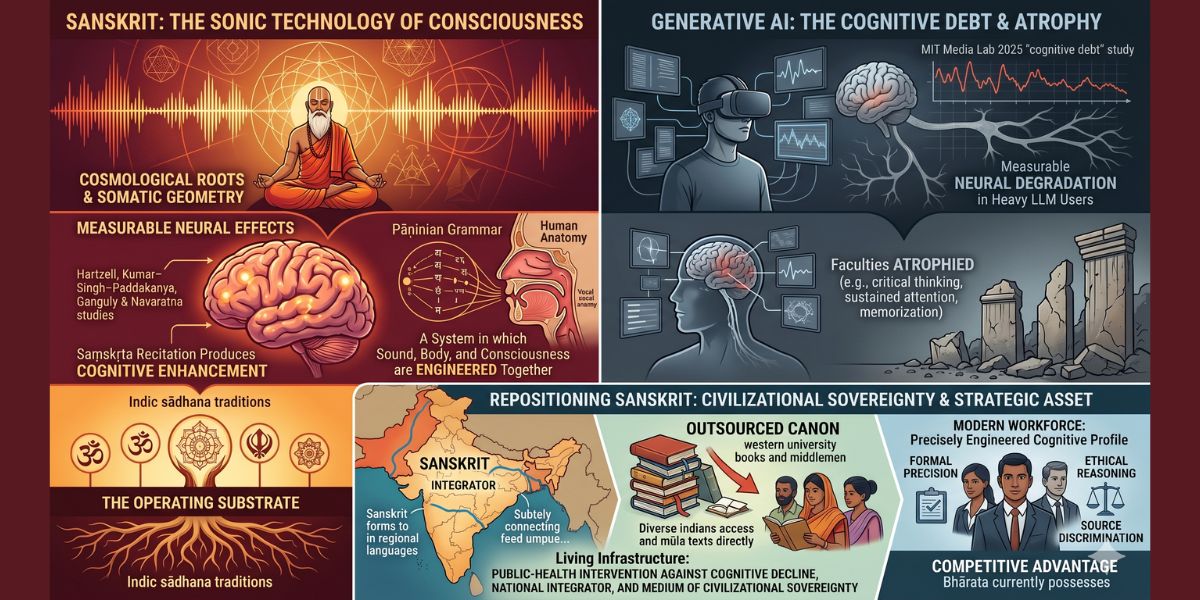
Repositioning Sanskrit for India’s Next Civilizational Chapter
Saṃskṛta Is Not Merely a Language
Vinay Kulkarni
A younger colleague asked me a question I have been asked many times in many forms: “How is Sanskrit different from any other classical language? Latin is ancient too. Greek is ancient too. Hebrew is sacred too. Why this special pleading for Saṃskṛta?”
The question is fair. It is also, I am increasingly convinced, a category error. In this article I will attempt to present my arguments for why Samskrita should not be clubbed with all other languages. Let us go beyond language politics and look at it as not only a national treasure but also a tool that can help us on many fronts – not just India but humanbeings as a whole.
When we line up Saṃskṛta beside English, Mandarin, Latin, Arabic, Kannada, Hindi, Tamil, Bengali etc— as comparative linguistics has done for two centuries — we have already smuggled the answer into the question. Languages are languages. Sound is sound. Grammar is grammar. The framing forces the conclusion. Of course all our classical languages have their own specialities, uniqueness, history, literature and contained knowledge and wisdom. I am not questioning that. But, if we are truly honest with ourselves we will be able to look at the various facets of Samskrita with an open mind.
But Saṃskṛta did not arise as a tool for trade, treaty, or governance. It was not first developed to write poems or sign contracts. It was cognised — heard, śruti — by the ṛṣis in deep states of meditative absorption, and only afterwards made available for human conversation. This is not a marketing claim. It is the foundational self-description of the tradition, and it has serious implications for how the language behaves in the human nervous system, in the human community, and in the human economy.
I want to set out, in three parts, what Saṃskṛta actually is, what it can do for Bhārata at this moment, and the specific cognitive profile it produces in a graduate of its disciplines. The repositioning, when it is finally taken seriously, is a civilizational move and not merely a cultural one.
Part One — What Sanskrit Actually Is
1. The Categorical Error: Sanskrit Is Not Merely a Language
When Sir William Jones addressed the Asiatic Society in Calcutta in 1786, he had spent enough time inside the language to abandon the comparative frame his colleagues took for granted. His verdict, much quoted since: “the Sanskrit language, whatever be its antiquity, is of wonderful structure, more perfect than the Greek, more copious than the Latin, and more exquisitely refined than either.” That is not flattery from a philologist with a soft spot for the East. It is a structural observation from a man whose day job was administering colonial law. He had no professional incentive to overstate the case. If anything, he understated it.
Every natural language we know maps sound to meaning by convention. Calling water water or pānī or agua is arbitrary; the sound has no intrinsic connection to the substance it points to. Saussure built modern linguistics on this insight. Saṃskṛta, however, makes a different claim about itself. In the Pāṇinian tradition, in the Vyākaraṇa darśana of Bhartṛhari, in the Mīmāṃsā position on śabda-nityatva — the eternality of sound — the relation between śabda (word) and artha (meaning) is held to be not arbitrary but inherent. This is the doctrine of sphoṭa, refined over centuries: meaning is not invented when the word is uttered; it is revealed.
To feel what “engineered for sonic precision” actually means, try this. Pronounce, slowly, the sequence क च ट त प. The first sound (ka) is articulated at the throat. The second (ca) at the palate. The third (ṭa) is cerebral — the tongue strikes the roof of the mouth. The fourth (ta) is dental — the tongue touches the back of the teeth. The fifth (pa) is labial — the lips close. In five syllables the tongue has walked the entire length of the oral cavity, from glottis to lips, in exact sequence. The Saṃskṛta consonant table is not arranged alphabetically. It is arranged anatomically.
The śikṣā texts and the prātiśākhyas of the Vedas devote thousands of sūtras to the exact mechanics of breath, tone, stress and articulation. No other classical language has anything resembling this apparatus.
2. Cognised from the Celestial Sounds of Nature
The ṛṣis describe Saṃskṛta as having been heard, not invented. The word for revelation in the Indic tradition is śruti — that which is heard. The Veda is apauruṣeya — not of human authorship. What were they listening to?
The tradition is consistent. They were listening to the resonant sounds that already pervade the natural world — the rustle of leaves, the call of birds, the flow of water, the deep cosmic drone the modern world has rediscovered as the Schumann resonance, and the inner unstruck sound the tantras call anāhata nāda. The forty-nine varṇas of the Saṃskṛta mātṛkā are held to be a phonetic catalogue of the elemental sounds out of which every worldly sound is composed. To learn Saṃskṛta, in this view, is not to learn a foreign code. It is to learn the alphabet of nature itself.
This is why the very first sound the tradition recognises is not a consonant but a pure vibration: Auṃ. Praṇava, the seed of all śabda. Even the structure of this single syllable carries the anatomical logic — A resonates at the navel, U in the chest, M at the throat and crown. The mantra is a map of the body as much as a map of the cosmos. Acoustical analysis of trained Vedic chanters has shown that sustained recitation of Auṃ produces remarkable autonomic stabilisation — slowed respiration, reduced heart rate, shifts in EEG microstate distribution. An AIIMS team in 2024 documented measurable reorganisation in the brain’s resting-state networks after even short bouts of verbal Auṃ chanting.
When we say Saṃskṛta is “based on natural sound,” we are not being poetic. We are describing the engineering specification.
3. The Body Is the Alphabet: Mātṛkā and the Cakras
Open any traditional diagram of the human subtle body and you will see something strange to the modern eye. Each cakra along the suṣumṇā has a precise number of petals — four at mūlādhāra, six at svādhiṣṭhāna, ten at maṇipūra, twelve at anāhata, sixteen at viśuddha, two at ājñā — and on each petal is inscribed a Saṃskṛta akṣara.
Add them up: 4 + 6 + 10 + 12 + 16 + 2 = 50. The number of varṇas in the Saṃskṛta mātṛkā.
The correspondence is not vague. Each petal carries a specific syllable in a specific order. The four petals of mūlādhāra carry vaṃ, śaṃ, ṣaṃ, saṃ. The sixteen petals of viśuddha carry the complete vowel inventory — aṃ, āṃ, iṃ, īṃ, uṃ, ūṃ, ṛṃ, ṝṃ, ḷṃ, ḹṃ, eṃ, aiṃ, oṃ, auṃ, aṃ, aḥ. The two petals of ājñā carry haṃ and kṣaṃ — the first and last consonants of the Saṃskṛta varṇamālā as conventionally taught. Every akṣara in the language has a location in the human body.
The tantras hold that the human body is itself constructed of sound — that the cakras are nodes in a phonetic geometry, and that each petal carries a specific akṣara because that akṣara governs a specific pattern of prāṇic flow. The bīja mantras at each cakra — LAṂ, VAṂ, RAṂ, YAṂ, HAṂ, AUṂ — are not mnemonic devices. They are the seed-sound frequencies of the elemental forces (pṛthvī, ap, agni, vāyu, ākāśa, cit) at each location.
The Saṃskṛta alphabet has cognates in the human body. The body is laid out as a manuscript written in the language of cosmic sound. To articulate the akṣaras with correct uccāraṇa is to activate the corresponding loci within one’s own subtle anatomy. This is what the tradition means by nyāsa — the ritual placement of mantras on the body during sādhana. No other language makes this claim. No other language can.
4. Sanskrit as the Operating Language of Tantra Sādhana
Once you understand the mātṛkā–cakra correspondence, the role of Saṃskṛta in tāntric sādhana stops being a cultural curiosity and becomes a functional requirement. A tāntric sādhaka does not chant a bīja mantra because it is beautiful, although it is. The sādhaka chants it because the specific vibrational signature of that syllable, articulated with the correct prāṇa-flow, activates a specific devatā within a specific cakra. The mantra is the technology. Substitute an English transliteration, alter the diacritic, change the rhythm, and you have a different technology — one that may produce nothing at all, or something other than what was intended.
This is why japa — repetitive recitation — sits at the centre of virtually every Indic sādhana lineage. The Bauddha, Jaina, Śaiva, Śākta and Vaiṣṇava traditions all converge on this practice. The mantra is repeated not because the devatā needs reminding, but because the practitioner’s nervous system needs to be rewired through sustained exposure to specific sonic patterns.
Strip Saṃskṛta out of Indian tantra and you do not get a translated tantra. You get a different practice — often a far less effective one. Sanskrit, in this sense, is both the container and the content. In Āyurveda, ghṛta is not the cure; it is the anupāna that carries the cure to where it must act. Saṃskṛta is the rare thing that is both. It is a bhāṣā and, at once, the jñāna-rāśi held within it.
5. The Sixth Sense: Sound as Direct Input to Manas
There is a conceptual move here that the English language makes hard to see, and that I want to make explicit before we turn to the laboratory evidence.
We are accustomed to thinking of five senses. The Indic tradition has long counted thinking as a sixth — manas as the sixth jñānendriya, the inner sense organ through which thought is received, distinct from the brain that processes its signals. Rudolf Steiner, working from European sources, arrived at much the same conclusion via a different route. Contemporary writers have extended the argument with reference to current neuroscience, drawing a sharp distinction between the brain as structural substrate and the mind as the functional, multilocational receiving instrument that occupies and animates it.
The structural point is the same in all three frames: the mind is not the brain. The brain is the processing substrate. The mind is the receiving organ.
If that frame is taken seriously, something important follows. Saṃskṛta recitation is not stimulation that happens to affect the brain. It is direct sensory input to the sixth-sense organ. The mantra is to manas what light is to the eye — the native, designed-for-purpose stimulus. Other sounds can reach this organ, of course, the way a flashlight can stimulate the retina. But the eye was made for sunlight, and the inner sense organ for thought was, in the tradition’s reading, attuned to the specific frequencies catalogued by the Saṃskṛta varṇamālā. This is why what the neuroscience finds, when it finds it, is so unsurprising from inside the tradition.
6. What Modern Neuroscience Has Begun to Confirm
For most of the modern period, all of this was dismissed as religious sentiment. That has begun to change in the last decade, and the evidence now arrives from at least three independent research programmes.
In 2016 the neuroscientist James Hartzell and colleagues published findings from a structural MRI study of 21 professionally qualified Vedic pandits, each of whom had memorised the Yajurveda Saṃhitā through traditional oral training. The pandits showed significant grey matter density and cortical thickness increases in regions tied to language, memory and visual processing. Several brain regions were over ten percent larger than in matched controls. The right hippocampus — central to long-term declarative memory — was enlarged across nearly three quarters of the structure. Hartzell named the phenomenon the “Sanskrit Effect.” An earlier study by Kalamangalam and Ellmore (Frontiers in Human Neuroscience, 2014) had already documented focal cortical thickening in the left orbitofrontal and right inferior temporal regions of Vedic priests, anticipating Hartzell’s findings.
In 2021, an Indian team — Kumar, Singh and Paddakanya, publishing in Scientific Reports — conducted a third independent study on 25 professionally qualified pandits and 25 carefully matched controls, recruited from government-supported Vedic schools near Lucknow. The pandits had begun training between ages nine and eleven and accumulated roughly seventeen thousand hours of recitation. Multiple structural analyses revealed increased grey matter in the midbrain, pons, thalamus, parahippocampus and orbitofrontal regions; increased cortical thickness in the right temporal pole and caudate; and increased gyrification in the insula, supplementary motor area and medial frontal regions. The post-training teaching duration of each pandit correlated specifically with grey matter density in the left angular gyrus — a region central to memory retrieval. The pandits also significantly outperformed controls on immediate recall.
This is consequential. The hippocampus and thalamus are among the brain regions most aggressively eroded by Alzheimer’s disease. The cortical regions thickened by Vedic recitation are precisely those that thin with age-related cognitive decline. We are looking at what may be one of the most powerful non-pharmacological neuroprotective protocols ever observed in a human population — and it has been quietly running, in pāṭhaśālās across India, for several thousand years.
The effects are not confined to lifelong pandits. A 2021 four-arm comparative study by Ganguly, Mohanty, Mishra and Patra randomised 138 middle school students into four conditions: chanting a Saṃskṛta verse (the Madhurāṣṭakam set to Toṭakam chanda), humming the same chanda without words, reading an English phrase, and silent sitting. The intervention ran fifteen minutes a day, in three short blocks, for thirty days. The Saṃskṛta-chanting group outperformed every other condition on the Digit-Letter Substitution Test (sustained attention) and the Stroop Color-Word Test (response interference). The crucial control — humming the same chanda without Saṃskṛta words — separated the contribution of rhythm from the contribution of the language itself. The language did extra work.
A complementary study by Navaratna and Anand at Bengaluru took 30 children aged six to eight, with no prior Sanskrit exposure, and taught them to chant the Śivatāṇḍava Stotra — a phonetically dense hymn in the Pañcacāmara meter — for twenty minutes a day over five weeks. Auditory-verbal digit span improved by sixteen percent. Visual memory by nearly twelve percent. Mantra span by over eight percent. The children did not understand the meaning of the verses. The improvements were driven purely by the structure and repetition of sound. Thirty children. Five weeks. Measurable cognitive enhancement in six-year-olds without any comprehension instruction.
And the laboratory evidence does not stand alone. Some 350 kilometres west of Bengaluru, on the banks of the Tunga river in Shimoga district, sits a village called Mattur. There, residents conduct daily transactions — vegetable purchases, school instruction, household conversation — in classical Saṃskṛta. Children enter a five-year compulsory Veda curriculum at age ten. The village runs a digital preservation programme in which damaged palm-leaf manuscripts are scanned and rewritten in present-tense Saṃskṛta for contemporary readers. Local report, confirmed by a steady stream of visitors, holds that almost every household produces at least one engineer. Mattur is not a museum. It is a controlled demographic experiment that has been quietly running, on real children with real exam scores and real career outcomes, since the village re-adopted spoken Saṃskṛta in the early 1980s.
What the laboratories are catching up to is what the tradition has always known: Saṃskṛta does not merely describe the world. It restructures the organ with which we perceive the world.
7. The Counter-Practice for an Age of Cognitive Debt
I have left the most urgent point of Part One for last.
The average human attention span has collapsed from twelve seconds at the turn of the millennium to roughly eight seconds today. The goldfish, that traditional symbol of our easy condescension, sits at nine. We are no longer the senior species in the sustained-attention department. This is not opinion. A 2026 study led by Johns Hopkins University and the Child Mind Institute, covering 18,500 children across eleven countries, found that children spending more than four hours a day on screens experienced a thirty-four percent steeper drop in sustained attention during cognitive testing. Carnegie Mellon researchers have shown that the modern brain now needs nearly twenty-seven minutes to fully refocus after a single digital interruption. A study published in Scientific Reports in 2022 demonstrated that simply reading on a smartphone, compared to paper, suppresses the body’s natural deep-breathing reflex, overstimulates the prefrontal cortex, and measurably lowers reading comprehension. The act of reading on a phone is not the same act as reading on a page. The brain knows.
Then, in June 2025, an MIT Media Lab team led by Dr Nataliya Kosmyna released a study titled Your Brain on ChatGPT, in which fifty-four adults wrote essays under three conditions: using a large language model, using a search engine, or using nothing at all. Subjects who relied on the LLM showed the weakest brain connectivity and consistently underperformed at neural, linguistic and behavioural levels. The researchers describe the result as “cognitive debt” — a likely decrease in learning skills that did not fully reverse even when the AI was withdrawn.
There is a historical irony in the AI framing that the current discourse has almost entirely forgotten. In 1985, a NASA researcher named Rick Briggs published a paper in AI Magazine titled Knowledge Representation in Sanskrit and Artificial Intelligence, in which he argued that the Pāṇinian grammar already constituted a natural-language formalism precise enough to function as the artificial language AI research was then struggling to build. Briggs put the matter plainly: much of the field, he wrote, was reinventing a wheel several millennia old. The conclusion four decades on is starker than even Briggs would have predicted. The AI systems we have actually built are remarkable in many ways, but they are not Pāṇinian. They are statistical pattern-matchers trained on internet text. And the human nervous systems exposed to them, as the MIT data now shows, are atrophying.
We are, in other words, witnessing in real time the first generation of human beings whose cognitive infrastructure is being silently outsourced — and the cost is being paid in attention, memory, and the capacity for original synthesis. The very faculties the pandit tradition spent millennia strengthening are the faculties the AI tools are most efficient at atrophying.
I am not anti-AI. I work with these tools daily. But the asymmetry is now too stark to ignore. Civilisation has stumbled into a position where the dominant cognitive technology of our era is producing measurable neural degradation, and we have, sitting unused in our own civilisational toolkit, a precise neurocognitive enhancement protocol of demonstrated effect. The remedy is not to abandon AI. It is to balance it. Half an hour of Saṃskṛta recitation a day is not a cultural indulgence. It is, in light of the evidence, a public-health intervention. It is what the gymnasium was for the industrial-age body — except that what is being conditioned here is the part of you that thinks, remembers, perceives and decides.
Part Two — What Sanskrit Can Do for Bhārata
8. The Forgotten Integrator: One Language Beneath Many
Bhārata is described, justly, as a civilisation of many languages. The official count stands at twenty-two scheduled languages, with the People’s Linguistic Survey identifying nearly eight hundred living tongues. The political conversation that follows from this fact is now familiar — north against south, Hindi against the rest, English as the reluctant compromise. The conversation assumes the differences are foundational. They are not.
Beneath the visible diversity of Indian languages sits a quiet shared substrate, and that substrate is Saṃskṛta. The Indo-Aryan languages — Hindi, Marathi, Bengali, Gujarati, Odia, Punjabi, Konkani, Kashmiri — are direct descendants. Their basic vocabulary is overwhelmingly Sanskritic. But even the Dravidian languages, structurally distinct, have absorbed massive Sanskrit vocabulary in the registers that matter most: philosophy, science, law, literature, ritual, formal speech. A Tamil scholar reading dharma, jñāna, mokṣa, prakṛti, śabda, rasa is reading the same words a Bengali scholar reads. A Kannada legal scholar invoking nyāya is invoking the same concept as a Marathi advocate. The shared vocabulary is not borrowing in the colonial sense; it is the common conceptual inheritance of a civilisation that thought in one language even while it spoke in many.
A simple comparative exercise demonstrates this with disarming speed. Place the words for the same concept across ten Indian languages side by side — mother, father, knowledge, river, light, truth, duty, peace — and the shared Sanskritic root becomes visible to the eye in seconds, even where pronunciation has diverged. The same exercise across the vocabulary of higher thought — ātman, brahman, karma, yoga, vāda, śāstra, alaṅkāra — produces near-identity. North and south, east and west, the words for the things that matter most are the same words. We have been speaking variants of one civilisational vocabulary the whole time. We just stopped noticing.
A country Knit together by shared culture, knowledge traditions and civilizational design and ethos
India was never knit together by political boundary or imposed administration. It was knit together by a shared culture, a common knowledge tradition, and a civilizational design whose grammar — in every literal and metaphorical sense — was Saṃskṛta. From Kashmir to Kanyakumari, from Gandhāra to the Gangetic plain, a Tamil pandit and a Kashmiri scholar could disagree fiercely about Vedānta and still know they were arguing inside the same conceptual universe, in the same technical vocabulary, using the same instruments of inference. That shared substrate is what made Bhārata a civilization rather than a collection of regions. The implication for any serious study of India is unavoidable. Just as no one pretends to study European culture, history, or literature without Latin and Greek — the languages in which that civilization actually thought itself into being — no one can claim serious access to Indian culture, history, or literature without Saṃskṛta. To approach Bhārata through translation alone is to read a civilization through its shadow. The original is in Saṃskṛta because the original was thought in Saṃskṛta. Everything else, however valuable, is commentary.
What is now called the Sanskrit Cosmopolis by historians — the millennium during which Saṃskṛta served as the shared intellectual medium from Kashmir to Kanyakumari, from Gandhara to Java — was not a Brahminical imposition. It was the organic outcome of a language that everyone could use as a common medium of higher discourse without anyone having to abandon their mother tongue. A revived Saṃskṛta would not threaten the regional languages. It would relieve them of the impossible burden of also functioning as the medium of pan-Indian intellectual exchange — a burden English currently carries badly. The integrator we keep looking for has been sitting on the shelf the whole time.
A modest beginning: a single, well-produced volume offering a comparative vocabulary of the major Indian languages alongside their Saṃskṛta source-words, distributed widely in schools, would do more for national integration than another decade of three-language-formula politics. The unity is already there in the lexicon. The exercise is one of recognition, not construction.
A recent example: The Anaimangalam Copper Plates — the 11th-century Chola charter returned to India by Leiden University in 2026, after centuries in a Dutch archive — make this visible at a single object. The plates are bilingual: the Sanskrit section establishes cosmic legitimacy and dynastic genealogy; the Tamil section records the specific land grants, tax structures, and village administration. Sanskrit articulated universal kingship; Tamil articulated local governance. Neither displaced the other. The charter itself records a Tamil Shaiva king endowing a Buddhist monastery built by a Srivijayan ruler from Southeast Asia — Tamil sovereignty, Sanskrit legitimacy, Buddhist institution, foreign patron, all sharing one piece of engraved copper. That is what a civilizational language makes possible: a polity confident enough to hold many traditions inside one frame, and precise enough to leave the receipts. And the long Dutch detour of these plates is, incidentally, the case for reclamation made in copper.
9. Under Foreign Curatorship: The Case for Civilizational Reclamation
There is an uncomfortable fact about the current state of Saṃskṛta scholarship that polite Indian conversation tends to skirt. The intellectual centre of gravity of Sanskrit Studies, as a discipline, no longer sits in India. It sits in Heidelberg, Oxford, Harvard, Berkeley, Vienna, Leiden, Pondicherry’s French institute, and a handful of Japanese universities. The critical editions our scholars work from are increasingly produced abroad. The major translation projects are funded by Western foundations. The frameworks within which Sanskrit texts are interpreted — philological, historical-critical, post-colonial, area-studies — are frameworks that emerged in European universities for European purposes. None of this is illegitimate. All of it is foreign.
The consequence is that the Indian civilisation no longer has primary custody of its own canonical texts. We have, for the most part, ceded that custody to scholars trained in traditions that have no particular reason to read the texts the way the texts ask to be read. When a Vyākaraṇa text is forced into the categories of structuralist linguistics, or a Mīmāṃsā commentary is read through the lens of legal hermeneutics borrowed from Roman jurisprudence, something is lost that cannot be recovered by adding footnotes. The container has been changed. The content arrives in a different shape.
This is not a quarrel with individual foreign scholars, many of whom do excellent work. It is a structural observation. A civilisation that cannot read its own mūla texts in the original language, with its own interpretive traditions intact, is a civilisation dependent on its translators. And dependence at this level of intimacy — the level at which a people understand who they are — is incompatible with full civilisational sovereignty.
The cure is straightforward, if not easy. Reclaim primary scholarship by training a critical mass of Indian Sanskritists who can read, edit, translate and interpret the texts from within the Indic paramparā rather than from outside it. This is not an argument against engagement with global scholarship. It is an argument for parity — for being one voice in the conversation, not the object of it. The Vyākaraṇa, Nyāya, Mīmāṃsā, and Vedānta traditions still have living teachers and unbroken transmission lineages. The infrastructure for reclamation exists.
The objection that always arrives at this point is that a serious Sanskrit revival is sentimental and unrealistic. The Hebrew precedent is the answer to that objection. When Eliezer Ben-Yehuda arrived in Palestine in 1881, Hebrew had been dead as a spoken language for nearly two thousand years — preserved only in ritual, in liturgy, and in scholarly correspondence between Jewish communities that otherwise shared no common tongue. That is almost exactly the position Saṃskṛta occupies in India today. Within sixty-five years, by the founding of Israel in 1948, ninety-three percent of Jewish children under fifteen in the new state spoke Hebrew as their sole language. Modern Hebrew now carries over thirty-three thousand words against the seven thousand of the biblical original. The revival happened. It is no longer a hypothesis.
Three things made it possible, and each has a Sanskrit counterpart waiting. First, the household and the school — Ben-Yehuda raised the first native Hebrew speaker in two millennia inside his own home, and the education system then turned each classroom into what one historian called a word-minting factory. Mattur shows that lever already works for Sanskrit. Second, a dedicated language academy — the Va’ad Halashon, today the Academy of the Hebrew Language — that systematically coined the thousands of new words a modern language needs for ice cream, bicycle, dictionary, economy. The existing Sanskrit institutions are waiting to take it on and are the seed of that institution; they need only the mandate and resourcing to play the same role. Third, state will — once political opportunity arose, Ben-Gurion made Hebrew the medium of schools, youth movements, compulsory military service, and even mandatory name-Hebraization for senior officers. A sort of “INTEL INSIDE” campaign for Samskrita is needed – a bottom-up push for Samskrita from the general population. If a language gone silent for two thousand years can become the everyday speech of an entire nation inside two generations, the claim that Sanskrit revival is unrealistic does not survive contact with the historical record.
10. The Middleman Economy of Misinterpretation
Abandoning Sanskrit literacy altogether and translating the texts into vernacular or English summaries — has produced its own pathology. We have replaced the colonial interpreter (and they are still thriving abroad) with the WhatsApp forwarder, the television preacher, the political ideologue with a Sanskrit-sounding slogan, the self-appointed guru whose authority depends entirely on the audience not being able to check the source.
The result is an extraordinary middleman economy in the interpretation of Hindu texts. Pick a contested verse from the Bhagavad Gītā in any current online debate and you will find a dozen confident interpretations — each citing the Sanskrit, none of them held accountable by an audience that can independently read it. A passage from Manu is invoked to attack Hindu tradition; another is invoked to defend a position the tradition does not actually hold. The text has become a Rorschach blot onto which any agenda can be projected, because the Indian public has lost the ability to read what the text actually says.
The remedy is not censorship of interpretation, which is unworkable, but distribution of literacy, which is. Once a critical mass of the Indian population can read Saṃskṛta texts in the original — not perfectly, not fluently, but enough to verify a citation — the middleman economy collapses of its own weight. The fraudulent interpretation requires an audience that cannot check. Remove that audience and the fraud has nowhere to land. This is precisely the corrective the printing press provided for the Bible in Europe. The same correction is overdue in India for its own canon, and Saṃskṛta is the only medium in which it can be carried out.
The argument for democratising Saṃskṛta literacy is therefore not a romantic one. It is a hygienic one. A population that can read its own texts is harder to lie to about its own tradition.
11. A Competitive Advantage Sitting Unused
India spends a great deal of energy looking for the strategic asset that will let it leapfrog the next phase of the global knowledge economy. It has, for the most part, looked at every option except the one already in its possession.
Briggs’ 1985 observation that Pāṇinian grammar was already a formal language fit for machine computation has been validated repeatedly in the intervening decades. The current generation of Indian academic projects — SanskritShala at IIIT Hyderabad, Sanskrit computational linguistics groups at JNU and IIT Bombay, the interactive Pāṇinian derivation engine at ashtadhyayi.com — are slowly making the case that Saṃskṛta is unusually well-suited to the next generation of language technology: precise, generative, recursively structured, with built-in disambiguation. None of the world’s other classical languages has anything comparable. India is the only country that owns its civilisation’s structured formal language as a living inheritance.
Stacked on top of this is the cognitive dimension already established. A workforce trained even partially in Sanskrit recitation enters adulthood with measurably enhanced sustained attention, working memory, and response inhibition — precisely the capacities most degraded by the digital environment in which all modern work now happens. The pandit tradition, taken at scale and adapted appropriately for general education, is not a heritage exercise. It is workforce preparation for the age in which deep cognition will be the rarest and most economically valuable human capacity.
If India were to seriously commit — across school curricula, executive education, public health, software and AI research, public broadcasting — to making Saṃskṛta literacy a normal capability of an educated Indian, it would acquire within one generation a strategic differentiator no other civilisation can replicate. Not because the language is sacred, although it is. Because the language is uniquely suited to producing the kind of minds the next century will demand. The competitive advantage is not in the past tense. It is in the future tense, and it is sitting, almost completely unused, in our own hands.
Part Three — Sanskrit as Talent
12. Sanskrit Study and the Industry It Already Trains For
In nearly every conversation I have with parents, recruiters, or vice-chancellors, the same question surfaces — what does a student do with a Sanskrit degree? The question reveals more about how we have framed employability in this country than about what Sanskrit actually trains. A serious engagement with Saṃskṛta, undertaken through the classical śāstric disciplines, produces exactly the cognitive and personality capabilities that corporations now spend significant sums developing in their managers through external executive education.
The table below maps eleven core clusters of Sanskrit and IKS study against the inner shifts they produce and the industry roles they directly equip a graduate to perform. It is offered as a working reference for faculty designing curricula, for HR leaders evaluating non-traditional talent, and for parents and students considering this path with clear eyes.
Note: This is my rough attempt to map advantages offered by the study of Samskrita (it involves more than merely learning the language – when you learn Samskrita, you also learn Nyaya, Tarka etc for example) to the skills the industry so badly needs today, especially in the backdrop of cognitive decline in children caused by excessive use of technology by all age groups.
Errors: if you see any errors in this table feel free to email me – vkulkarni@alchmi.com
| Skills Developed Through Sanskrit Study | Personality & Cognitive Shifts | Industries, Roles & Modern Competencies Served |
| Vyākaraṇa — Pāṇinian Grammar Aṣṭādhyāyī, Mahābhāṣya, Nirukta Working with a closed formal rule system of nearly 4,000 sūtras Recursive rule application and ordering (paribhāṣā logic) Sandhi, morphology, and dhātu-based word derivation Etymological analysis (nirvacana) and semantic disambiguation | Precision of expression; intolerance for vagueness Systematic thinking; comfort with formal abstraction Pattern recognition across large rule sets Recursive, layered cognition Mental discipline to hold many interacting constraints at once | Software architecture, compiler and DSL design, programming language theory, NLP and computational linguistics, ontology and taxonomy design. Roles: software architect, language engineer, AI researcher, lexicographer, technical editor, knowledge engineer. Why it maps: Pāṇini’s generative grammar is widely acknowledged as a precursor to modern formal grammars; the cognitive habits it builds are identical to those required for clean abstraction in any rule-based system. |
| Nyāya & Navya-Nyāya Pramāṇa, anumāna, hetvābhāsa, vyāpti Five-step inferential structure (pratijñā, hetu, udāharaṇa, upanaya, nigamana) Identification of fallacies (hetvābhāsa) in argument Establishment of invariant concomitance (vyāpti) Navya-Nyāya technical language — a near-symbolic logic | Rigorous, evidence-anchored reasoning Ability to spot weak premises and false analogies Epistemic humility — knowing what one knows and how Comfort with disagreement; argument without enmity Disciplined hypothesis testing | Management consulting, legal practice, judicial work, equity research, scientific research, audit and assurance, policy analysis, investigative journalism, data science. Roles: strategy consultant, litigator, judge, research scientist, equity analyst, auditor, intelligence analyst. Why it maps: every senior knowledge role rests on the ability to construct sound arguments, demand evidence, and detect specious reasoning. Nyāya formalises exactly this competency. |
| Tarka & Anvīkṣikī Counterfactual reasoning, philosophical inquiry Reductio ad absurdum (tarka) as instrument of inquiry Anvīkṣikī — the discipline of philosophical investigation, named by Kauṭilya as foundational to all learning Five-fold structured doubt (saṃśaya) and its resolution Holding hypothetical positions for the sake of examination | Counterfactual imagination — ‘what if it were otherwise’ Steel-manning opposing positions Intellectual courage to question received wisdom Tolerance for productive uncertainty Disciplined skepticism without cynicism | Scenario planning, R&D leadership, venture investing, strategic foresight, antitrust and competition policy, philosophy of science, organisational design. Roles: corporate strategist, VC analyst, R&D head, foresight practitioner, policy researcher, ethics officer. Why it maps: Kauṭilya placed anvīkṣikī at the head of the four vidyās precisely because rulers and administrators must reason rigorously about what is not yet present. Modern strategy work demands the same. |
| Mīmāṃsā — Hermeneutics Pūrva-Mīmāṃsā interpretive principles Six tools of textual interpretation (upakrama-upasaṃhāra, abhyāsa, apūrvatā, phala, arthavāda, upapatti) Hierarchy of meanings; resolving apparent contradictions in a corpus Distinction between vidhi (injunction), niṣedha (prohibition), and arthavāda (explanatory praise) Context-sensitive reading (prakaraṇa) | Multi-layered reading — comfort holding several meanings together Charitable interpretation of conflicting sources Ability to harmonise apparent contradictions Patient, contextual judgment over hasty conclusions Discrimination between principle, intent, and rhetoric | Contract law, regulatory interpretation, product management, executive coaching, qualitative research, intelligence analysis, brand strategy, organisational diagnosis. Roles: contract lawyer, compliance head, senior product manager, executive coach, ethnographer, brand strategist, OD consultant. Why it maps: every organisation runs on contested texts — contracts, regulations, requirements, mission statements. Mīmāṃsā trains the exact skill of resolving them with intellectual integrity. |
| Alaṅkāra Śāstra, Sāhitya, Chandas Rasa, dhvani, metre, narrative Theory of rasa (eight or nine aesthetic emotions) and bhāva Dhvani — the doctrine of suggested meaning beyond the literal Metrical composition across dozens of chandas Figures of speech, narrative structure, and character study through Kāvya and Nāṭya | Audience sensitivity; reading the emotional room Persuasive expression without crudity Aesthetic discernment — recognising what moves and why Emotional intelligence grounded in classified affect Storytelling as architecture rather than ornament | Marketing leadership, brand and content strategy, advertising, journalism, screenwriting, public relations, executive communications, UX writing, design leadership. Roles: CMO, creative director, brand strategist, speechwriter, copy chief, narrative designer, communications head. Why it maps: rasa theory is the world’s oldest systematic account of how communication produces specific emotional effects — exactly what every modern brand and creative team is trying to engineer. |
| Arthaśāstra & Nītiśāstra Statecraft, economics, governance Saptāṅga theory — the seven limbs of a functioning polity or enterprise Taxation, treasury, and resource allocation principles Intelligence, counsel, and the management of information asymmetry Maṇḍala theory of stakeholder mapping and alliance Daṇḍanīti — calibrated use of incentive and penalty | Long-horizon strategic thinking Stakeholder mapping as second nature Comfort designing systems of incentive Balancing competing legitimate interests Ethical reasoning under genuine ambiguity | Senior leadership, public administration, corporate governance, board work, public policy, organisational design, foreign service, sovereign and family-office investing. Roles: CEO, COO, board director, civil servant, policy advisor, governance head, family office principal. Why it maps: the Arthaśāstra is, plainly, a treatise on running a complex organisation under uncertainty. Its frameworks translate with little adaptation to modern enterprise leadership. |
| Dharmaśāstra & Puruṣārtha Ethics, jurisprudence, life-goals framework Case-based moral reasoning (āpaddharma, sva-dharma, sāmānya-dharma) Four-fold puruṣārtha — dharma, artha, kāma, mokṣa — as a balancing framework Jurisprudential method: precedent, principle, and exception Recognition that context modifies obligation | Ethical reasoning that survives novel situations Awareness of competing legitimate goods Aversion to mechanical rule-following Integrity grounded in framework, not impulse Capacity to mentor others in moral discernment | Corporate ethics and compliance, ESG and sustainability leadership, judicial work, mediation, HR business partnering, healthcare ethics, leadership coaching. Roles: chief ethics officer, ESG head, ombudsperson, mediator, CHRO, executive coach, board ethics committee member. Why it maps: every leader eventually faces genuine ethical dilemmas where no rule fits cleanly. Dharmaśāstra is the world’s most developed corpus for that exact kind of reasoning. |
| Vāda, Jalpa, Vitaṇḍā Classical traditions of structured debate Three modes of debate — truth-seeking (vāda), competitive (jalpa), refutational (vitaṇḍā) Codified roles of vādī, prativādī, sabhya, sabhāpati Norms of fair refutation and the marking of points lost Conduct under public examination | Articulation under pressure Listening to opponents charitably and accurately Comfort being publicly wrong and recovering Separation of person from position Productive conflict without personal animus | Senior negotiation, mediation, sales leadership, courtroom advocacy, parliamentary work, executive facilitation, board chairmanship, conflict resolution. Roles: head of negotiation, trial lawyer, board chair, professional facilitator, ombuds, leadership trainer, sales VP. Why it maps: most leadership failure is not analytical — it is the inability to disagree well. Classical vāda training drills precisely that capability over years. |
| Śravaṇa, Manana, Nididhyāsana The three-fold method of inner mastery Disciplined listening (śravaṇa) — full attention without rebuttal Reflection (manana) — questioning and integration Sustained contemplation (nididhyāsana) — until understanding becomes second nature Memorisation through oral paṭha modes (saṃhitā, pada, krama, jaṭā, ghana) | Expanded working memory and sustained attention Freedom from the compulsion to immediately respond Cognitive endurance for long-form material Integration of knowledge into behaviour over time Resilience against fragmented attention | Any senior knowledge role; particularly research science, surgery, software engineering, equity analysis, judicial work, teaching, executive coaching. Roles: principal scientist, surgeon, staff engineer, senior analyst, judge, professor, master coach. Why it maps: the single capability most eroded by modern work environments — deep, sustained attention — is exactly what the śravaṇa-manana-nididhyāsana triad systematically builds. |
| Jyotiṣa, Gaṇita, Śulbasūtras Astronomy, mathematics, applied geometry Computational astronomy — pañcāṅga construction, eclipse calculation Geometry through altar construction (Śulba) Prosody-based combinatorics (Piṅgala) anticipating binary notation Algorithmic procedures in Līlāvatī and Yuktibhāṣā | Quantitative reasoning grounded in application Abstraction from observed phenomena to model Algorithmic decomposition of complex problems Comfort with iterative refinement of estimates Connection of mathematics to lived ritual and purpose | Data science, quantitative finance, actuarial work, engineering, applied mathematics, climate modelling, astronomy research, algorithm design. Roles: data scientist, quant researcher, actuary, applied mathematician, modelling engineer, algorithm designer. Why it maps: the Indian mathematical tradition is computational and constructive rather than purely axiomatic — the same orientation that modern data and engineering work rewards. |
| Pāṭha-bheda & Manuscript Research Source criticism, paleography, citation tradition Identification and weighing of textual variants (pāṭha-bheda) Paleographic reading across regional scripts Disciplined citation tradition (uddharaṇa) with full provenance Distinguishing original (mūla) from commentary (bhāṣya, ṭīkā, vyākhyā) | Source discrimination as a reflex Attention to provenance and chain of transmission Critical evaluation of claims by their grounding Patience with primary material over summaries Suspicion of authority not backed by reference | Legal due diligence, investigative journalism, forensic accounting, intelligence analysis, historical research, archival and library science, fact-checking, regulatory investigation. Roles: due diligence lead, investigative reporter, forensic auditor, intelligence analyst, archivist, research librarian, regulatory investigator. Why it maps: in an age of synthetic content and confident misinformation, the trained Sanskritist’s instinct to trace every claim to its mūla source is a rare and valuable competency. |
This mapping is not an argument that Sanskrit graduates should be hired as a favour to tradition. It is an argument that they should be hired because the training they have undergone produces a specific and rare cognitive profile — formal precision, charitable interpretation, structured argument, ethical reasoning, sustained attention, and instinctive source discrimination — that the contemporary economy actively struggles to source. The capabilities listed in the middle column do not arrive automatically with a degree certificate. They arrive with the disciplines named in the left column, taken seriously, over years. Where those disciplines are taught well, the right column follows.
13. Pāṇini’s Aṣṭādhyāyī as a Working Formal System
Bhate and Kak (1993) make a case that should reframe how we situate Sanskrit in contemporary intellectual discourse. Pāṇini’s Aṣṭādhyāyī, composed roughly in the fifth century BCE, is not merely a grammar of a classical language. It is a formal generative system — about 4,000 sūtras that produce the infinite sentences of Sanskrit through a finite, algebraic rule set. The architecture of the Aṣṭādhyāyī maps almost directly onto the architecture of a modern computer program: context-sensitive transformations, recursion, sequential rule application, definitions, theorems, and meta-rules (paribhāṣā) that govern how other rules behave.
Three of Pāṇini’s devices carry particular weight for any reader trained in computer science. The pratyāhāra system compresses sets of phonemes into single-symbol codes (yaṇ, ac, hal) — the kind of compression a programmer recognises as essential to economy of expression. The anuvṛtti mechanism, the inherited carry-forward of terms from earlier sūtras into later ones, functions as scope inheritance; it lets Pāṇini avoid restating dhātoḥ across more than five hundred rules of the third chapter. The siddha principle partitions the grammar into a declarative core, where rules can feed each other freely, and a procedural tail, the tripādī, where order of application is fixed. This is the same distinction modern systems make between declarative and imperative computation.
The kāraka theory deserves separate notice. By mediating between semantic roles (agent, object, instrument, location) and surface case-endings through a deep-structure intermediate layer, Pāṇini built what is recognisably the architecture of natural language processing — a layered model that contemporary NLP rediscovered only in the late twentieth century. Frits Staal’s observation captures the asymmetry: Indian linguists in the fifth century BCE knew more about formal language than Western linguists in the nineteenth century CE, and the gap may not yet have closed.
The implication for repositioning Sanskrit is direct. The Aṣṭādhyāyī is not a relic to be preserved. It is a working formal system whose principles — context-sensitivity, rule economy, scope inheritance, declarative-procedural separation — sit at the foundation of computational linguistics, machine translation, and artificial intelligence. To treat Sanskrit as a heritage object is to miss what Pāṇini actually built.
Where Sanskrit Belongs Now
Sanskrit is not a language among languages. It is a sonic technology with cosmological roots, somatic geometry, and measurable neural effects. It is the operating language of the most sophisticated inner-science tradition our species has produced. It is the shared substrate that quietly unifies the spoken languages of an entire civilisation. It is the cure for an interpretive economy that has been corrupted by its own intermediaries. It is the strategic differentiator a knowledge economy in the age of AI cannot manufacture by any other means. And it is, almost incidentally, the most effective antidote we currently possess to the cognitive flattening that the age of generative AI is quietly imposing on the human mind.
The repositioning is not a marketing exercise. It is the simple acknowledgement of what the language actually is, what it actually does, and what it is uniquely equipped to do at this particular moment in human history.
When the next person asks me how Saṃskṛta differs from Latin or Greek, I will answer plainly. Latin gave Europe its grammar of law. Greek gave it the grammar of thought. Saṃskṛta gives the human being the grammar of the human being — and gives Bhārata the grammar of itself.
In an age when machines are learning to speak, perhaps it is time the human being relearned how to chant. And perhaps it is time for the civilisation that gave the world this language to take it back into its own hands.
Select References
Briggs, R. (1985). Knowledge Representation in Sanskrit and Artificial Intelligence. AI Magazine, 6(1).
Ganguly, M., Mohanty, S., Mishra, S., & Patra, S. (2021). Sanskrit Prosody: A Potential Tool to Impact Neuropsychological Variables in Middle School Children. Towards Excellence, 13(2): 917–927.
Hartzell, J. F., et al. (2016). Brains of Verbal Memory Specialists Show Anatomical Differences in Language, Memory and Visual Systems. NeuroImage, 131: 181–192.
Honma, M., Masaoka, Y., Iizuka, N., et al. (2022). Reading on a smart device affects sigh generation, brain activity, and comprehension. Scientific Reports, 12: 1–11.
Jones, W. (1786). Third Anniversary Discourse to the Asiatic Society of Bengal, Calcutta.
Kalamangalam, G. P., & Ellmore, T. M. (2014). Focal cortical thickness correlates of exceptional memory training in Vedic priests. Frontiers in Human Neuroscience, 8: 833.
Kosmyna, N., et al. (2025). Your Brain on ChatGPT: Accumulation of Cognitive Debt when Using an AI Assistant for Essay Writing Task. MIT Media Lab / arXiv:2506.08872.
Kumar, U., Singh, A., & Paddakanya, P. (2021). Extensive long-term verbal memory training is associated with brain plasticity. Scientific Reports, 11: 9712.
Kumar, N. (2021). Where Do the Thoughts Come From? International Journal of Indian Psychology, 9(2): 1076–1094.
Navaratna, D., & Anand, H. J. (2025). Unlocking the Sanskrit Effect: What an Ancient Chant Can Teach Us About the Brain. Indica Today.
Pancholi, H. (2023). Scientific Effects of Sanskrit Language. International Journal of Emerging Knowledge Studies, 2(9): 284–287.
Pollock, S. (2006). The Language of the Gods in the World of Men: Sanskrit, Culture, and Power in Premodern India. University of California Press.
Tayade, P., et al. (2024). Effect of short-term chanting on electroencephalographic microstates. Pan African Medical Journal, 49:76.