From Documentation to Darśana
Digital Tools and the Future of Indian Knowledge Systems
Preservation is the easy part. The real task is learning to ask the right questions of our own inheritance.
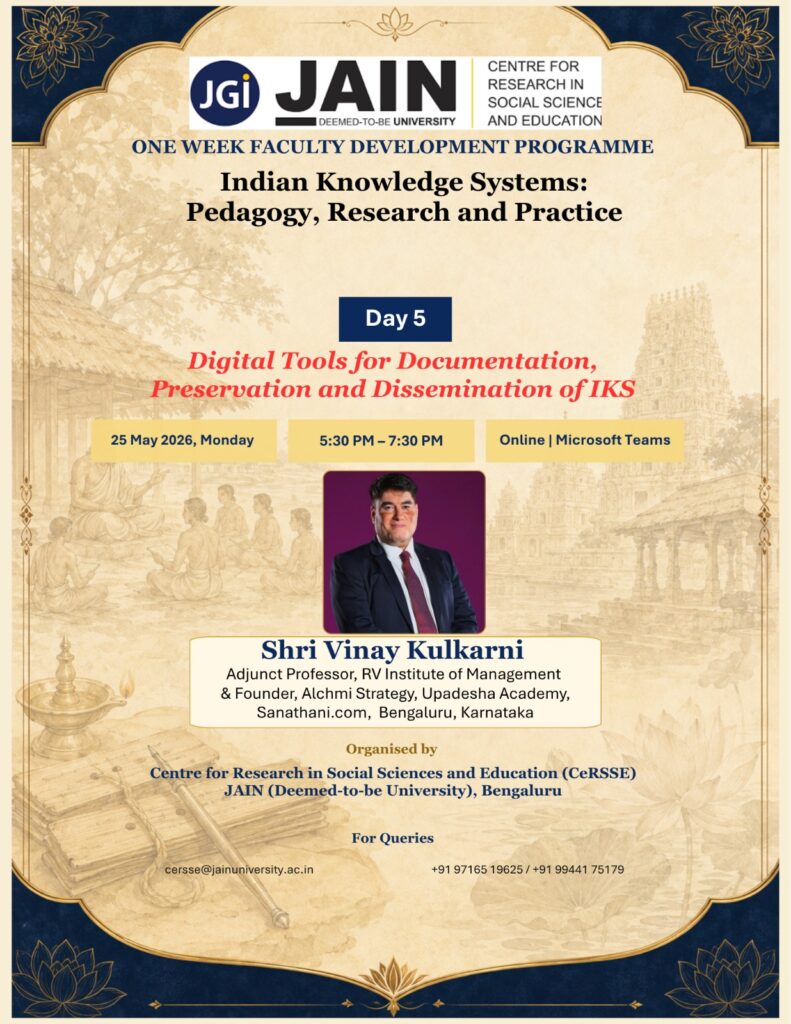
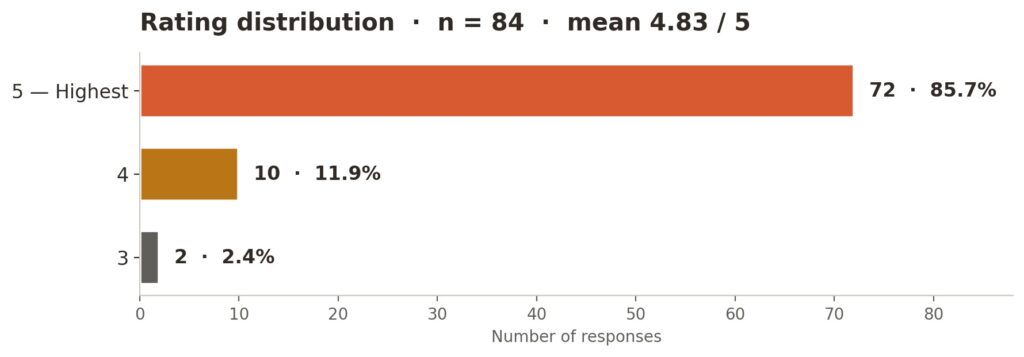
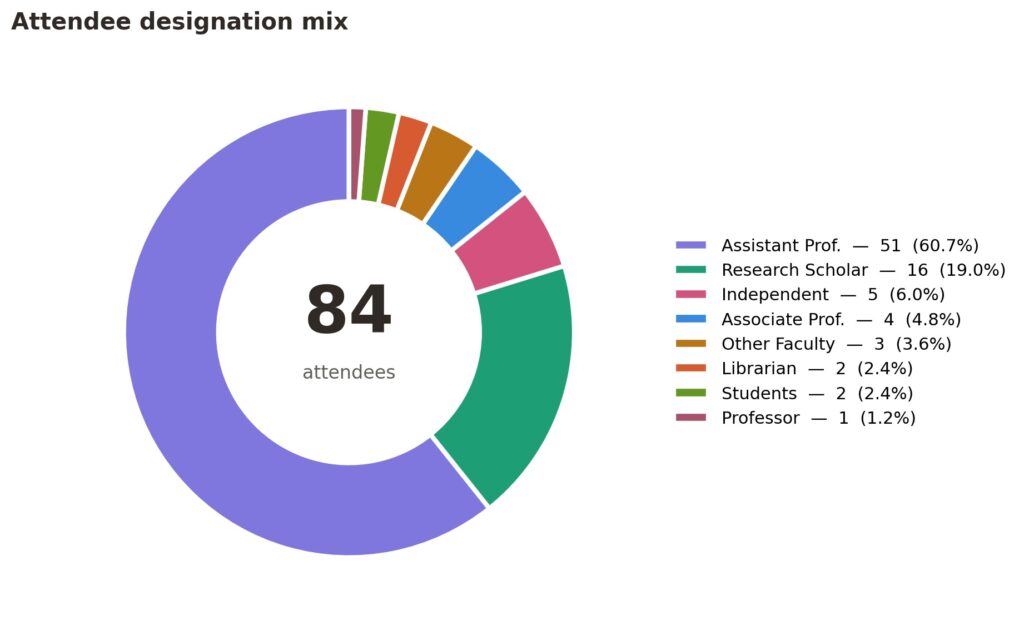
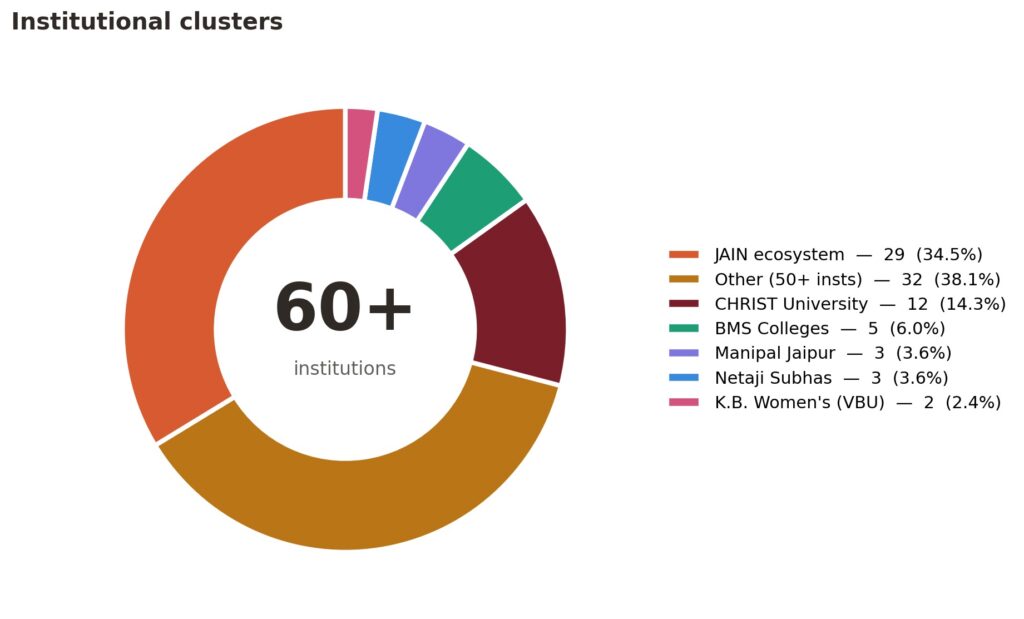
Student Feedback for this session
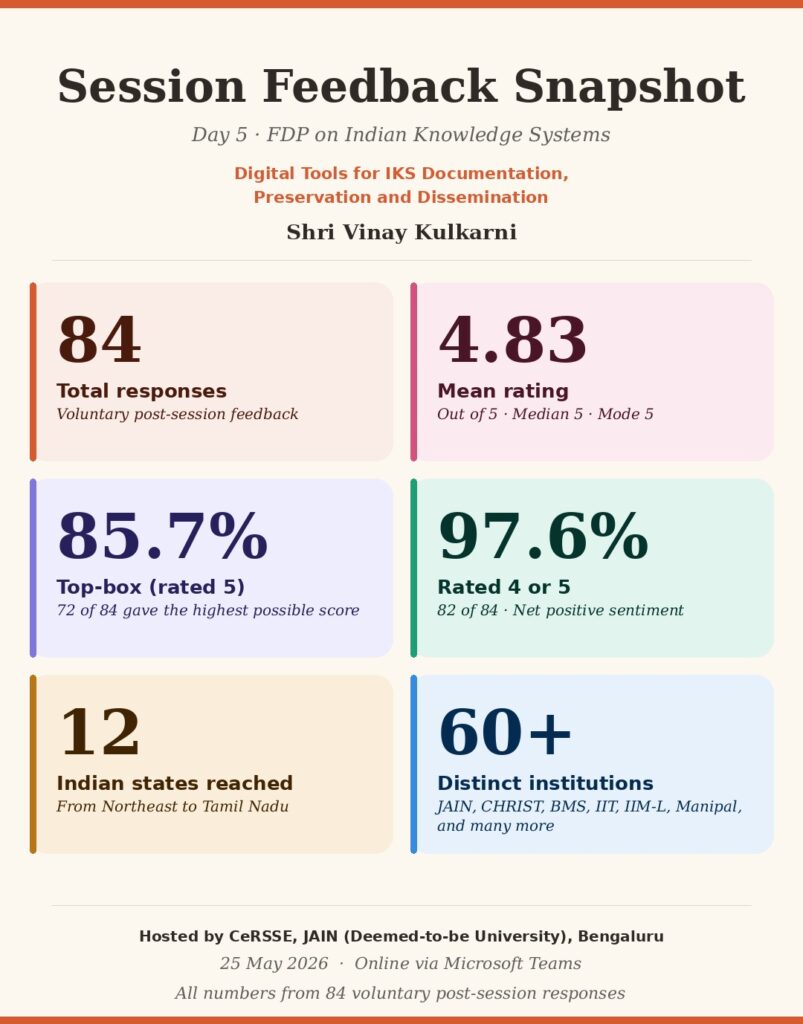
DETAILED REFLECTIONS
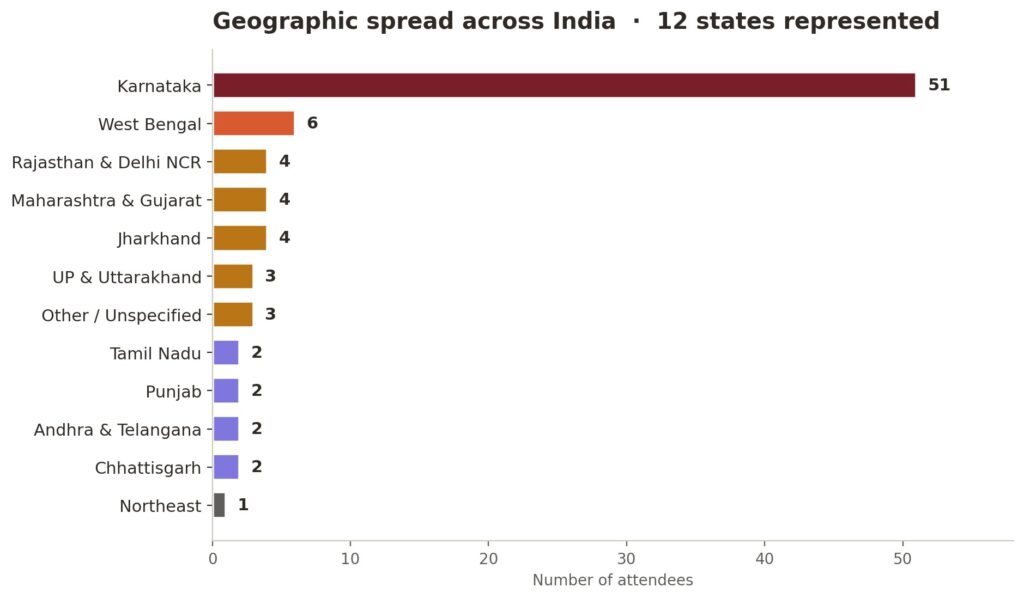
Pragya Research Scholar, Central University of Gujarat Rating: 5/5
“One of the best sessions till date. The dimensions it opened up. The mindset shift that happened today which made me take the road of going deeper into what sort of research are we doing. Today’s session made me question and also, to dig deeper into becoming someone who asks the right kind of questions. Thank you to the organizing team. Gratitude.”
Hardi Master Research Scholar, University of Mumbai Rating: 5/5
“The case studies provided by Kulkarni sir gave an in-depth understanding of the need to preserve. I request Avnish sir if possible to conduct such lecture by Kulkarni sir once again. His insights are truly knowledgeable.”
Karuna Kumari Ram Research Scholar, Sido Kanhu Murmu University Rating: 5/5
“Vinay Kulkarni Ji’s lecture was highly practical. He explained very simply why and how digital documentation should be done in the context of IKS.”
Shilpa Venkatesh Research Scholar, Jain University Rating: 4/5
“Nice explanation with good illustrations. Sir elaborated on how one can understand digitization in this modern era and how one can use that for research. Thank you.”
Mary Nely Pushpa Kujur Assistant Professor, K.B. Women’s College, VBU Hazaribagh Rating: 5/5
“Very informative, well structured and interactive session. Explained the topic very clearly.”
Mrs. Suchitra Dey Assistant Professor, Sandipani Academy, Bilaspur, Chhattisgarh Rating: 5/5
“Thank you so much sir for your informative and wonderful session.”
STRONG ENDORSEMENTS
Sapna Research Scholar, Panjab University Chandigarh Rating: 5/5
“This was the greatest session. It was very interactive and interesting.”
Kavita Rani P Passionate Educator, Jain University Rating: 5/5
“Very practical thoughtful and insightful session. It was great listening to you / Thank you so much!”
Vani U Homemaker, IIT-Roorkee Rating: 5/5
“Very practical and highly effective! Thank you so much for bringing him again!!”
Salam Manisana Devi Assistant Professor, JAIN School of Design Media and Creative Arts Rating: 5/5
“Amazing session which align with all discipline specialty design.”
Shivani Jandhyala Assistant Professor, CHRIST University Rating: 5/5
“Very interesting and saved many sites like muktibodha etc.”
Dr. M.S. Priyadarshini Associate Professor, CHRIST University Rating: 5/5
“Really very interesting inputs on dissemination.”
Dr. Antra Gupta Assistant Professor, Markham College of Commerce, Hazaribagh Rating: 5/5
“Interesting and insightful.”
ACTION REQUESTS (worth following up on)
Dr. Deepakkumar S Assistant Professor, Christ University Rating: 5/5
“Enriching session, I need to reach out to him, so it will be good if you can share their contact information.”
Sonali Khade Assistant Professor, Ghanshyamdas Saraf College of Arts & Commerce Rating: 5/5
“Please share PPT because it has excellent reference content.”
Dr. Muthulakshmi R Independent Researcher Rating: 5/5
“Conduct more sessions like this.”
Dr. Suresha R Assistant Professor, Central Sanskrit University Rating: 3/5
“Please share the online resources and PPT.”
BRIEF AFFIRMATIONS
Sohini Bhattacharyya Psychological Counselor & Music Therapist, Pradip Centre for Autism Management Rating: 5/5 “Excellent session”
HARIHARAN R Guest Lecturer, Government Law College, Tiruchirappalli, Tamil Nadu Rating: 5/5 “Excellent Session”
Dr. Sriparna Chatterjee Assistant Professor, Matiabuj College, Kolkata Rating: 5/5 “Excellent observation”
Prasanna Byahatti Assistant Professor, JAIN University Rating: 5/5 “Best session”
Srikrishna Bhaskar Rao Assistant Professor, Jain University, Global Campus Rating: 5/5 “Very interesting and informative session”
Latha M Librarian, JAIN (Deemed-to-be University) Rating: 5/5 “Very informative session”
Ms Karishma Vincent Assistant Professor, Women’s Christian College Rating: 5/5 “Very informative”
Srijita Barui PG Student, Netaji Subhas Open University Rating: 5/5 “Today’s session was very interesting.”
Dr. Sahana Florence P Assistant Professor, B.M.S. College of Law Rating: 5/5 “Session was very informative.”
SOWJAJYA S K Research Scholar, Jain Deemed to be University Rating: 5/5 “Very informative.”
Dhiyaneshwari R.P Assistant Professor, SAHS JAIN Rating: 4/5 “Very thoughtful session”
Dr. Nirmala Khess Assistant Professor, K.B. Women’s College Hazaribagh VBU Rating: 5/5 “Good session”
Srimanti Sarkar Assistant Professor, West Bengal State University Rating: 5/5 “Very good”
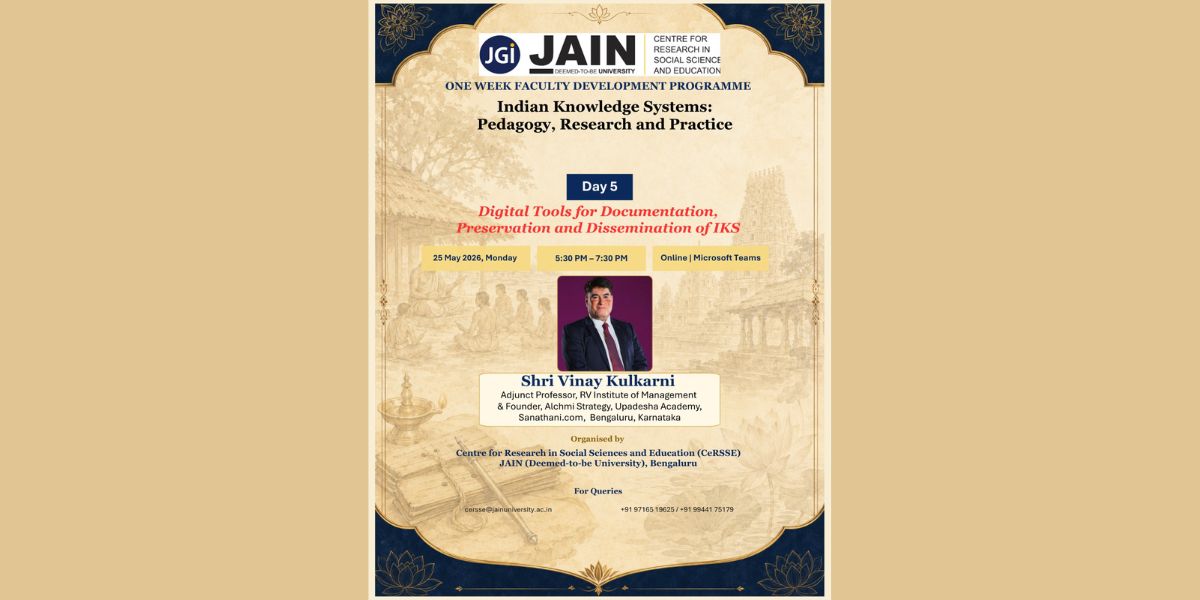
When I was aksed by JAIN University to teach a session for their Faculty Development Programme on Digital Tools for the Documentation, Preservation, and Dissemination of Indian Knowledge Systems, I assumed the talk would be a routine survey — a tour of portals, an inventory of apps, a look at the major government missions, and the usual closing exhortation to use them. Preparing for it turned out to be something else. Examined honestly, the topic is not a technical brief. It is a civilizational question wearing the costume of a digital one. And the technical answers, important as they are, are not where the real work lies.
When I asked the participants at the start what came to mind on hearing the topic, the responses arrived in a pattern I have heard before. Manuscripts must be preserved. Palm leaves are decaying. Apps and platforms must be built. Information must be made accessible. Pedagogy needs new tools. Each of these is true, and each of them, taken alone, is incomplete. Underneath every one of those statements sits an unspoken assumption about what Indian Knowledge Systems are and what preservation means — an assumption inherited largely intact from a colonial framing that still operates as our default. If we do not surface and examine that assumption, all the digitisation in the world will leave us standing exactly where we are.
This article is my attempt to set out, in the order they unfolded for me as I prepared the talk, the questions I think we have to ask before we ask which tool to use.
Part One — The Real Stakes
1. The Storm Has Passed. Now What?
In the seventy-nine years since the colonisers left, we have been doing something simpler than we admit. We have been sheltering. The storm came, swept through, and a great deal of what we were — texts, sculptures, manuscripts, traditions, lineages, institutional memory — was either physically carried away, written out of the official narrative, or quietly allowed to lapse for want of paramparā. We took shelter wherever we could find it. We learned to live inside the categories given to us. We told the story of who we were in the vocabulary of who told that story to us.
The storm, now, has mostly passed — though I am not sure it has entirely passed. We are stepping out, looking around, and asking the obvious question: ab kyā bachā hai? What is left? What can we rebuild from?
That is a different question from “what should we digitise?” — and it has to be asked first.
There is a line I find myself returning to often. Until the lion is able to tell its own story, the story of the hunt will always belong to the hunter. For seventy-nine years the story of India has been told, ingested, and lived almost entirely through narratives spun by a colonial hand — narratives the West continues to spin with subtler tools and broader reach. Every inscription we recover, every copper plate we read, every vīragallu (hero stone) we identify in a forgotten village edge, every manuscript we transcribe — these are not just artefacts. They are the materials with which Bhārata learns, slowly, to tell its own story on its own terms.
That is what the digital question is actually about. Not pixels and PDFs. Sovereignty.
2. The Sone kī Chiḍiyā Problem: Loss by Abundance
For a long stretch of our history we were sone kī chiḍiyā — the golden bird. The result of that abundance is now our problem.
Walk into a vast warehouse store with a million SKUs across forty departments and three floors. Stand in the middle of it. Now try to find one specific bolt of cloth on a particular shelf. You cannot. Things are not lost in the sense of being absent. They are lost in the sense of being buried under the accumulated weight of other things. That, more than any single act of plunder, is the deeper problem with the IKS inheritance. We did not lose because we had little. We lost because we had so much that the inventory finally got the better of us, and then a colonial fire passed through the warehouse.
The implication for documentation is direct. We are not preserving in the way the Greeks needed to preserve. They had a finite, well-mapped canon, much of it already lost, and what remained could be catalogued by a single generation of scholars. We have ten million manuscripts at the lowest estimate — and that is only the written record. Whole śākhās of the Vedas have already gone silent because the last bearer of an oral lineage passed without a successor. Whole village dance forms have disappeared in a generation. A family in Kerala that for centuries cast bronze mirrors using a method known nowhere else — one family, last man, his daughter learned just in time. That is the pattern.
So when someone says, in good faith, we should digitise the manuscripts, the answer is yes, and also: that is the easy part. The harder part is knowing what else counts as the inheritance, and getting to it before the last bearer takes it with him.
3. What Vidyā Means — and What Knowledge Is Not
There is a translation problem at the centre of all this that no portal will fix.
The English word knowledge and the Sanskrit word vidyā are not synonyms. Vidyā is what the Indic tradition has always set apart as the form of learning that leads to mukti— the inquiry that ends in freedom. Sā vidyā yā vimuktaye, say our texts. Everything else — śilpa-naipuṇam, useful skill, transmissible craft, applied knowledge of the material order — is something different. Useful, necessary, even venerable. But not what the ṛṣis meant when they spoke of jñāna.
We have so much written text — more, by any measure, than any other civilization — and yet the tradition is explicit: the Veda itself does not deliver the knowledge by being read. Knowledge, in the Indic frame, is anubhava. It is experienced, embodied, transmitted through a living guru who walks the śiṣya to an insight that no manuscript can hold. The Western frame, by contrast, treats knowledge as information — quantifiable, storable, transmissible by text. When we set up our digitisation projects on the Western frame and call them IKS preservation, we have already mis-specified the problem.
This is not an argument against digitisation. It is an argument for honesty about what digitisation can and cannot carry. The śāstras it can preserve. The paramparā that turns the śāstra into jñāna — that we have to preserve differently, and we cannot afford to confuse the two.
4. The Many Forms IKS Actually Inhabits
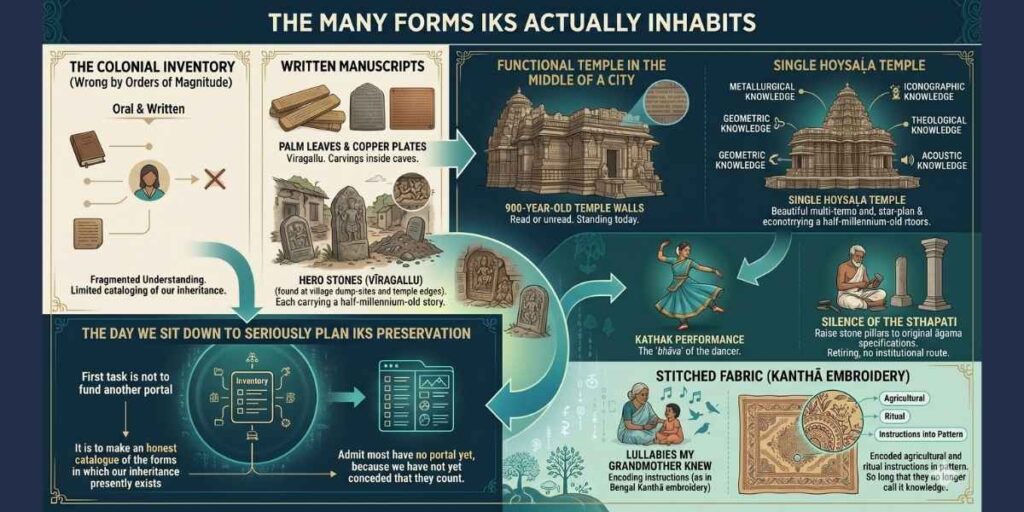
If you ask the average academic where Indian knowledge lives, you will get two answers: oral and written. This is the colonial inventory. It is wrong by orders of magnitude.
Indian knowledge lives — and has always lived — in at least these forms. In palm leaves and copper plates, yes. In inscriptions on the walls of nine-hundred-year-old functional temples standing today in the middle of growing cities. In carvings inside caves that no one has properly read for fifteen centuries. In vīragallu — hero stones — that researchers I know personally have found at village dump-sites and dilapidated temple edges across Karnataka and Tamil Nadu, each carrying a half-millennium-old story nobody asked to hear.
It lives in the architecture of a single Hoysaḷa temple, which holds enough metallurgical, geometric, iconographic, theological and acoustic knowledge to occupy a serious researcher for a lifetime. In the bhāva of a Kathak performance. In the silence of the sthapati who can still raise a stone pillar to the spec of the original āgamas — except that the last sthapatis are retiring and there is no institutional route to becoming one. In the lullaby my grandmother knew at ninety-five — perhaps two hundred of them — that died with her because we did not think to record. In the stitched fabric of a kanthā embroidery from Bengal, where the women have been encoding agricultural and ritual instructions into pattern for so long that they no longer call it knowledge.
The day we sit down to seriously plan IKS preservation, the first task is not to fund another portal. It is to make an honest catalogue of the forms in which our inheritance presently exists — and to be honest that most of them have no portal yet, because we have not yet conceded that they count.
Part Two — From Preservation to Inquiry
5. The Real Greenfield: AI, Integrated Databases, and the Quality of Our Questions
I want to come now to what I think is the actual opportunity in front of us — and one that, in my reading, almost no one is naming clearly.
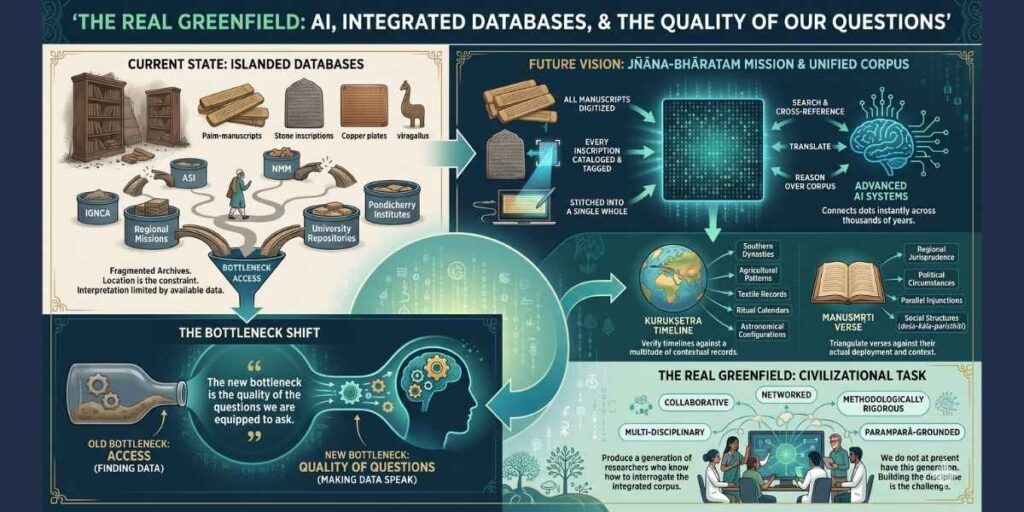
Set aside, for a moment, the question of which app to use. Imagine, instead, the state of affairs five or ten years from now, after the Jñāna-Bhāratam mission and its successors have done their work. Imagine that every manuscript known to us has been digitised. That every inscription, every copper plate, every vīragallu has been catalogued and tagged. That the islanded databases — currently scattered across IGNCA, ASI, NMM, the regional manuscript missions, the university repositories, the Pondicherry institutes — have been stitched into a single integrated whole. And that this integrated corpus has been connected to a generation of AI systems capable of searching, cross-referencing, translating and reasoning over it.
What does that change?
It changes the bottleneck. For a thousand years the bottleneck in Indic research has been access. A scholar in Karnataka who wanted to verify a claim against a Maithili manuscript in Bihar had to undertake a journey that could itself be the subject of a three-hour film. Most never went. Most research was done within whatever the scholar’s own institution had on its shelves, with whatever interpretive lineage that institution carried. Once the bottleneck of access is removed, a new bottleneck appears — and this is the one I want to flag.
The new bottleneck is the quality of the questions we are equipped to ask.
When the Kurukṣetra timeline can be cross-referenced in seconds against southern dynastic chronologies, against agricultural patterns, against textile records, against ritual calendars and astronomical configurations — the limit on what we can know about ourselves shifts from “what data exists” to “who can frame the inquiry well enough to make the data speak.” When a contested Manusmṛti verse can be triangulated against its actual deployment in regional jurisprudence, against the political circumstances of the period, against parallel injunctions in the Dharmasūtras, and against the social structures of the specific deśa-kāla-paristhiti in which it was applied — the question is no longer whether one can find the verse, but whether one can ask the question that lets the verse and its silence both speak.
This is the real greenfield. The integrated database is the easy part. The civilizational task is to produce a generation of researchers — collaborating, networked, multi-disciplinary, methodologically rigorous, paramparā-grounded — who know how to interrogate it.
We do not, at present, have that generation. We barely have a discipline for producing it.
6. The Missing Discipline
We are about to hand a vast, integrated database and a battery of AI tools to a research community that was trained, almost without exception, in nineteenth-century European silos — history over here, chemistry over there, Sanskrit literature down the corridor, archaeology somewhere in the basement, engineering in a separate building entirely. The categories themselves were drawn for the convenience of a different civilization. We then inherited the categories, built our universities around them, and now wonder why our researchers cannot see the obvious connections.
The Mādhava school of mathematics flourished in fourteenth-century Kerala. It produced infinite series for trigonometric functions that European mathematics did not reach for another three hundred years. The standard question asked about it is: how did this happen? The far more interesting question — never asked, because the silo prevents the question — is: what was simultaneously happening in temple construction, in astronomical observation, in ritual calendar reform, in maritime navigation, in trade with the Arab and Chinese networks, in the patronage politics of the Zamorin, that made Mādhava’s school not an isolated genius but the visible peak of a much larger civilizational pattern? The data exists to answer that question. The discipline to ask it does not.
If there is a Vice-Chancellor or Dean reading this, I would put the proposition to them plainly. We need a new kind of programme — call it Integrative IKS Research, or whatever name will survive committee — whose explicit task is to train researchers in multi-dimensional inquiry. Researchers who can walk into a thousand-year-old temple and read it simultaneously as historian, metallurgist, iconographer, acoustician, psychologist, sociologist, structural engineer, and śraddhā-vidyā student of the paramparā that built it. Researchers who can hold all of those readings together and ask the question that no single discipline could have framed.
That programme does not exist. The market for its graduates already does.
7. The Temple as Living Laboratory
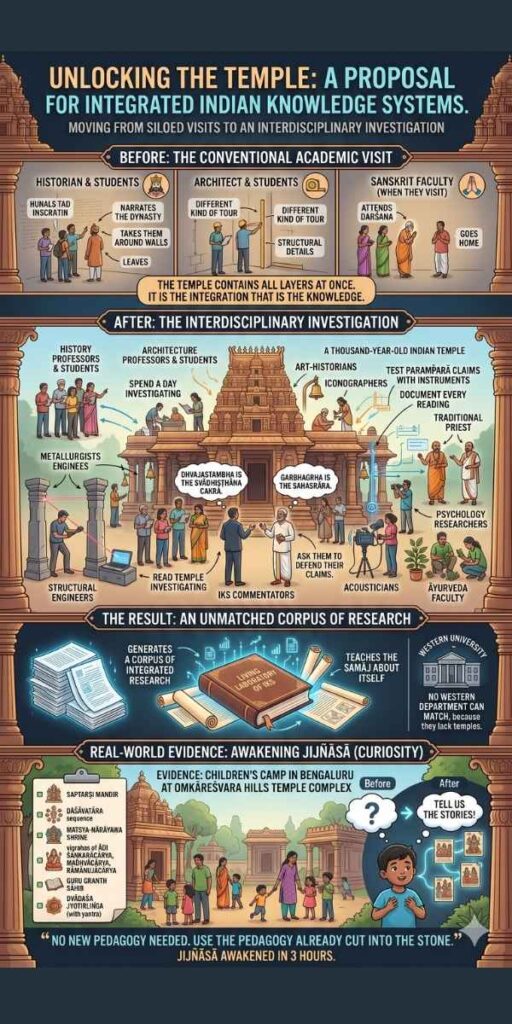
Take any thousand-year-old temple within a hundred kilometres of where you live. Most academic visits to it look the same. The historian shows up with the history students, takes them around the walls, points at the inscriptions, narrates the dynasty, leaves. The architecture department, separately, brings its own students for a different kind of tour. The Sanskrit faculty, when it visits at all, attends the darśana and goes home. The temple, meanwhile, contains all of those layers at once. It is the integration that is the knowledge.
I want to propose something every Indian university could try within a year.
Take one such temple. Send to it, on the same day, an interdisciplinary group — history professors and students, architecture professors and students, Sanskrit faculty, art-historians, iconographers, metallurgists, structural engineers, acousticians, psychology researchers, Āyurveda faculty. Add the temple’s traditional priest. Add a śilpa-śāstra paṇḍit if you can find one. Add a few well-known IKS commentators — the kind who confidently claim from a podium that the dhvajastambha is the svādhiṣṭhāna cakra, the garbhagṛha is the sahasrāra — and ask them to defend their claims in front of all the others. Now spend a day there. Not as a tour. As an investigation. Have each discipline read the same temple in its own register. Have the priest and the paṇḍit explain what the paramparā says. Let modern scholars test the paramparā claims with their instruments. Document every reading. Cross-reference them.
What you have produced in one day is not a temple visit. It is a living laboratory of the Indian knowledge system. Repeated across the country, across temples, across years, it would generate a corpus of integrated research that no Western department can match — because no Western department has temples like ours to read.
Add children to the same exercise. Not as decoration. As participants. Add their parents. Now the temple is also doing what it was always meant to do, which is to teach the samāj about itself.
This summer I ran a children’s camp in Bengaluru and took the children to the Omkāreśvara Hills temple complex. The site has a Saptarṣi Mandir, a Daśāvatāra sequence on the outer wall, a Matsya-Nārāyaṇa shrine, vigrahas of Ādi Śaṅkarācārya, Madhvācārya, Rāmānujācārya, the Guru Granth Sāhib, and a Dvādaśa Jyotirliṅga installation in which each jyotirliṅga is consecrated with its yantra. None of these children — bright, curious, urban — had heard the words Saptarṣi, Tryācārya, or Jyotirliṅga before that morning. By the time we returned, they were demanding I tell them the stories of each. The jijñāsā had been awakened in three hours, on site, by a temple that had been sitting fifteen kilometres from their school all along. We did not need new pedagogy. We needed to use the pedagogy that was already cut into the stone.
8. The Disappearing Vaidya
While we plan preservation, a quieter loss is happening in parallel — and Āyurveda offers the clearest current example of it.
I recently spoke at length with a number of Āyurveda students currently in BAMS and post-graduate programmes across India. Three things came up in nearly every conversation. Tantrayukti has been quietly dropped from much of the curriculum. The aṣṭāṅga framework is being taught as a list to be memorised rather than as a clinical method to be lived. And the pharmaceuticalisation of Āyurveda — patentable molecules extracted from the dravyaguṇa corpus and sold as branded products — is steadily replacing the practice of a traditional vaidya who knew which deśa-kāla-prakṛti configuration called for which anupāna in which patient on which day.
There is, in parallel, a documentary I would recommend to anyone teaching IKS — a day-in-the-life of a traditional vaidya in Kerala who began learning Āyurveda on his father’s lap at the age of four. By twenty he could recognise hundreds of herbs in the forest, knew their rasa and vīrya at different seasons, knew when each had to be plucked and how. That vaidya exists. So do his colleagues. We have not, as a country, asked the obvious question: how many of them are still practising, where, and how do we make sure their accumulated clinical knowledge is captured in a form that does not collapse into a pharmaceutical patent application?
This is what I mean when I say documentation is the easy part. We can scan the Suśruta Saṃhitā in a week. We are about to lose the people who know what it means.
Part Three — Documentation, Dissemination, and Dhārmic Pedagogy
9. Stitching the Civilizational Story
When the digitised corpus eventually comes online and the questions begin to be asked at scale, one of the first things that will become visible is something we have stopped seeing in the colonial frame: Bhārata was never stitched together by political union. It was stitched together by a shared knowledge system, a shared philosophical vocabulary, and a shared aesthetic.
Sanjeev Sanyal has pointed out, and the Karṇāṭa and Sena dynastic histories confirm, that kings from what is now Karnataka travelled to Bihar and ruled the Maithili-speaking regions for more than two hundred years — without imposing their own language. Instead they patronised and developed the local language. The Sena dynasty, plausibly from the Mysore region, ruled Bengal for over a century, took the Mahiṣāsuramardinī form of Durgā with them, and laid the foundations of what we now call Bengali high culture. R. C. Majumdar wrote about this. It is not obscure. It is simply not in the syllabus.
What does this mean for the average modern Indian student? It means the colonial narrative — of India was always fragmented, Britain unified it — is empirically wrong, and we can now demonstrate it from primary sources. It means the Hindi-versus-Tamil fight, the North-versus-South fight, the endless three-language-formula politics — all of it rests on a fragmented reading of a civilization that was, at the level that actually mattered, deeply integrated for a very long time.
Once the database is queryable, this kind of story will be recoverable not in fragments but in pattern. The story of who we were will, finally, be tellable in our own voice.
10. Storytelling as Strategic Capability
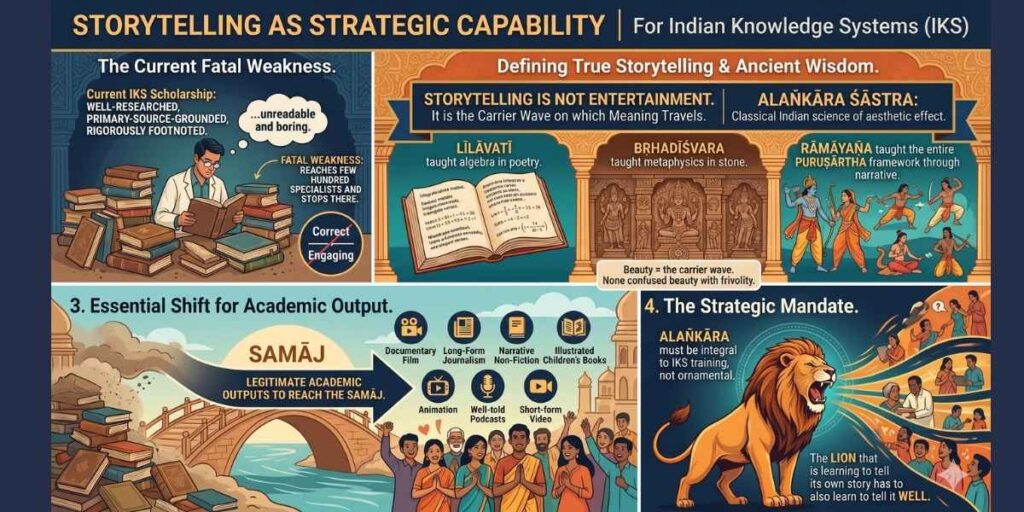
I had a conversation recently with an established IKS author who told me, with weary honesty, that most of the new IKS scholarship being produced — well-researched, primary-source-grounded, rigorously footnoted — is, to put it plainly, unreadable. The books are correct. They are also boring. They will reach a few hundred specialists and stop there.
This is, in my reading, a fatal weakness of the current revival, and one we have to take seriously.
Storytelling is not entertainment. The minute you think of it as entertainment, you have already abandoned the field to whoever does the storytelling instead. The minute you think of entertainment as frivolous, you have lost the battle for the public mind. The Alaṅkāra Śāstra — the classical Indian science of aesthetic effect — was developed by people who understood, with a precision the modern academy has lost, that the way a thing is said determines whether it lands. The Līlāvatī taught algebra in poetry. The Bṛhadīśvara taught metaphysics in stone. The Rāmāyaṇa taught the entire puruṣārtha framework through narrative. None of these confused beauty with frivolity. They knew that beauty is the carrier wave on which meaning travels.
If we want IKS scholarship to actually reach the samāj — which, I would argue, is the only reason to do it — then documentary filmmaking, long-form journalism, narrative non-fiction, illustrated children’s books, animation, well-told podcasts, and yes, even short-form video, must be accepted as legitimate forms of academic output. Alaṅkāra must be part of the IKS researcher’s training, not a separate ornamental subject. The lion that is now learning to tell its own story has to also learn to tell it well.
11. The Gurukula–University Bridge
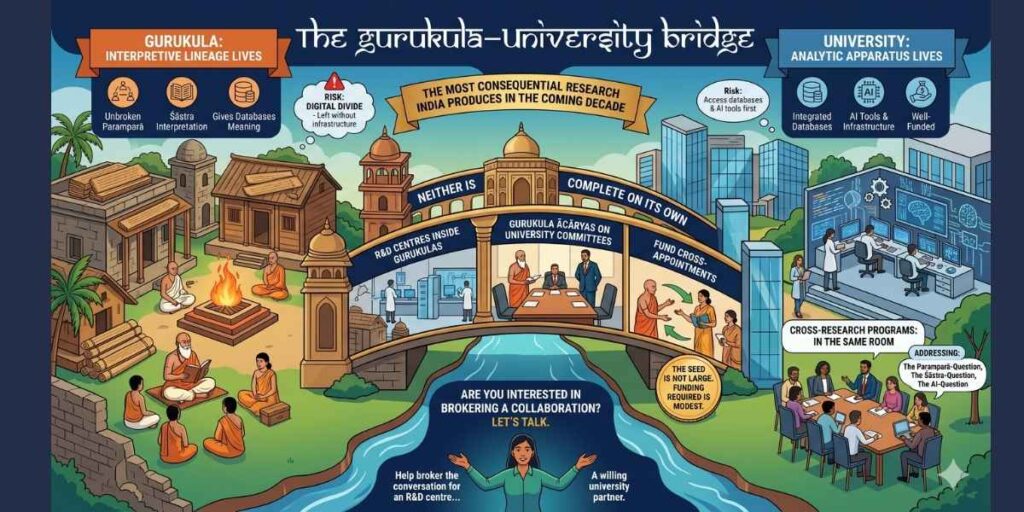
The risk of the coming digital integration is a digital divide — the well-funded universities will get access to the integrated databases and AI tools first, while the gurukulas, which actually hold the unbroken paramparā that gives those databases their meaning, will be left without the infrastructure to use them.
This is precisely backwards. The gurukula is where the interpretive lineage lives. The university is where the analytic apparatus lives. Neither is complete on its own. The serious civilizational move is to bridge them — to set up R&D centres inside gurukulas, to bring gurukula ācāryas onto university committees with full standing, to fund cross-appointments, to design research programmes in which the paramparā-question and the śāstra-question and the AI-question are addressed in the same room.
If any gurukula reading this is interested in setting up an R&D centre in collaboration with a willing university partner, I am happy to help broker the conversation. The seed of this is not large. The funding required is modest by university standards. The output, done well, would be among the most consequential research India produces in the coming decade.
12. A Cultural Map for Every City
Most Indian cities have, within their municipal boundaries, an embarrassment of IKS riches that almost no resident has properly visited.
In Bengaluru, where I live, there is the Bangalore Museum — whose holdings of broken sculptures, temple columns, inscriptions and ritual objects would take a serious student years to digest. There is the building, completed in recent years by one of the original publishers of Amar Chitra Katha, in which every floor is carved end-to-end by sculptors brought in from across the country — one floor Vaikuṇṭha, one floor Kailāsa, every story from the relevant Purāṇa sculpted in stone. Hardly anyone in the city knows it exists. There is the Omkāreśvara complex I mentioned. There is the nine-hundred-year-old functional temple half a kilometre from my office. Multiply this by every major Indian city. The inventory is staggering.
A cultural map of every city — well-curated, professionally produced, integrated into school curricula, available on a phone — would be one of the highest-leverage dissemination projects we could undertake. It would also force a quiet shift in pedagogy. Pratyakṣa — direct perception — was always considered the most reliable pramāṇa in our system, and anubhava the deepest mode of knowing. The current education system, which keeps a child in an air-conditioned classroom looking at a photograph of a temple that is, in fact, fifteen minutes away by metro, has the relationship between knowledge and experience exactly inverted. The temple is the textbook. The textbook should be the supplement.
13. From Documentation to Darśana
I want to close by returning to the question I asked at the start of the JAIN University session: what is this all for?
If we treat the IKS digitisation project as a technical exercise — manuscripts in, PDFs out, portals built, missions concluded, reports filed — we will produce, in twenty years, a magnificently catalogued archive of a civilization that no longer knows how to read itself. The catalogue will then be read, as so much else has been, by scholars trained elsewhere, with frameworks built elsewhere, for purposes set elsewhere. We will have preserved the body and lost the breath.
If, instead, we treat the project for what it actually is — a once-in-a-century opportunity to re-acquire primary custody of our own civilizational inheritance, to train a generation of researchers capable of interrogating it, to bridge the paramparā and the university, to rebuild the jñāna–śilpa connection that was severed under colonial education, and to tell the story of Bhārata in Bhārata’s own voice — then the digital tools become what they were always meant to be. Sādhana-instruments. Means.
The verbs of this work are six. Find. Reach. Capture. Process. Preserve. Share. They are all necessary. None of them, by themselves, is the point. The point is the seventh verb, the one we keep forgetting to name: understand. And the darśana — the seeing — that arises from understanding.
The IKS project is not a department. It is not a portfolio. It is the next phase of how a civilization that briefly forgot itself is now, slowly, with imperfect tools and the right intent, learning to remember.
If any reader is working in this space — in archives, in gurukulas, in universities, in policy, in technology, in documentary production, in paramparā lineages — I would be glad to hear from you. The work is too large for any one of us. It is exactly the right size for all of us, working as a network.
Vinay Kulkarni
Founder & CEO, ALCHMI Strategy Consulting
Adjunct Professor, RV Institute of Management and IKS Faculty