Vedanta in Education — Or Is Vedanta Itself Education?
By Vinay Kulkarni
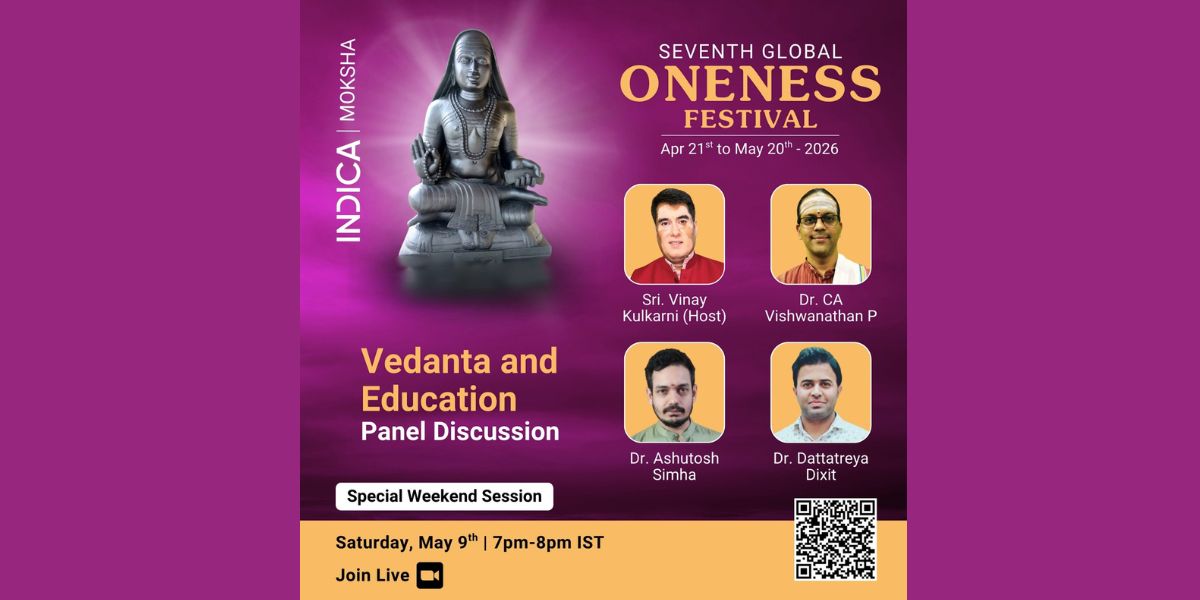
I recently had the privilege of moderating a panel discussion on Vedanta in Education, convened during a festival of Indian thought hosted with Indica. Education is close to my heart. Most of my work and writing circles back to one stubborn question — what does it actually mean to educate a human being, and what can education mean for a civilisation that is trying to remember itself? So when I sat down with three remarkable minds for this conversation, I did not want a seminar. I wanted a churning.
And before the first question, I confessed the mischief in my own framing. We had titled the session Vedanta in Education. But I kept turning it over. Is it Vedanta in education? Or is Vedanta itself education? Hold that question. The whole hour was, in a sense, an answer to it.
Three scholars sat with me, each living proof that the supposed wall between the modern and the perennial is a wall we built, not one we found. Dr. CA Vishwanath P — Chartered Accountant, Company Secretary, an Ācārya in Alaṅkāra Śāstra from the National Sanskrit University at Tirupati, and the force behind the Vyoma Linguistic Labs Foundation. Dr. Ashutosh Simha — a doctorate in geometric control theory from the Indian Institute of Science, postdoctoral years in Estonia and at TU Delft on nonlinear systems and robotics, today a professor of computer science and a senior member of Vedanta Bhāratī. And Dr.Dattatreya Dixit — a traditional Sanskrit scholar, translator and practitioner-educator, gurukula-trained from boyhood, who has run over three hundred and fifty Sanskrit orientation programmes for scholars across the world. To all of them, my namaste, and my gratitude.
Why Does the Human Being Alone Need Education?
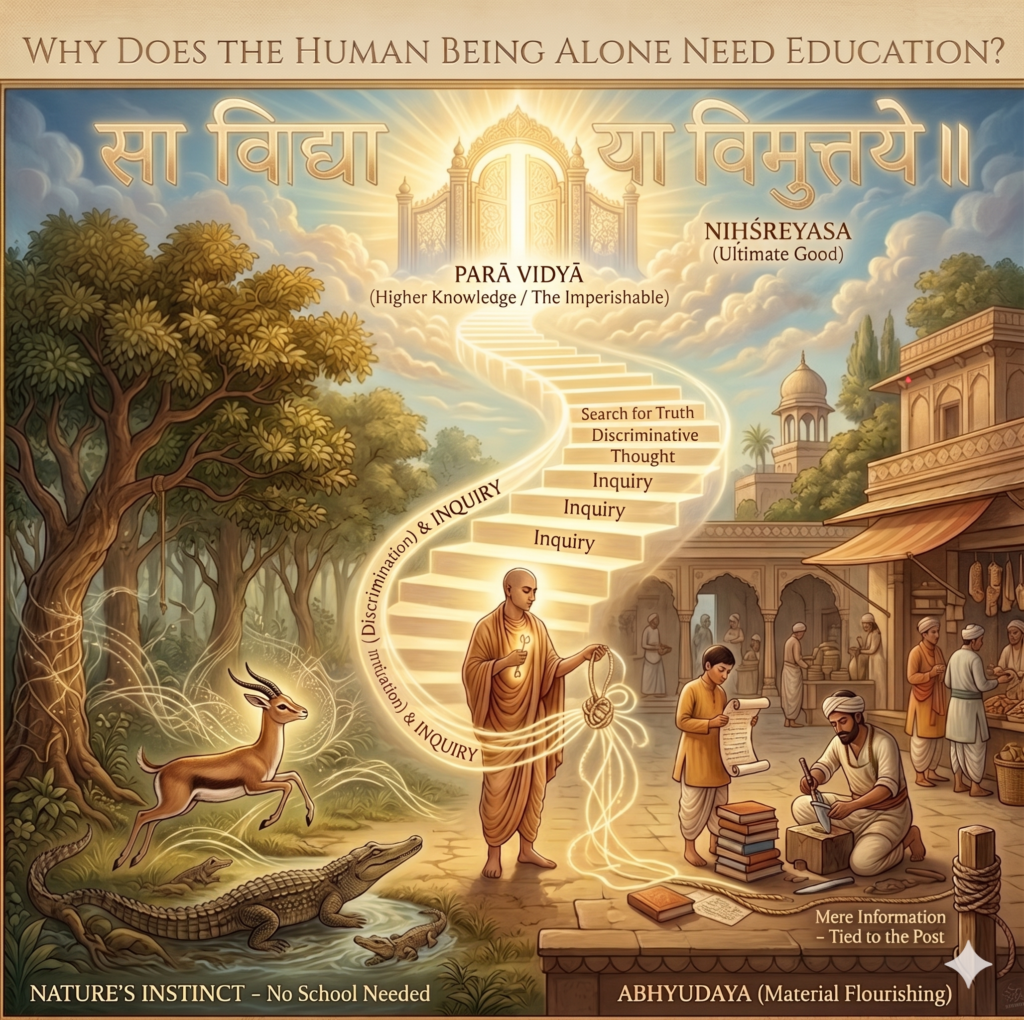
Walk through any forest. There is no tiger school. No crocodile school. No academy for eagles. The gazelle knows how to outrun a cheetah within hours of its birth. When the crocodile eggs hatch, the hatchlings know to head for water. Nature equips every creature with precisely what it needs to live the life it was born to live.
So why the human being? Why are we, alone among the species, sent to be taught? Are we not equipped to simply live as nature designed us? I have sat with this question for years, and I do not think it is a small one. It is the question. Because the answer decides what we think a school is for.
Our tradition does not begin with curriculum. It begins with vidyā. And we have a precise sense of the word — sā vidyā yā vimuktaye. That is vidyā which liberates. Not that which informs. Not that which decorates a résumé. That which sets free. Vishwanath ji put it sharply: education is the faculty that lets a human being discriminate — viveka — and discrimination, followed honestly, becomes inquiry, and inquiry walks toward truth. So the only real question a student can ask of any subject is this: does what I am studying take me toward that truth, or does it tie me more tightly to the post?
We also distinguish vidyā from śilpa — the liberating from the useful, the inner from the worldly skill. But here is where India refused the Western habit. We did not make it a binary. We did not ask you to choose the soul or the salary. We held abhyudaya — material flourishing — and niḥśreyasa — the ultimate good — with the same two hands. The panel kept returning to the old distinction of parā and aparā vidyā: even the Vedas and their limbs are counted as the lower knowledge; only that by which the imperishable is known is the higher. Both matter. The sequence between them is everything.
The Cow With Four Legs
I shared a parable I once read from a great saint, and it has never left me. Think of the four puruṣārthas — dharma, artha, kāma, mokṣa — as a cow. Try to seize the milk directly, lunge for artha and kāma on their own, and the cow kicks you. But hold the dharma leg and the mokṣa leg, steady her with those, and she gives you nectar.
This is why the order cannot be rearranged. Dharma, artha, kāma, mokṣa — in that sequence, not for decoration but as load-bearing structure. Our whole life was once designed around it: brahmacarya, gārhasthya, vānaprastha, sannyāsa, the same logic written across a lifetime.
And here is the wound. After the colonial encounter we inherited an education built on only two of the four legs — an artha–kāma model. Acquisition and consumption. Dharma gone. Mokṣa gone. We sit our children on a two-legged stool and then wonder why they wobble. We have an assembly line that produces clerical output, and we call it school.
Vedanta Means Ānanda
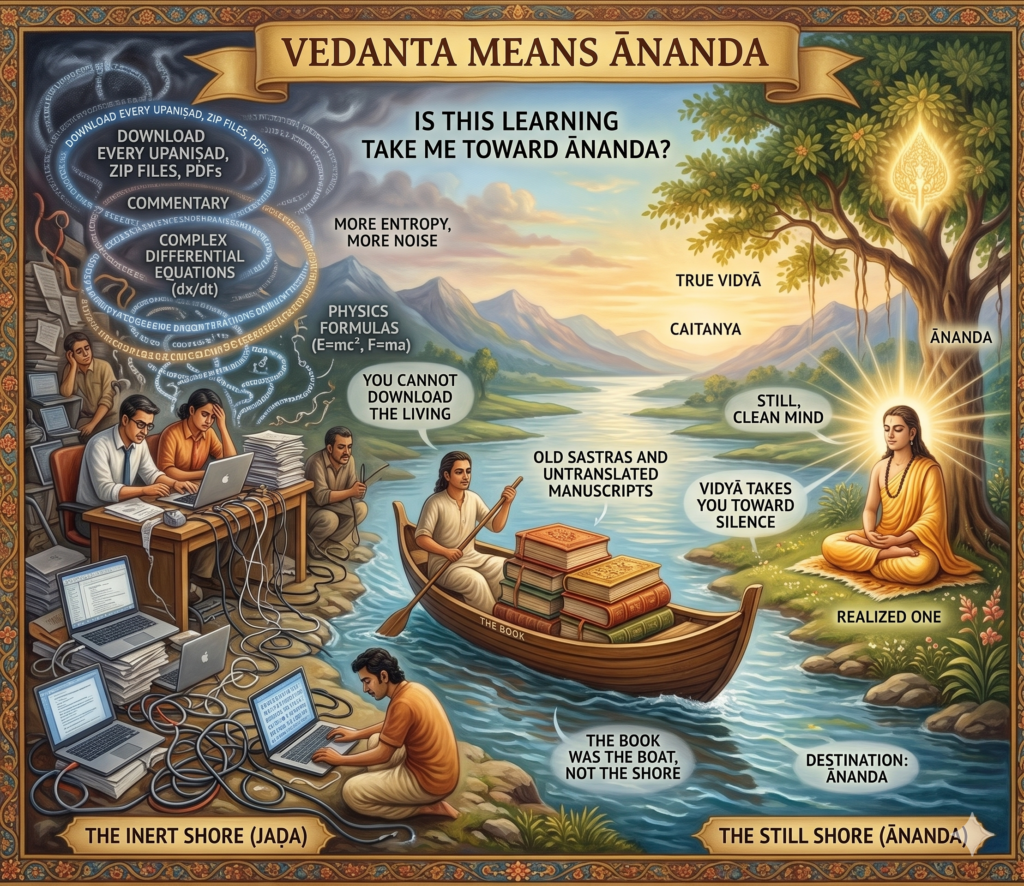
Then Ashutosh ji said something that reorganised the room. Anta does not mean the end of a book. It means where the Vedas converge. And where do they all run and come to rest? In ānanda. Vedanta is ānanda. So in any classroom, learning anything — differential equations, physics, the Veda itself — the first question should be the one almost no one asks while sitting in that classroom: is this going to give me ānanda in some way, or not? That question is missing from our science classes. It is missing, he admitted, from many Vedanta classes too.
Which is why I pushed him. The internet is full of PDFs. Download every Upaniṣad, every commentary Dixit ji could name, onto my laptop tonight — am I now a vedāntin? He smiled and gave the cleanest answer I have heard. Information is jaḍa — inert. Ānanda is the furthest thing from jaḍa; it is the very crest of caitanya, consciousness. You cannot download your way into the living.
And the distinction he drew between knowledge and vidyā I will carry for a long time. Vidyā takes you toward silence. Information takes you toward more entropy, more noise. The old description of the realised one is not the man who has read the most. It is the one who knows the śāstras and yet whose mind is perpetually still, perpetually clean. We venerate the well-read. We have entire libraries of untranslated manuscripts and yet, somehow, we hand the book less authority than the West does. Perhaps because we always knew the book was the boat, not the shore.
No Quarrel Between Science and Vedanta
Is it a contradiction, I asked, to be steeped in geometric control theory and in Vedanta Bhāratī at the same time? Ashutosh ji does not experience one. Science and engineering, his profession, study what is outside — the object. Vedanta turns the attention around, to the subject, to the one who is aware of the object at all. And modern physics, edging toward the place where mind and matter refuse to stay separate, is asking the very question our ṛṣis asked with confidence several thousand years ago: is the observer truly distinct from the observed, or is what we call external reality non-different from the one who perceives it?
He described an experiment in living pedagogy. Under their guru’s guidance, Vedanta Bhāratī took the Dakṣiṇāmūrti Stotram — a text that names no god, prescribes no ritual, and does nothing but analyse our ordinary daily experience to drive home the highest truth — and asked students to replace its classical dṛṣṭāntas with examples from cutting-edge technology. Artificial intelligence. VLSI. Brain-computer interfacing. Held on the palace grounds in Bengaluru, it drew more than five hundred participants, with hackathon booths where Gen Z students — the very ones who would sprint a mile from anything that smelled religious — stood guarding “their” tattva with fierce pride. We remember that Swami Vivekananda carried Vedanta to the West and held his own in conversation with its finest scientific minds. For the Indian mind, there was never a contradiction here. There was only a forgetting.
How Indians Thought About Knowledge
If we want Vedanta in education, we have to talk about epistemology — how Indians actually thought about knowing. Vishwanath ji told a story from a course taught to some of the brightest young minds in the country. The students were made investigators in a corporate scenario: should an established multinational acquire a particular startup? They were handed the ṣaṭ-pramāṇas, the six instruments of valid knowledge.
At the level of pratyakṣa — direct perception — the presentations were brilliant. At upamāna — comparison — the benchmarks against peer companies were excellent. The śabda was all there; the social-media footprint of the target company was impressive. Everything checked out. And then the students went and looked. No servers. No electricity bills. No customer complaints, because there were no customers. A company that existed only on paper. It was anupalabdhi — the pramāṇa of non-apprehension, the knowledge that comes from a meaningful absence — that finally returned the verdict: do not acquire. The rarely-used instrument saved them. That is when these sharp young people wanted to know more. That is how buddhi-jijñāsā works — you do not drag the mind toward this knowledge, you let it discover that the knowledge was already reaching for it.
But brahmavidyā, the panel was clear, is finally experiential. There is the old account of the disciple who comes to the teacher and asks, teach me brahmavidyā. A year of silence. He asks again, and again. The teacher says: the moment I open my mouth and use a śabda, it is no longer Brahman. I can keep telling you that jaggery is sweet. The sweetness will not arrive until you taste it. The text is a ladder — viveka, then vairāgya, then the six-fold wealth, then mumukṣutva, step after step. But the ladder is not the terrace. After the text comes nididhyāsana, and that part no one can do for you.
Sanskrit: The Container and the Content
If Vedanta is the medicine, is Sanskrit the carrier? In Āyurveda, ghṛta is not the cure; it is the anupāna that carries the cure to where it must act. I offered that metaphor and the panel ran with it. Sanskrit, as the great scholars describe it, is the rare thing that is both the container and the content — a bhāṣā and, at once, the jñāna-rāśi held within it.
And the container is not neutral. Chanting Sanskrit ślokas produces the effect of prāṇāyāma — the breath disciplines itself, a bhrāmarī-like resonance sets in. The combination and number of syllables appears to activate more neurons and, crucially, to slow the pruning of synapses — the very thing modern childhood is losing. Memory. Focus. The capacity to hold attention for longer than a swipe. I spent five days at a summer camp this year, watching children closely, and almost every measure you can name — reading comprehension, persistence of hearing, the ability to follow what is spoken, the ability to hold a human conversation — looked bleak. The eight-second mind is not a metaphor anymore. Sanskrit and Vedanta together may be one of the few anupānas we have left for that wound.
The Teacher Is the Whole Curriculum
Here is the part we keep skipping. This is not about content. It is about pedagogy. And people teach the way they were taught. We have an entire army of teachers trained the Western way, and we are about to ask them to teach the Indian way. We should think very honestly about how that is supposed to work.
When a surgeon does a cataract operation, the old clouded lens has to come out before the new one goes in. Put the new lens over the old and you have not restored sight, you have doubled the distortion. The same is true of the mind. We have to decolonise — remove the old lens — before we fit the IKS lens. Otherwise we are layering Indian vocabulary over colonial sight and calling it revival. A śāstri curriculum does not automatically produce śāstra-dṛṣṭi. Going through the syllabus is not the same as acquiring the eye. We are not trying to teach about the five kośas; we are trying to educate through all five, when modern education mostly stops at the annamaya kośa and never goes deeper.
The Bridge Between Teacher and Student
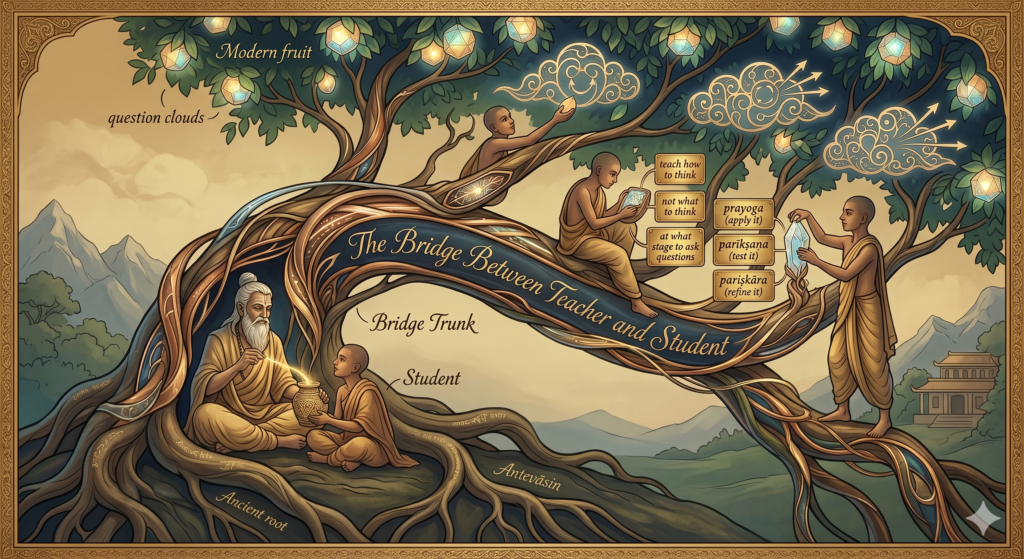
Dixit ji, gurukula-raised, kept returning to a phrase his ācārya gave him: prayoga, parīkṣaṇa, pariṣkāra. Apply it, test it, refine it. And he was firm that the bond is everything. The Upaniṣad is not a distance-education programme. The word itself carries the sense of sitting near — the antevāsin, the one who lives close to the teacher. Make the knowledge practical and the bridge to the student forms almost on its own.
And there is a discipline to that bridge that the modern mind resents. We are told the modern student learns by asking many questions, constantly, immediately. Good — but tell me, I asked them, the food on your plate: do you digest it on the plate, or after it has reached your stomach? You digest it after you have taken it in. So too with a teaching. When you are meant to be doing śravaṇa, and you leap straight into manana and interrogation, the bridge through which transmission happens never gets built — or it breaks before it is finished. The question is not forbidden. It is a matter of when. Knowing which questions are worth your time, and at what stage to ask them, is itself a large part of the pedagogy. The aim, as Dixit ji put it, is to teach how to think — not what to think. Ancient root, modern fruit.
Consequential, Not Contradictory
A child asks: you say God is everywhere, so why send me to the temple? Vishwanath ji’s answer was elegant. It is not a contradiction. It is a consequence. The day you can see the divine everywhere, in everything, you will not need the temple — every place will already be one. Until that day, you go to the temple, because the going is the practice that builds the eye. The same arc runs through vidyā. The student begins with the karma portion — there is something to attain, a duty to perform. Then he reaches the mahāvākyas and is told he is already That. “First you tell me to attain, now you tell me I already am — how?” The confusion is not a flaw in the teaching. It dissolves, step by step, through sādhana. Never contradictory. Always consequential.
Svadharma and the Arjuna Caveat
Modern education treats every child as the same child. An assembly line cannot do otherwise. And this is the source of so much quiet suffering — the student is never pointed toward his own svadharma, toward what he came here to do and what nature has actually endowed in him. Manu, Ashutosh ji reminded us, says the dharma śāstra is taught so that beings may attain sukha. Even dharma is for sukha. One way to reach it is a ten-year course in rules and injunctions. The other way is for a person to see clearly where the source of sukha truly is — and where it is not. Once that is seen, most of the rest follows on its own. Less krodha. Less lobha. Respect for others, not as instruction but as natural conduct. This is Vedanta’s irreplaceable role in education: it tells you where to look.
But Vishwanath ji raised a caveat we must not lose. Many young people are becoming Arjunas — in genuine fear of the vyāvahārika world, they announce they are headed for the pāramārthika, while still seated firmly in the transactional world and still expecting its benefits. These Arjunas have to be sent back to the field. Renunciation handed out before paripakvatā — ripeness — is not Vedanta; it is escape wearing Vedanta’s clothes. This is why the questioning and the right kind of dialogue must continue. The whole Bhāratīya jñāna-paramparā rests on it — look at the Upaniṣads, look at the Gītā, every one of them is a conversation. Bring Vedanta into education without that discipline of dialogue and we will make monks of children who were meant to be warriors. Dixit ji’s prescription was the gentlest: begin with the simple. Satyaṃ vada. Dharmaṃ cara. Speak truth, walk in dharma. Plant the small, beautiful things at the bāla stage, and the child will one day value the whole treasure. Open with the hardest Vedanta and everyone runs.
Neither Tokenism Nor Nostalgia
Two failures wait for us on this road, and we should name them before they trap us. The first is romanticism — the pretence that everything in ancient India was perfect. It was not, and we serve nothing by saying it was. The second is tokenism — adding one Sanskrit subject, renaming a building, declaring we will “bring back Nalanda,” and imagining the work is done. Nalanda was not a name. It was an atmosphere. You cannot resurrect an atmosphere with a press release. The parents have to be inside it. The teachers have to be prepared for it. The seeds, thankfully, are still alive — like those ancient seeds a squirrel buried, recovered after centuries and found still able to sprout. Our task is not to recreate the past. It is to extract the eternal first principles our old systems were built on and rebuild, from first principles, for the future.
Vedanta Belongs at the Beginning
So — Vedanta in education, or Vedanta as education? After this hour I am settled. In our condition today, given how far we have drifted, we must bring Vedanta into education with great care and the right pedagogy. But the deeper truth the panel kept circling is that Vedanta is not a subject you bolt on. Vedanta is education itself.
It is not, whatever the colonial mind whispered to us, a thing you take up on the porch after retirement, or between two trains on a railway platform while the years run out. That image is the measure of how thoroughly we forgot. Vedanta belongs at the beginning of a life, not its epilogue. People keep asking why this civilisation has stopped producing the Brahmagupta, Pingala and Bhaskara level minds. I will say plainly what I believe: we surrendered our own system of education. Restore it — restore the four legs, the five kośas, the teacher who is the curriculum, the silence that vidyā walks toward — and the minds will come. I am quite sure of it.
My deep thanks to Dr. CA Vishwanath, Dr. Ashutosh Simha and Dr. Dattatreya Dixit for a session that gave me far more than I brought to it. And my invitation, to every educator and every institution reading this: do not skim Vedanta. Sit near it. Let it look back at you. Then build.
Link to The Panel Discussion on YouTube:
Note: My name is shown as Swami Suprabhananda by mistake – it is being corrected.