

The Raw and Unfiltered experience of Life
There is a quiet revolution happening within me. Or perhaps, it’s not a revolution at all. Maybe it’s just a soft remembering—of something I’ve always known but never really lived. It begins with a simple but powerful insight: there is a difference between conceptual happiness and phenomenal happiness.
Let me explain.
All the mischief in the world stems from conceptual happiness ideas that have been marketed to us from early childhood—by all the people around us who wanted to preach their own limited beliefs. These conceptual frameworks prevent you from experiencing life as it is, as it happens and flows. And hence we miss opportunities to experience pure, unadulterated, and untainted phenomenal happiness which has no form or shape, no definition and no fixed version. It can come in any form, any time, for any reason. We can experience it only if we allow ourselves to be in the flow—to flow with life instead of spending all our time analyzing. When Bill Moyers asked Joseph Campbell if we are all looking for the meaning of life, he said, “No! We are all looking for an experience of life!”
Conceptual happiness is what you were taught to chase—happiness that had a definition, a form, function, shape, color, and description. From kindergarten bulletin boards to corporate boardrooms, it has always had a clear definition. It comes with a checklist. Success. Fame. Recognition. Approval. Accolades. The right house. The right degree. The right number of likes on a social media post. It’s clean, boxed, and marketed in shiny wrapping paper.
But it is also second-hand.
Phenomenal happiness, on the other hand, is raw, unshaped, unbidden. It has no definition, no category. It cannot be predicted or pursued—it simply arises. You are walking barefoot on wet grass and suddenly, something inside you breaks open into laughter. You hear a tune from your childhood and your heart lifts. You pick up a book and land on a page in the middle, and the world disappears. That is phenomenal happiness. It is not a goal. It is a gift—offered only when you stop trying to be happy and simply show up to life as it is.
Too much left-brain logical thinking and forcing oneself to experience life through secondhand concepts and ideas is probably the root cause of all misery. It is the condition of the hunter who ignores all the prey in front of him and goes looking for that golden musk deer. He does not realize it may just be urban legend—just a made-up story from someone’s imagination. Why not use our own imagination? But the chains of mental conceptual bondage are very strong and very many and very hard to break, especially when you do not know how many of them are tying you down.
All the mischief in the world comes from the tyranny of conceptual happiness.
It is a mischief that begins early. By the time we are four, we are told what happiness looks like. By the time we are sixteen, we’ve internalized these ideas so deeply that we no longer see the world; we only see what we were taught about the world. This is what I mean when I say we live life through second-hand concepts. And this—this disconnection from reality, this compulsive filtering of experience through ideas—is, I believe, the root cause of our misery.
The left brain, for all its gifts, has hijacked our perception. It doesn’t let you play the game—it only wants to analyze it. The sad result is that we miss the sheer, pulsing nowness of life. We don’t see the sunrise; we evaluate it. We don’t feel the joy of music; we compare it to other music. We don’t experience love; we assess its future. We do not live. We strategize, conceptualize, optimize—and in doing so, we anesthetize. We create all these concepts in our mind and soon they become the walls of a self-created prison—we reject what life throws at us because it does not meet our definitions of love, success, quality, whatever. In the end, we may never know what someone really meant to say, whether someone really loved us, whether someone really meant to harm us, and so on. We may not even know what is good for us… but we certainly judge everything based on some ideas that are never tested or examined. So sad!
We have spent too many years worshipping the ideas that came from other people’s minds, while doubting the ones that sprang from our own. In my own experience, the deepest truths, the most luminous thoughts, have always visited me when my mind was in communion with something beyond—beyond logic, beyond tradition, beyond even language—the infinite source of everything. Call it silence. It doesn’t matter. What matters is that the moment I stop believing that truth must be validated by others to be real, I become free.
This reminds me of the first essay that I enjoyed reading—Ralph Waldo Emerson’s Self-Reliance. I found it as a teenager at the Indian Institute of World Culture, one of my favorite havens growing up. I didn’t understand all the words then, but I understood the music.
The essay begins with these two quotes:
“Man is his own star; and the soul that can render an honest and a perfect man, commands all light, all influence, all fate; Nothing to him falls early or too late. Our acts our angels are, or good or ill, our fatal shadows that walk by us still.”
~Epilogue to Beaumont and Fletcher’s Honest Man’s Fortune
And another:
“Cast the bantling on the rocks,
Suckle him with the she-wolf’s teat,
Wintered with the hawk and fox—
Power and speed be hands and feet.”
Emerson says: Trust thyself. And yet how few of us do. Most of us are too busy living as echoes—repeating the values of our teachers, the ambitions of our parents, the dreams of society, the morality of our religion, and the desires of advertisers. We fear being misunderstood. We fear being alone. We fear breaking the pattern.
But to be great, Emerson writes, is to be misunderstood.
His essay Self-Reliance is a fierce call to arms—a reminder that our first thought, our private conviction, is often more universal than the inherited wisdom of the ages. He says every man is a cause, a country, and an age. That our duty is not to conform, but to become. That we must stop asking the world for permission to live.
And we are so scared of saying the wrong thing, making the wrong choice, attracting ridicule and criticism. We need to overcome this fear.
Quoting Emerson again: “A foolish consistency is the hobgoblin of little minds, adored by little statesmen and philosophers and divines. With consistency a great soul has simply nothing to do. He may as well concern himself with his shadow on the wall. Speak what you think now in hard words, and tomorrow speak what tomorrow thinks in hard words again, though it contradict everything you said today.—’Ah, so you shall be sure to be misunderstood.’—Is it so bad, then, to be misunderstood?” We may have to give up the quest to be understood and also to understand everyone. It may not be worth it! Those who want to will understand, others may not even want to! Nothing should be too strained or forced. Some things are best allowed to happen organically.
It’s almost eerie how Emerson’s words echo those of Krishna on the battlefield of Kurukshetra. Arjuna, trembling, confused, and heartbroken, is us. Krishna, serene and luminous, simply says: “Do your duty. Live your Swadharma. Be who you are. The rest is noise.” (paraphrased).
So much of what we call “the pursuit of happiness” is simply running away from ourselves. This pursuit is an alien idea. And all the philosophies in the world are meaningless if they don’t bring us back home—to our breath, our heart, our moment. When we are kids we are in the here and now and we are happy in just being ourselves and enjoying whatever is happening at the moment. The mistakes begin to creep in when we first learn to set goals from others. Inadvertently we end creating a concept of happiness which is achieved when those goals are achieved. What if we are taught dharma at this moment. What if we had learned to do things because they needed to be done, for everyone’s benefit. And we would do it in a state of happiness. We are just happy doing things that simply need to be done for everyone’s benefit. The moment you create the idea of “individualized” happiness is when perhaps the second mistake happens! So 1) Tying happiness to an outcome and 2) Tying it to an outcome that I like or prefer even though it may not benefit others and 3) Choosing to define it in black and white terms based on someone else’s notions or beliefs and finally 4) Describing an unfavorable outcome as a sad failure – and all this without really understanding the process of “Sristi.”
There is nothing more you can get from the outwardly gaze, it makes more sense to turn our gaze inward—where all the mystery lies and all the answers.
And it is thus that I have come to realize that I must carefully analyze my every belief, notion, concept, mental model and study myself—study my own thoughts, my own actions and reactions, my own emotions and emotional responses to external stimuli. Observe what attracts me, what disgusts me, what causes delight and what brings trauma. This is indeed the most interesting research project in the world. My God! There is so much to study and learn. And how much joy it brings—the knowledge of self and the knowledge of “the” self. This is the real university. This is the Ph.D. I never pursued. And oh, what a fascinating curriculum it is! The syllabus changes every day. The classes are in session 24×7. And the only examination is: Are you awake? Are you aware?
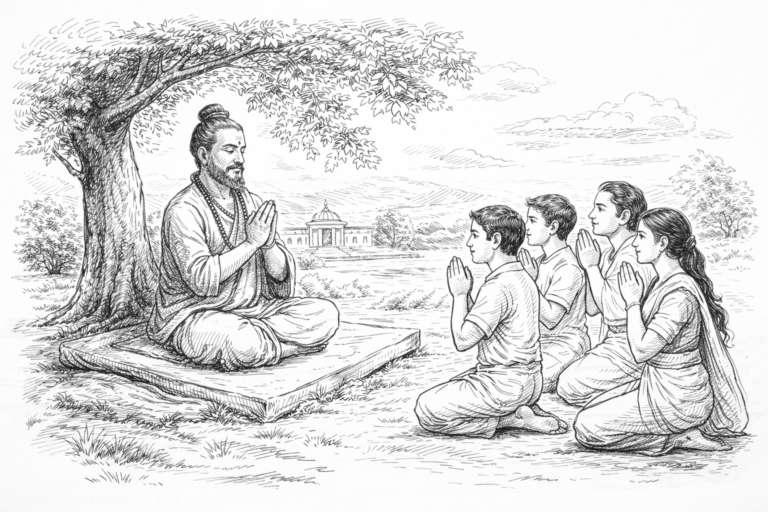
That is why my guru always says, “Aap Ko Dhyaao, Aap ko Bhajo, Aap Mein, Aap Ke Ram, Aap Banke Rehete hain” ( “Meditate on your self, worship your self, Your Ram dwells inside you as the self”) Oh, how much peace and tranquility it brings—the simple act of removing attention from the objects and focusing it on the subject which is me. Forget the scenery and focus on the seer. It appears God has hidden all the secrets of the universe at the tip of my nose!
No lab is more profound than your own mind. No microscope more powerful than attention. And the best part? The more you look, the more you discover that there is nothing in you that is not also in the stars. Worship yourself—not in arrogance, but in reverence. For within you is Shiva. Within you is the witness. The still point. The seer of the scenery.
Happiness, it turns out, is not something to be chased or achieved. It is not in the destination. It is in the undisturbed presence at the center of your being. It is in the smile that arises when you’re not trying. It is in the moment when your breath deepens for no reason at all.
Forget the scenery. Focus on the seer. God, I believe, has hidden the secrets of the universe at the tip of your nose. In the one place you’ve never truly looked!
So, I must goad myself to pause. And look again.
You are not here to live a conceptual life—either your own or someone else’s. Happiness that hangs at the end of a long process that you are pushing yourself to go through may not be happiness at all. In fact, the idea of happiness that needs to be achieved may itself be an illusion. You are not here to perform for an audience. You are here to experience. You are here to taste the juice of this moment, raw and unfiltered. We are here to feel the phenomenon of being alive.
Just be here now. Just be. Do not resist the reality that is bursting forth. Let it flow. Through.




https://shorturl.fm/aLs1f