
Before You Build
Is your product filling a gap in the universe or creating a gap to fill
There is a question I return to often — whether I am sitting across from a founder at the edge of their first real venture, or watching a well-funded organisation spin its wheels despite every structural advantage. The question is deceptively simple.
What is the problem you are actually trying to solve?
Not the solution you want to offer. The problem. The gap that exists whether or not you show up to fill it.
This distinction — between problem and solution — is where most enterprises, dharmic or otherwise, begin to come apart at the seam. We fall in love with what we want to do, what we have trained to do, what feels noble and important. And then, quietly, almost unconsciously, we begin building a story around it. We construct the problem to fit the answer we have already decided upon. This can be called reverse marketing. In plain language, it is the beginning of a very expensive self-deception.

The Right Starting Point: Problem Before Product
There is a principle from systems engineering that applies as much to a dharmic enterprise as it does to aerospace: a well-defined problem is fifty percent of the solution. The moment you clearly articulate what is broken, missing, or unaddressed — and do so with intellectual honesty rather than commercial convenience — the solution begins to take shape on its own.
The customer, as the saying goes, does not come to the hardware store wanting a half-inch drill bit. They come wanting a half-inch hole. That hole can be made in a dozen ways. If you assume the customer already knows the right tool, you will spend your life selling drill bits to people who might have been better served by something entirely different.
So, the first discipline is this: go up before you go across. Move higher in the problem space before you descend into solution development. Identify the unaddressed need — not the one that conveniently fits your offering, but the one that genuinely exists and has not been answered. That honesty will lead you somewhere real.
The Dharmic Test: Easy, Effortless, Enjoyable
Once you have honestly identified the problem, the next question is equally important: why are you the one to solve it?
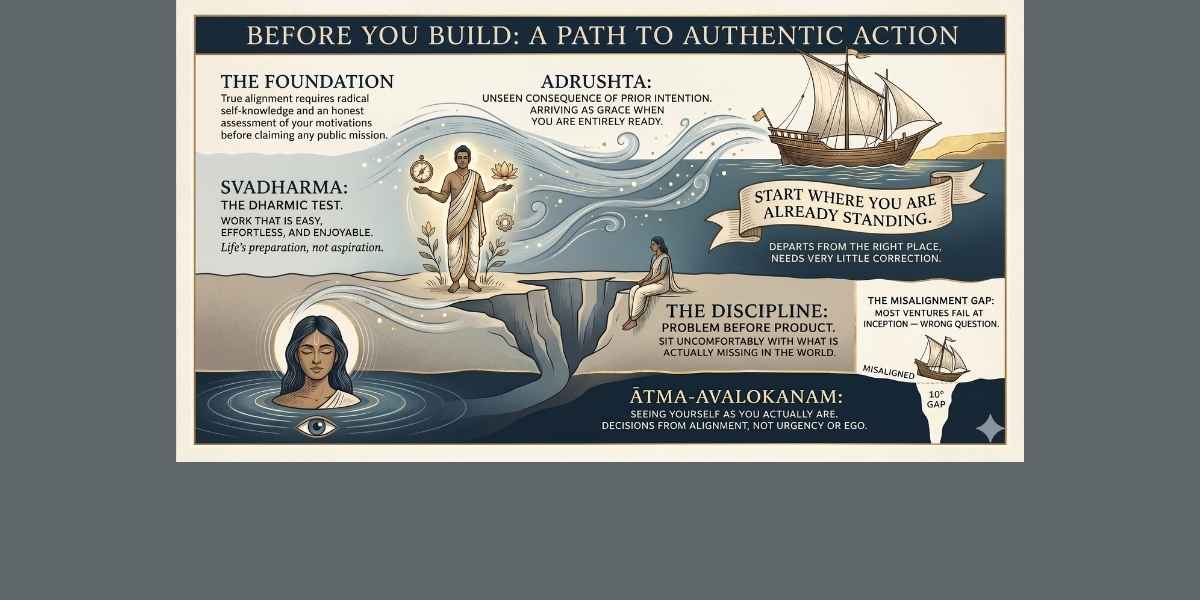
Here is a test I have used for years, drawn not from any MBA framework but from something far older and more precise. Ask yourself whether what you are proposing to do passes three conditions simultaneously — Is it easy? Is it effortless? Is it enjoyable?
I do not mean easy in the sense of requiring no skill. I mean easy in the sense that no one has to teach you how to begin. When the camera turns on, do you need to prepare — or does what needs to be said simply arrive? When an unexpected stage appears, do you scramble — or do you discover that your entire life up to that moment has been the preparation?
I once walked into a situation where someone handed me a microphone and said, essentially, “go.” There was no script, no teleprompter, no advance notice. What came through was not something I had assembled the night before. It was the distillation of decades of living inside these questions. That is what effortlessness actually looks like — not the absence of depth, but such depth that the doing becomes natural.
This is, in its essence, what the tradition calls svadharma. Your dharma is not an aspiration you work toward — it is a recognition of what is already operating through you. The work is simply to see it clearly.
If you find yourself on a steep learning curve at the moment of execution, the cost is not just financial. It is credibility, energy, and the opportunity cost of the thing you could have done where you were already prepared. Do not enter a venture in order to learn. Learn first. Then enter. And when you do, the doing should feel like finally being asked to do what you were already doing anyway.
Knowing Who You Are Actually Serving
One of the most persistent errors in mission-driven work is ambiguity about the actual customer. We say “we serve everyone” and thereby serve no one with any real distinction.
In the context of education, the question is worth sitting with carefully. Are you serving the student, the teacher, or the institution? These are not the same. Serve the wrong audience with the right content and you create expectation without fulfilment — and that particular downward spiral, once it begins, is difficult to reverse.
The moment you have genuine clarity about who is on the other end of your offering, the design of everything changes. The language changes. The pricing changes. The distribution changes. The whole product — not just your piece of it, but the full ecosystem required for someone to actually benefit — becomes visible.
Think of it this way. If you introduce a new kind of toothpaste into the world, someone else must already be providing the toothbrush. The whole product has to exist for your piece of it to function. This means knowing not only what you are offering, but what else needs to be in place — what is already in place — and where the gaps still remain.
On Building Teams: Hire for Who They Already Are
This principle extends to team building in ways that have cost me significantly when I have ignored it.
I have made the mistake of hiring people I liked and believing I could train them into what the role required. Each time, the project paid the price. At the moment of hiring, the person should already be able to do something exceptionally well. We can add to that. We can deepen it, expand it, orient it toward a shared purpose. But we cannot begin from a blank slate and fill it during the work itself. That is running a school, not an enterprise.
The Danger of Flattering Yourself
There is a particular hazard I have watched it quietly claim otherwise sincere efforts. It is the temptation toward grandiose self-description.
“He has transformed millions of lives.” “She is the foremost voice of our generation.” These lines are written into introductions and marketing materials as though the scale of the claim creates the scale of the impact. It does not. In fact, it often does the opposite — it creates a gap between the expectation and the experience that erodes trust over time.
Permission to teach comes from within, confirmed by the lineage, and expressed through the natural arising of opportunity. The moment I begin to hallucinate about my virtues I have already compromised the very thing that made the offering worth anything.
Marketing, understood correctly, is the creation of the product itself. What we usually call marketing — the promotion, the advertising, the titles and thumbnails — is downstream of that. If the product is real, the rest follows: slowly, steadily, through word of mouth and deep attention to the few rather than shallow attention to the many.
Ātma-Avalokanam: The Practice That Makes All of This Possible
Everything described above rests on a single foundation — the capacity to see yourself clearly.
Metacognition, the ability to observe your own thinking, your motivations, your blind spots in real time, is not a modern discovery. It is what our tradition has always called Ātma-Avalokanam: self-contemplation, the ongoing act of turning awareness back upon itself. Without it, every strategy is guesswork dressed up as planning.
This is not the same as self-criticism or self-doubt. It is the quiet, rigorous practice of asking: Am I being truthful here? Is this decision coming from clarity or from the fear of missing out? Am I raising my hand for this task because I am ready for it, or because I want to appear ready? This does not make you perfect – it only helps you recognize and see that you are not perfect. Seeing the illusion is the beginning of intelligence as JK once said.
The highest expression of this practice produces what the tradition calls sākṣī-bhāva — the witness stance. Not detachment in the cold sense, but a kind of steady, undefended awareness of what is actually happening inside you and around you. From that place, decisions arise not from urgency or ego but from alignment. And alignment, sustained over time, is the only thing that actually builds something worth keeping.
I notice that the Shadripus are always active and wanting to dominate me and to keep them at bay I always must be very alert. Aatmavalokana helps me see them working and helps me disarm them before they cause irreparable damage. Being honest with yourself is the first step. If you say the Shadripus are not a problem for me then you bave a problem!
Adrushta: The Grace That Cannot Be Manufactured
There is something I have noticed across the years of this work that I cannot fully account for through any framework, dharmic or otherwise. It keeps showing up.
In Sanskrit, there is no word for luck. What we have instead is adrushta — literally, “the unseen.” Something you did at time one appears as consequence at time forty. The cause and effect are both real, the karmic thread connecting them is real, but the arrival of the fruit carries a quality that can only be described as grace. You did not manufacture it. You cannot claim it entirely as your own achievement.
I have had people walk into rooms and ask me to speak without prior notice. What came through was not something assembled in the moment. I have had opportunities arrive through what I can only describe as a prior intention — a thought, a willingness to contribute, and then the call. I am not being mystical for effect. I am reporting what I have observed, consistently, over a long period of time.
This does not make planning irrelevant. It makes the quality of your inner preparation more important than any outer strategy. When opportunity arrives, it is not asking whether you have a deck ready. It is asking whether your whole life up to that point has been a preparation for this moment.
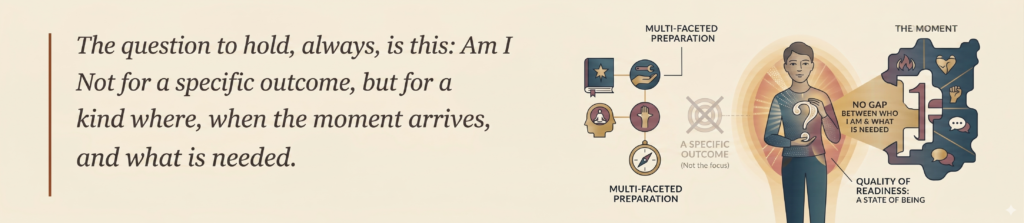
The question to hold, always, is this: Am I preparing in the right way? Not for a specific outcome, but for a certain quality of readiness — the kind where, when the moment arrives, there is no gap between who I am and what is needed.
Start Where You Are Already Standing
If there is a single thread running through everything above, it is this: begin with what is already true about you, not with what you hope to become.
Know the problem before you design the solution. Know your audience before you define your offering. Know your team’s actual strengths before you assign responsibilities. Know your own motivations before you claim any public mission.
And above all, apply the effortless test — not as a counsel of passivity, but as a compass of alignment. If what you are doing does not feel, in some essential way, like the most natural thing you could be doing with your life right now, the work ahead will cost more than it needs to. Not merely in money, but in the quality of what gets produced and the wellbeing of everyone it touches.
A ship that leaves port ten degrees off course is fully off course after a hundred miles. There is no recovering from that with speed or effort alone. But a ship that leaves from the right place, in the right direction, under its own natural momentum — that one needs very little correction along the way.
Start there.
From your heart to set the minds (of founders) in right direction …
those who mind reading this piece with an open heart would be able to be at peace with in and enable peace along with prosperity 🧘♂️
Superb 🪷
Thank you Vinay Ji.