The Recipe Is Not the Dish
What the Mind Calls Practical, and Why It Is Often Wrong
People ask me for my recipes all the time. I share them willingly — the ingredients, the quantities, the sequence, even the timing. And yet, almost invariably, they come back and say, “I tried it, but it doesn’t taste the way yours does.”
I used to wonder why. Now I know. A recipe is a description of a dish. It is not the dish itself. And the gap between those two things — between the description and the reality — is where most of what we call knowledge actually lives.
This is not a small gap. It is where the entire question of what is “practical” and what is “theory” plays out, every single day, in every conversation, meeting, classroom, and kitchen.
The Court That Never Closes
The human mind is a relentless court of judgment. It never really goes off duty. It is constantly processing, sorting, classifying, and filing. And the filing system it uses is not neutral — it is built entirely from the past.
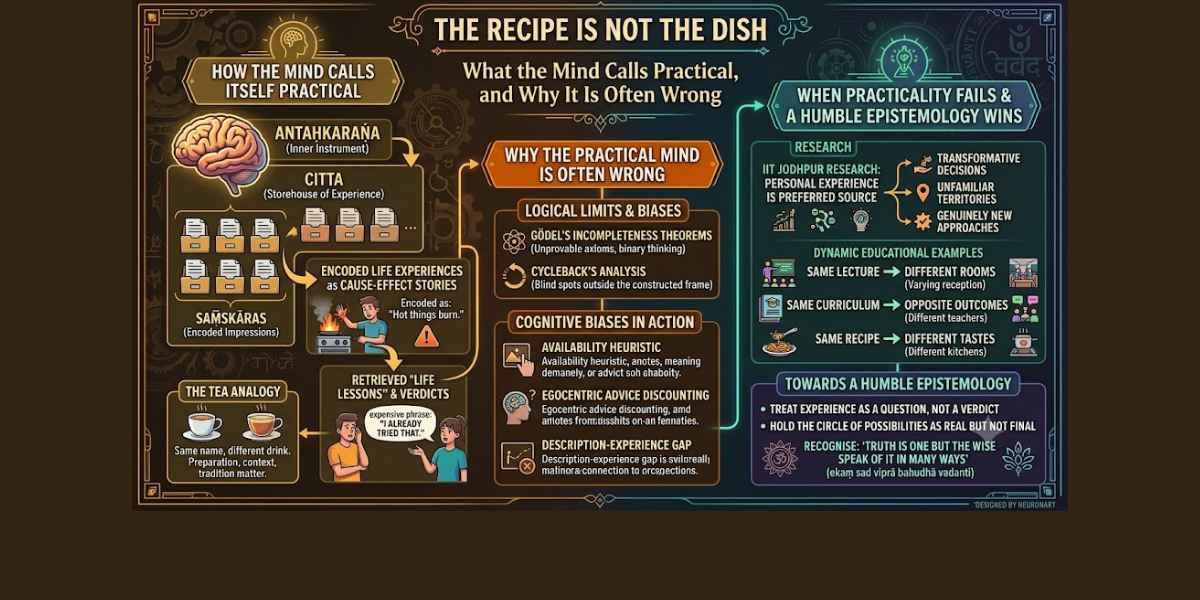
In the Vedāntic framework, the Antaḥkaraṇa — the inner instrument — has four interlocking functions. The manas receives and processes sensory input. The buddhi discriminates and decides. The ahaṃkāra, the I-sense, personalises everything — it makes every experience mine. And the citta is the vast store of impressions — the saṃskāras — that accumulate over a lifetime, and if our tradition is to be taken seriously, over many lifetimes before this one.
It is the citta that concerns us most here. Because it is from the citta that the mind draws its references when it encounters something new. Every experience you have ever had — every conversation, every failure, every moment of betrayal or breakthrough — has been encoded into a pattern. The mind extracts from that experience a kind of lesson: “when A happened, B followed.” It constructs a story, gives that story a moral, and stores the moral as a mental model. Henceforth, whenever it detects anything resembling A, it reaches automatically for B.
This is what we call experience. This is also what we call intuition. And this is, in many cases, precisely the thing that prevents us from seeing what is actually in front of us.
Here is something worth pausing on: the logic that the mind applies in this court is not the perfect instrument we imagine it to be. The writer and philosopher David Cycleback points out that all human logic rests on unprovable axioms — foundational assumptions that we accept not because they have been proven, but because they seem coherent or useful. The logician Kurt Gödel demonstrated, with mathematical rigour, that in any sufficiently complex logical system there will always be true statements that cannot be proven within that system. No framework, however carefully constructed, can encapsulate all truths.
What this means in practice is quietly unsettling. The verdicts the mind reaches — this is practical, this is not; this works, this does not — are not the output of a perfect reasoning machine. They are conclusions drawn within a system that is itself constrained by its own premises. You cannot see outside the frame using only the tools that the frame provides.
I wrote about this at length in my earlier piece, A Note on Mental Models and Perception. The mental models we carry are not neutral lenses. They are stained glass — they colour everything that passes through them, and we rarely notice the colour because we have never seen the world without it.
The Inner Interrogation Room
Sit across someone who is presenting a proposal, an idea, a collaboration. Watch what happens inside you — not on the surface, where you are nodding politely or asking questions, but beneath that, where the real processing is taking place.
The mind is simultaneously running multiple threads. Who is this person, really? What is his angle? Can I trust him? Is what he is saying true, and how would I even verify that? Is it possible? Has anything like this worked before? Have I seen it fail? What does my gut say? And lurking beneath all of this — what does this mean for me?
None of this is bad. All of it is human. The problem is when we mistake this internal tribunal for objective assessment. We are not evaluating the proposal on its merits alone. We are evaluating it through the accumulated weight of everything that has ever happened to us.
Research in cognitive psychology has a name for one of the key mechanisms at work here: the availability heuristic. We assess the probability or plausibility of something based on how easily we can recall relevant examples from memory. If we have seen a similar idea fail — even once, even under entirely different conditions — that memory becomes the most available reference point, and it dominates the evaluation. The new situation does not get a fair hearing. It gets the verdict that the most memorable past situation earned.
Compounding this is what researchers call the false-consensus effect: a well-documented tendency to overestimate how widely our own beliefs and experiences are shared. When someone says, “In my experience, this approach doesn’t work,” there is often an implicit assumption that their experience is representative — that what held true for them, in their context, with their constraints, reflects some broader truth. It rarely does. But the ahaṃkāra, the I-sense, finds it very difficult to believe otherwise.
There is also egocentric processing at work — the mind’s tendency to attend selectively to experiences that confirm what it already believes. It is not that disconfirming evidence is never encountered; it is that it is weighted less, remembered less vividly, and retrieved less readily. The citta stores all experience, but it serves the ahaṃkāra preferentially.
As I explored in You Only See What You Are Ready to See, our readiness to receive a new idea is itself conditioned by where we are in our own journey. The proposal does not land on a blank surface. It lands on a surface already covered in writing.
I Already Tried That Tea
Someone tells you there is a tea that can help with a health issue you have been carrying for years. Your immediate response: “I tried that already. It didn’t work.”
Here is the question worth sitting with: are you certain it is the same tea?
A medicinal herbal tea is not a simple object. It carries what I would call ingredient complexity — the specific variety of herb, the soil in which it grew, the season in which it was harvested, the age of the dried leaves, the mineral content of the water used to brew it. It also carries dynamic complexity — the temperature of the water, how long it steeps, whether it is covered or open, the sequence in which multiple herbs are combined, the vessel in which it is made.
Change any one of these variables and you have, in a meaningful sense, a different preparation. The name remains the same. The experience may be entirely different.
Cognitive research describes this as the description-experience gap. Information received as a description — reading about something, being told about it, seeing it summarised — is processed very differently by the mind than information gained through direct, embodied experience. When you say “I tried that tea,” you are drawing on an experiential memory. But the person offering the tea is often speaking from a different experiential tradition entirely. You are not, in fact, comparing the same thing. You are comparing two descriptions of things that may share only a name.
The mind, of course, does not see it this way. The mind heard “tea for this condition,” matched it to a prior experience labelled “tea for this condition,” retrieved the verdict from the citta — “did not work” — and closed the case. The entire process took perhaps a second. The new information was never really received because the mental model had already processed it out of existence.
This is what Māyā actually looks like in daily life. Not some grand cosmic illusion, but the quiet, efficient way in which the mind substitutes its memory of a thing for the thing itself. As I wrote in Cutting Through the Misty Veil of Māyā, the mind creates its own bondage through precisely this mechanism — assumption masquerading as experience.
What the Recipe Cannot Carry
Let me stay with the kitchen metaphor for a moment, because it is rich enough to bear the weight of this idea.
When someone asks me for a recipe and I share it, I am transmitting information. Ingredient names, measurements, sequence, time. What I am not — cannot — transmit in that transaction is the knowledge that lives in my hands. The fact that how vegetables are cut matters enormously, not just aesthetically but chemically. The surface area exposed determines how the vegetable releases moisture, how it absorbs the oil, how it caramelises or softens. The variety of eggplant in Bengaluru is not the same as the variety in Udupi, and they do not behave the same way in a pan. The cooking vessel — a heavy-bottomed kadai, a pressure cooker, a thin steel pot — changes the thermal dynamics of the entire preparation. The oil matters. The flame matters. Whether you add salt early or late matters.
I can write none of this into a recipe without making it a textbook. And even then, the person reading it would need to cook the dish perhaps fifty times before the knowledge stopped living in their head and began living in their hands.
This is the distinction the Indian knowledge tradition has always understood — the difference between śravaṇa (hearing or reading), manana (deep reflection), and nididhyāsana (sustained, embodied practice). Knowledge received at the level of śravaṇa is information. Knowledge that has passed through manana and nididhyāsana is understanding. And understanding, over time and with refinement, becomes what the tradition calls jñāna — not merely knowing, but being.
When someone labels something “theoretical” and dismisses it, what they usually mean is: “I have not yet embodied this knowledge.” Which is different, quite substantially different, from saying the knowledge is wrong.
When Experience Itself Becomes the Obstacle
There is a subtler problem underneath all of this, and it deserves its own space.
We tend to treat personal experience as the most reliable form of knowledge — the gold standard against which all other information is measured. And in many ordinary situations, it functions well as such. But researchers at IIT Jodhpur, studying how people draw on different sources of knowledge when making decisions, point out something that should give us pause: personal experience is most limited precisely in the moments that matter most.
They describe what they call “transformative decisions” — choices that fundamentally alter the decision-maker’s life in ways they cannot fully anticipate beforehand. Choosing a career direction. Starting a new kind of enterprise. Moving across cultures. Adopting a radically different approach to health or practice. These are the decisions where personal experience is least available and least reliable as a guide — because by definition, the person has not yet lived what they are considering. And yet these are also the decisions where people feel most compelled to reject external input and rely on the thin evidence of what they have already done.
This creates what might be called an epistemological tragedy. The moments when we most need to hold our prior experience lightly are precisely the moments when we are most likely to grip it tightly.
Cycleback raises a related point from the side of logic rather than experience. Binary thinking — the classification of things as either true or false, practical or theoretical, working or not working — is deeply embedded in classical logical reasoning. But many real-world situations involve ambiguity, degrees of truth, and variables that do not resolve into clean categories. A herbal preparation that works for one constitution may be genuinely neutral for another and mildly harmful for a third. A pedagogical method that electrifies one classroom may leave another unmoved. The binary verdict — this works, this does not — does violence to this complexity. It imposes a rigid frame on a reality that does not fit inside it.
And there is something else: logic, as Cycleback observes, is inherently context-dependent. The moment you abstract away context to achieve a general conclusion — “this method does not work” — you risk making a statement that is technically valid within your experience but misleading when applied elsewhere. What we call general principles are often highly localised truths that have been unwittingly promoted.
The tradition of India has always known this. The insistence on guru-paramparā — on the transmission of knowledge through a living lineage, not through text alone — is precisely an acknowledgement that context cannot be abstracted away. The Āyurvedic physician does not prescribe a herb; she prescribes a herb for this person, this prakriti, this season, this stage of life. The abstraction of the general formula is always a beginning, never an end.
The Same Curriculum, Not the Same Classroom
I have been thinking about this in the context of teaching. Two teachers — equally qualified, equally sincere, covering identical material. The outcomes in their classrooms may be completely different. I have seen this enough times to know it is not an anomaly. It is the norm.
What accounts for the difference? It is not the content. The content is the same. It is everything else — the way the teacher holds space, the quality of presence they bring, how they read the energy of the room, when they pause and when they press forward, how they handle a question that challenges their framework, whether they teach from memory or from understanding.
A teacher who has truly understood what they are teaching teaches differently from one who has merely memorised it. The first teacher can approach the same idea from twelve different angles depending on which student is asking and what that student needs. The second can only re-explain the same explanation more slowly.
I have delivered the same lecture to two different audiences and received nearly opposite responses. Same words. Different rooms. In one room, the idea landed and ignited something. In the other, it fell flat and aroused suspicion. What changed? Everything that the lecture touched — the collective citta of the audience, the expectations they carried in, the conversations they had before walking into the hall, their readiness, in Joseph Campbell’s phrase, for the adventure being offered.
As I reflected on in You Only See What You Are Ready to See: readiness is the invisible variable that determines almost everything. The teacher cannot fully control it. The communicator cannot fully control it. What both can do is become more sensitive to it — more attuned to the room, to the moment, to the person across the table — and respond accordingly.
The Circle Within Which We Judge
In my earlier piece, Circle of Possibilities: How We Evaluate Ideas, I described the mental framework through which each person assesses what is possible. This circle is not fixed. It is shaped by personality, saṃskāras, value systems, professional conditioning, and the accumulated weight of what has and has not worked in one’s life.
What gets labelled “practical” is, more often than not, simply what lies inside one’s current circle of possibilities. What gets labelled “theoretical” — or “not workable” or “too idealistic” — is what lies outside it.
The word “practical” is one of the most effective ways we have of foreclosing inquiry. It sounds grounded. It sounds wise. It sounds like the voice of experience. And sometimes it is. But often it is simply the voice of the closed citta, which has decided that it already knows, and would rather not go through the trouble of examining that assumption.
Research on decision-making describes a hierarchy that most people follow, usually without knowing it: they first reach for their own personal experience, then for the experiences of people they know and trust, and only reluctantly for the knowledge of strangers and experts. There is wisdom in this ordering — personal experience is immediate and directly relevant. But the same research identifies a persistent problem: when personal experience is thin, outdated, or drawn from genuinely different conditions, people continue to weight it more heavily than they should, and systematically discount the knowledge of those who have actually navigated the territory being considered.
There is even a name for this tendency: egocentric advice discounting. The more someone feels confident in their own prior experience, the less weight they give to external input — even when that input comes from sources better positioned to know. The ahaṃkāra, protecting its own edifice of understanding, quietly demotes whatever challenges it.
The entrepreneur who has built a massive corporation calls something impractical through the lens of frameworks she has been trained in. The academic calls it impractical because there is no established literature to support it. The doctor calls it impractical because it does not fit the clinical protocols she follows. Each of them is, in a sense, correct — within their circle. The question is whether their circle is the right frame for this particular question.
The Diversity That Makes Understanding Possible
Here is something I have found deeply generative in collaborative work: the very diversity of mental models and circles of possibility, which seems like an obstacle to agreement, is actually the condition for a richer understanding.
In Collaboration, Consciousness and Diversity, I explored how Nature itself depends on diversity — the forest does not grow from a single species of tree. The intelligence of an ecosystem lies in the multiplicity of its elements and the relationships between them. The same is true of a team, a learning community, an inquiry circle.
When I sit across someone who has tried the tea and found it wanting, and I listen carefully to exactly what he tried, how he tried it, what happened, what did not — I am not just gathering data about his experience. I am expanding my own understanding of the variable space within which the tea operates. His failure is not evidence that the tea does not work. It is evidence that it did not work in those specific conditions, with those specific variables, in that specific person’s constitution and context. And that information, properly received, is valuable.
This is what Collaboration for Truth means in practice. Not the agreement of minds that see the same thing, but the patient assembly of partial perspectives into something closer to the whole. As the Ṛgveda puts it — Ekaṃ Sat, Viprāhā Bahudhā Vadanti — truth is one, but the wise speak of it in many ways. The many ways are not a problem to be resolved. They are the very texture of honest inquiry.
Cycleback makes a related point from his study of logic across cultures. Western classical logic, with its emphasis on rigid either/or dichotomies, is one tradition of reasoning. Daoist and Buddhist thought, by contrast, have long embraced contradiction and fluidity as inherent features of reality rather than problems to be eliminated. The Indian darśana tradition is rich with this same recognition — that different frameworks illuminate different facets of the same reality, and that the insistence on a single framework always costs you something. The tradition of tarka and vitarka, of structured debate and counter-argument, was not designed to produce a winner. It was designed to produce a fuller picture.
What, Then, Is Theory?
I want to offer a small but important reframe. Theory is not the opposite of practice. Theory is practice that has not yet found its hands.
Every skilled practitioner was once a theorist. Every master chef once read a recipe and found it wanting. Every great teacher once sat through lectures that left them cold and wondered how to do it differently. The gap between theory and practice is not a permanent condition. It is a stage — one that closes through sustained, reflective engagement with the material.
The trap is not theory. The trap is the certainty that what one has already practised is the whole of what is possible. The trap is the mind that has converted its experience into a verdict rather than a question.
I am reminded of Maharshi Patañjali’s description of avidyā — the deepest ignorance is not the absence of information but the confusion between what is transient and what is real, between the map and the territory, between the recipe and the dish. We mistake our mental models for reality itself, and in doing so, we stop learning.
Gödel’s incompleteness theorems, applied not to mathematics but to the mind, suggest something similar: no matter how much we have experienced, no matter how refined our logical framework, there will always be truths we cannot reach from within our current system. Not because those truths are inaccessible in principle, but because the system we are using to reach them has built-in limits. Growth requires stepping outside the system. It requires, occasionally, the willingness to be wrong about what we think we know.
The art of thinking clearly — as I explored in that article — begins with the recognition that every label we assign, every category we use, every box into which we place an experience, is a tool of convenience, not a statement of final truth. The eggplant does not know it is supposed to behave according to the recipe. The student does not know they are supposed to respond to the lecture in the way the previous audience did. The situation does not know that you have already decided how it ends.
Toward a More Humble Epistemology
What would it look like to approach a meeting, a proposal, a strange new idea — or a cup of medicinal tea — with what the Zen tradition calls shoshin, beginner’s mind?
It would look like slowing the internal tribunal down. It would look like becoming curious about the variable space — all the ways this thing might be different from what you encountered before. It would look like asking the person across the table not just whether something works, but exactly how they experienced it not working, and what that tells both of you about the conditions required for it to work.
It would look like recognising that your circle of possibilities is real, but not final. And that the person across the table from you — the one whose logic has been trained by a completely different set of experiences — carries a perspective that, if you are willing to receive it, could expand that circle in ways your own experience never could.
The IIT Jodhpur research describes a cascade of strategies that people use when navigating unfamiliar decisions: filtering information analogically, seeking social proof, adapting expectations as more is learned, and regulating their emotional responses to stay open rather than reactive. What is striking is that these strategies are not exotic or difficult. They are simply habits of epistemic humility — the practice of holding your prior conclusions a little more lightly, and your incoming evidence a little more generously.
The mind that knows it has a citta full of assumptions is already freer than the mind that does not. Seeing the illusion is the beginning of intelligence. The cook who knows that her recipe is an approximation of the dish, not the dish itself, will cook it with more attention, more responsiveness, more willingness to adjust in the moment. The teacher who knows that the lecture she delivered brilliantly last year may not land the same way this year — because the audience is different, the moment is different, and she herself is different — will walk into the room more awake.
And perhaps that is where the real knowledge lives — not in the recipe, not in the lecture notes, not in the verdict stored in the citta, but in the quality of attention we bring to this moment, this person, this cup of tea.
If this resonated, you might also enjoy: Circle of Possibilities: How We Evaluate Ideas | You Only See What You Are Ready to See | A Note on Mental Models and Perception | Collaboration for Truth | Cutting Through the Misty Veil of Māyā