The Eight-Second Mind
A Parent’s Reckoning
What the latest neuroscience reveals about what our children are losing, and how five quiet days of Bharatiya cultural education might begin to give it back.
The Number That Should Stop Every Parent In Their Tracks!
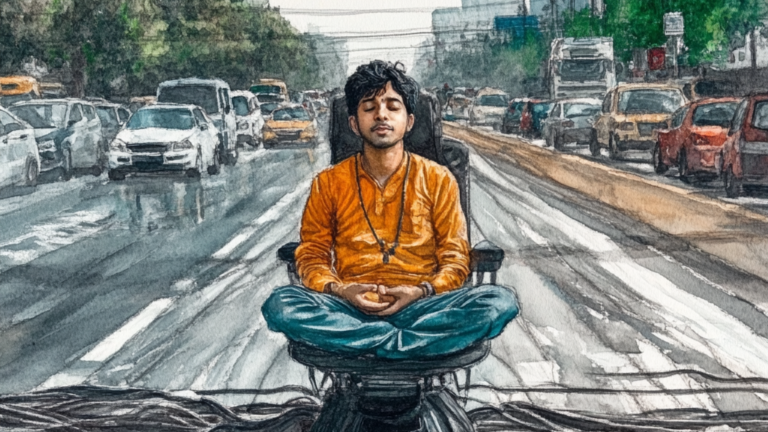
The average human attention span has collapsed from twelve seconds at the turn of the millennium to roughly eight seconds today. The goldfish, that traditional symbol of our easy condescension, sits at nine. We are no longer the senior species in the sustained-attention department.
This is not opinion. It is now one of the most replicated findings in cognitive psychology. A 2026 study led by Johns Hopkins University and the Child Mind Institute, covering 18,500 children across eleven countries, found that children who spend more than four hours a day on screens experience a 34 percent steeper drop in sustained attention during cognitive testing than their lower-screen peers. Carnegie Mellon researchers have shown that the modern brain now needs nearly twenty-seven minutes to fully refocus after a single digital interruption. A landmark study published in Scientific Reports demonstrated that simply reading on a smartphone, compared to paper, suppresses the body’s natural deep breathing reflex, overstimulates the prefrontal cortex, and measurably lowers reading comprehension. The act of reading on a phone is not the same act as reading on a page. The brain knows.
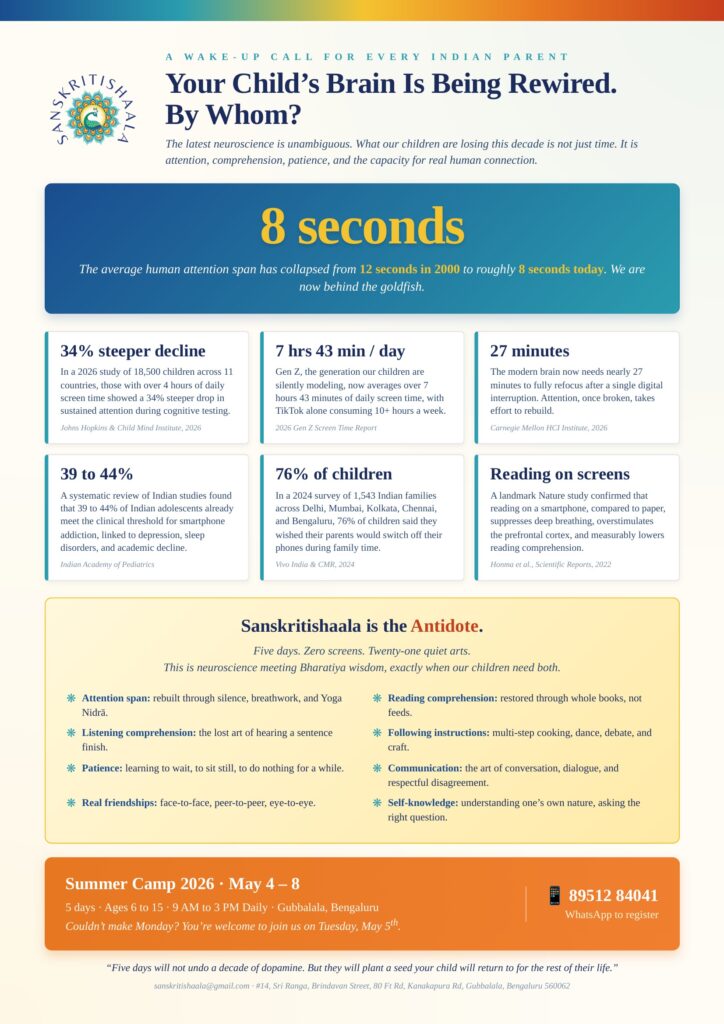
Closer to home, the Indian Academy of Pediatrics warns that 39 to 44 percent of Indian adolescents already meet the clinical threshold for smartphone addiction. The figure is intimately correlated with depression, sleep disorders, and academic decline. In 2024, a survey of 1,543 Indian families across Delhi, Mumbai, Kolkata, Chennai, and Bengaluru found that 76 percent of children, three out of four, wished their parents would put down their phones during family time. Over 90 percent wished some social media apps had never been invented at all. Our children are not asking for more access. They are quietly asking for less.
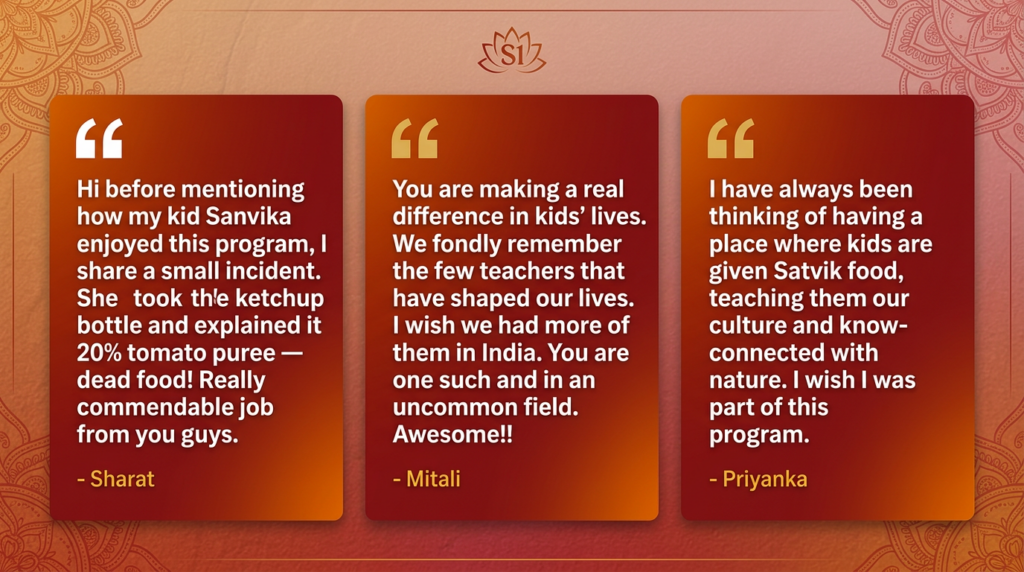
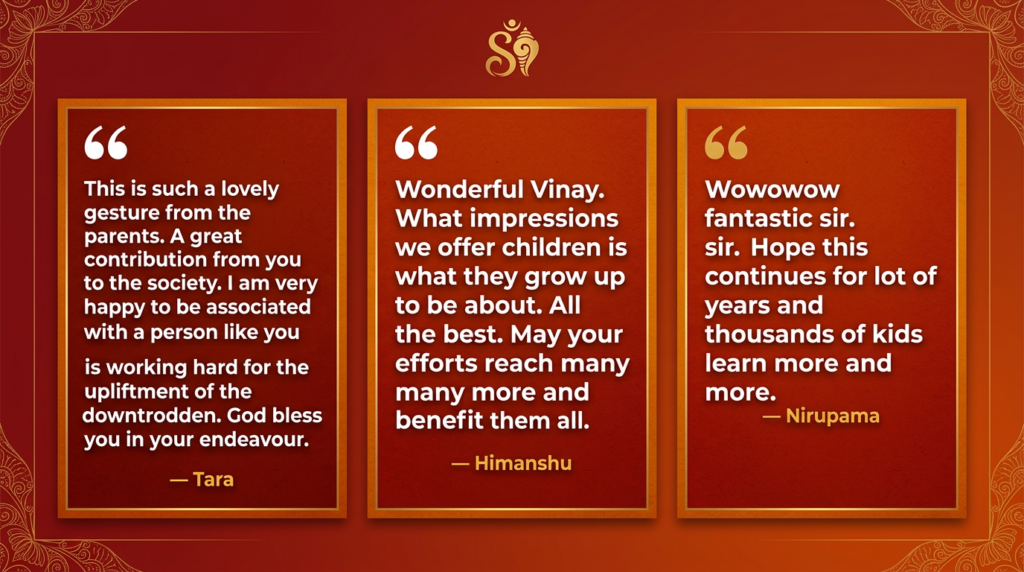
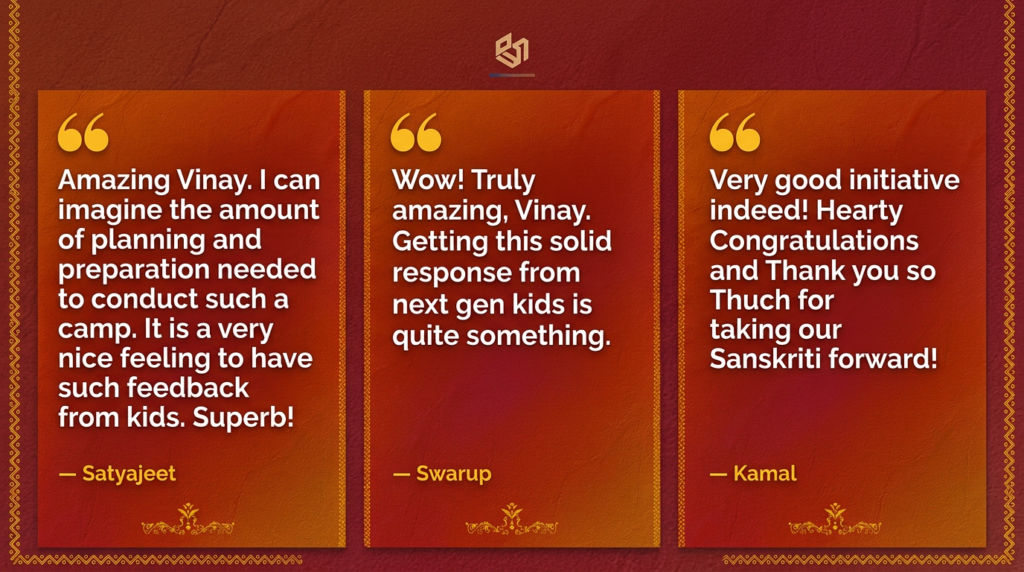
Feedback from Happy Parents
What Attention Is, and Why Its Loss Is Not Only Cognitive
Swami Vivekananda said: “To me the very essence of education is concentration of mind, not the collecting of facts. If I had to do my education over again, and had any voice in the matter, I would not study facts at all. I would develop the power of concentration and detachment, and then with a perfect instrument I could collect facts at will.”1
Attention, in this view, is not merely a tool we use to read a book or finish a homework assignment. It is the very substrate on which a human being becomes capable of self-knowledge, of relationship, of meaning. A child who cannot attend cannot listen. A child who cannot listen cannot understand. A child who cannot understand cannot connect. A child who cannot connect grows into an adult who is lonely in a way no amount of social media will heal.
What we are watching, in the data, is not a learning problem. It is a foundational human problem. The capacity to be present is being eroded before our children have the chance to know what it feels like.
The Quiet Inheritance We Are Forfeiting
Bhārata’s pedagogical traditions assumed something the modern educational system has almost entirely forgotten. How a child learns shapes who they become. The Upaniṣads describe learning as a threefold practice. śravaṇa, listening with full attention. manana, turning the teaching over in reflection. nididhyāsana, sustained contemplation until the truth is known directly, not merely held intellectually. Each stage requires longer, deeper, slower attention than the last. The whole architecture of becoming a wise human being was built on the assumption that a child could sit still, listen all the way through, and then sit with what they had heard.
We are now, for the first time in the long human story, raising a generation that cannot sit through śravaṇa. Not because they are lazy. Because their nervous systems have been reshaped, hour by hour, by an industry whose business model is the manufacture of compulsive distraction.
This is the part that does not show up in screen-time statistics. The loss is not only of minutes. It is of the inheritance.
What Five Days Cannot Do, and What They Can
Let me say this plainly. Five days at a summer camp will not undo a decade of dopamine. Anyone who promises that is selling you something.
But five days can do something else. A single, vivid, embodied experience of an alternative way of being can plant a saṃskāra, a latent impression, that the child returns to for the rest of their life. The first time a child experiences ten unbroken minutes of maunam, real silence, and notices that the silence is not empty but full, something happens that no app can subsequently take from them. They remember the taste. They look for it again. The seed is planted.
This is the modest, honest claim of the work we do at Sanskritishaala.
A Day at Sanskritishaala
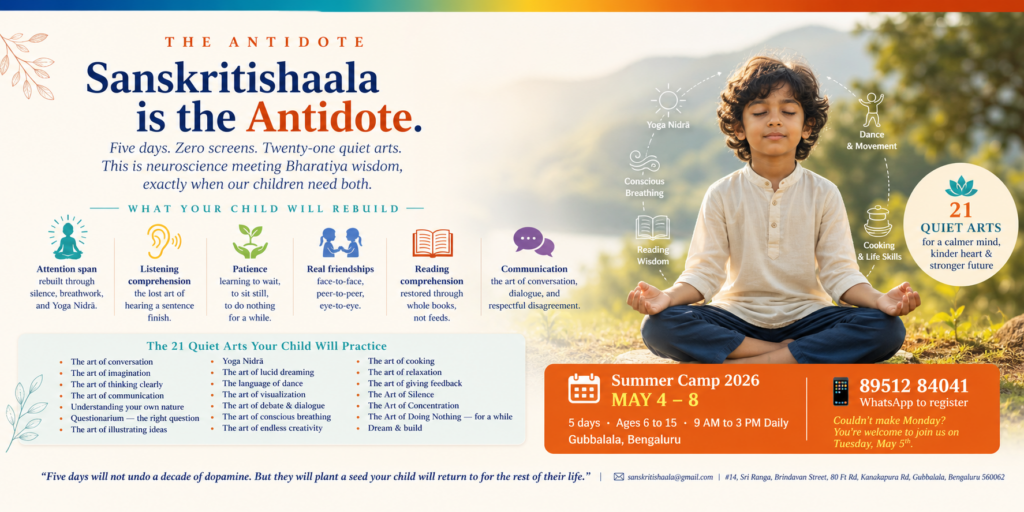
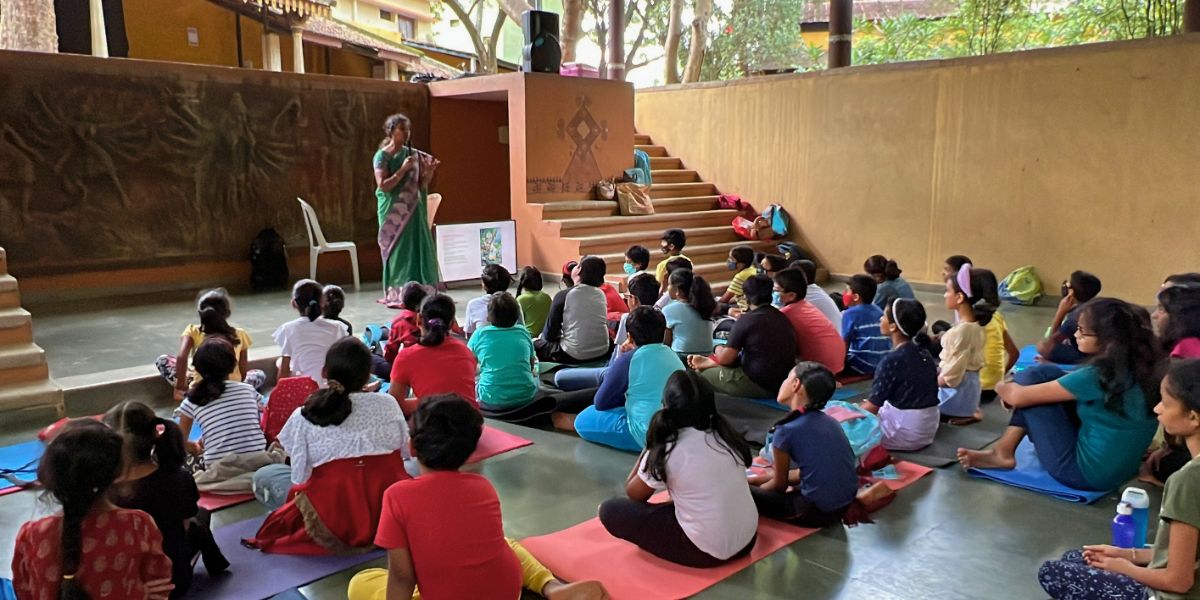
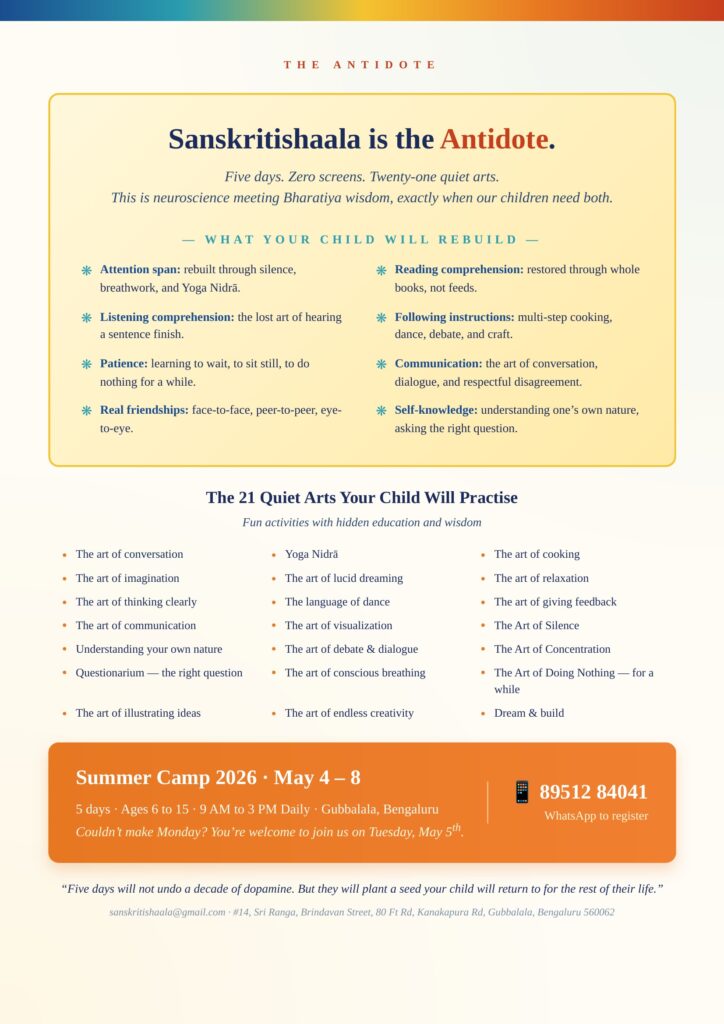
Sanskritishaala is, at its heart, an experiment in what Bharatiya cultural education looks like when it is given five uninterrupted days to do its work. The camp runs from May 4 through May 8, 2026, at our space in Gubbalala, Bengaluru. Children aged six to fifteen come for the day, from nine in the morning to three in the afternoon. They do not touch a screen for those six hours. What they do instead is the whole point.
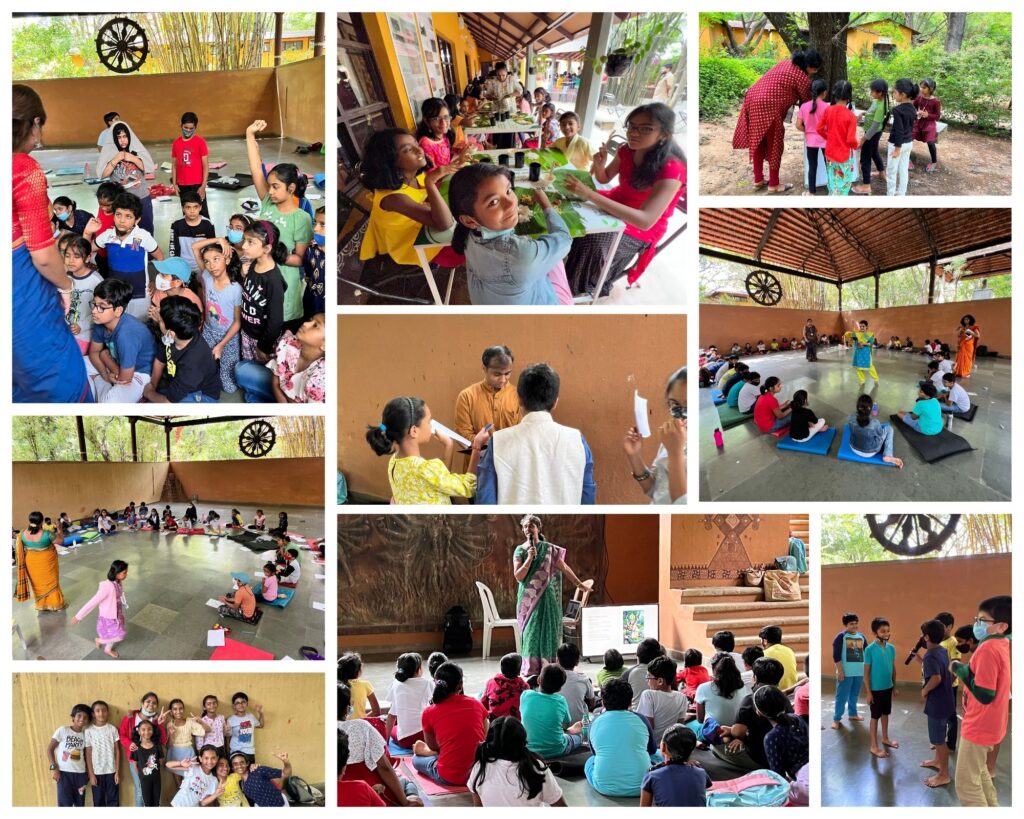
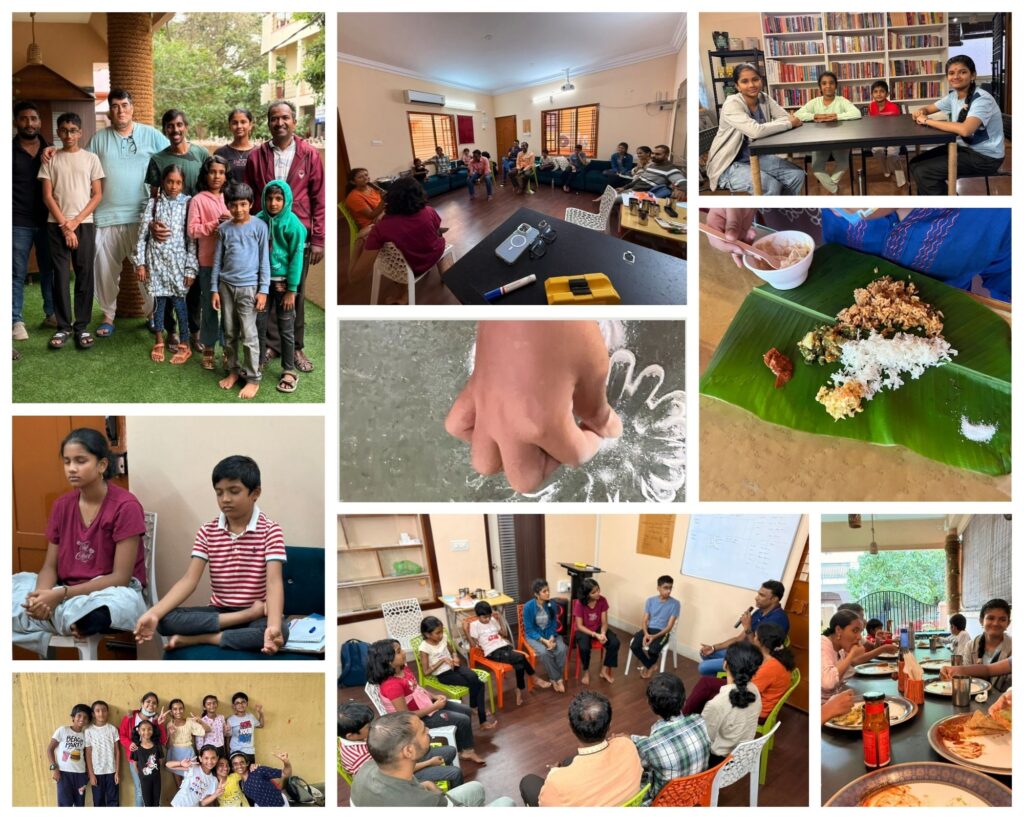
A morning at Sanskritishaala does not look like a classroom. The day begins with the children sitting on the floor in a quiet circle, breathing together, before a single word is spoken. They learn that the day has a form, that the form begins in stillness, that stillness is itself a teacher. By mid-morning they may be in the library, three children huddled around a single table, working on a question together, surrounded by walls of actual books. They are reading whole pages instead of feeds, and they feel the difference in their own minds.
At lunch, the children sit at long tables and share food from thali plates, laughing across the table at things no algorithm chose for them. The communal meal is not a break from the teaching. It is the teaching. Anna, food, has its own dharmic weight in the tradition. Children who eat together remember each other. They build friendships that have nothing to do with profile pictures, the kind that a child carries forward into the world the way an earlier generation carried childhood neighbours.
The afternoon brings the embodied work. Yoga Nidrā in a quiet hall. The language of dance teaches them the fundamentals of communication as well as expressing their emotions in a productive way. Small dialogue circles where the children practice listening to one another finish their sentences, then disagree, then recover the thread. There is cooking, illustration, debate. There is also, quite deliberately, time to do nothing for a while, which is where original thought is born and where a child first meets their own mind without help.
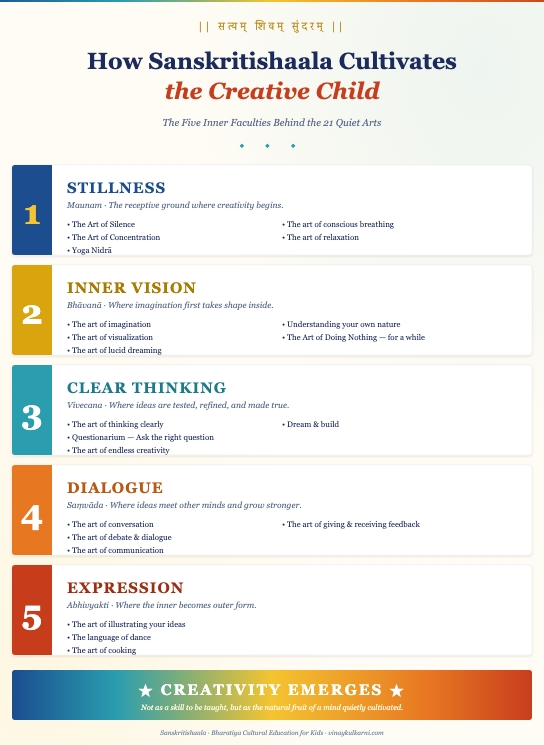
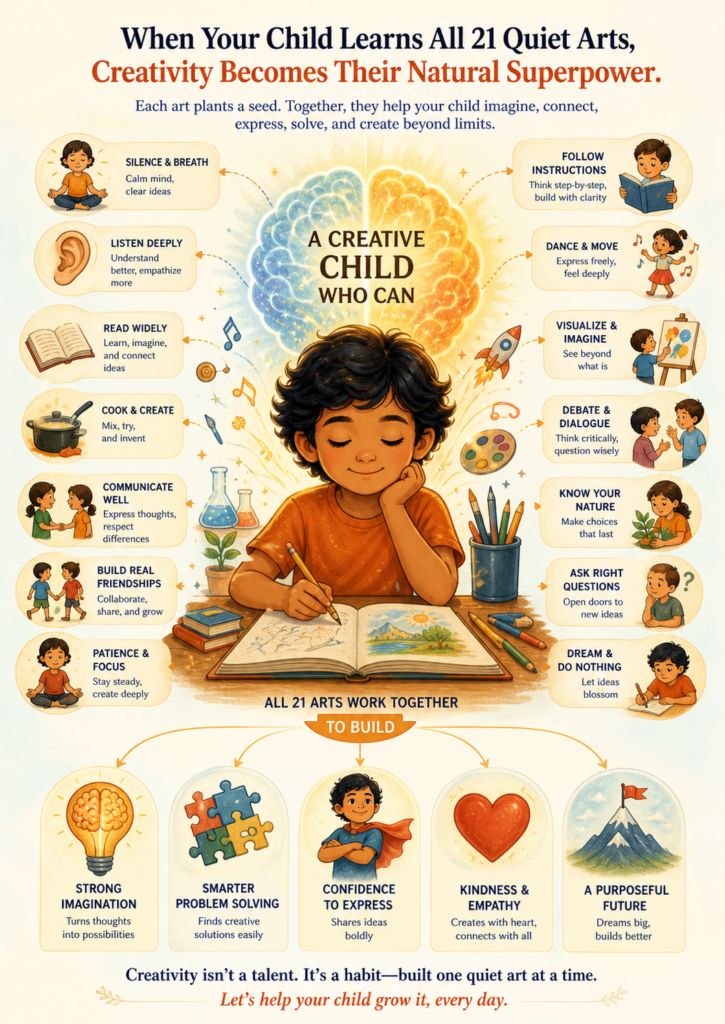
Across the five days, twenty-one quiet arts are practiced. The art of conversation. The art of imagination. The art of thinking clearly. The art of communication. Understanding one’s own nature. The Questionarium, the art of asking the right question. The art of debate and dialogue. The art of conscious breathing. The art of illustrating ideas. The art of endless creativity. Dream and build. Yoga Nidrā. The art of lucid dreaming. The language of dance. The art of visualization. The art of cooking. The art of relaxation. The art of giving and receiving feedback. The art of silence. The art of concentration. And the art of doing nothing, for a while.
Each of these is, in its own way, a direct reversal of something the screen has trained out. Conscious breathing reverses the suppressed-sigh pattern researchers found in smartphone readers. Sustained listening reverses the four-second cycle of feed scrolling. Real conversation, with its pauses and disagreements and recovered threads, reverses the algorithmic curation of opinion. Yoga Nidrā restores the parasympathetic balance constant stimulation has eroded. None of this is presented as therapy. It is presented as joy. We call them fun activities with hidden education and wisdom. The fun is on the surface. The education and the wisdom work underneath, in the tissue of what the day actually feels like.
This is how children should be taught. Not only by lecture. By living the form. By eating together, sitting together, breathing together, dreaming together. Satyam, the truth of what is being lost. Śivam, the divine good that the tradition knows how to cultivate. Sundaram, the beauty of children, laughing in a circle, learning who they are.
The Question Every Parent Eventually Has to Answer
If you are reading this, you already know the situation. You see your child’s eyes when the screen comes out and when the screen goes away. You have watched the dinner conversation thin to nothing. You have wondered, quietly, whether the child you are raising will be capable of the full human inheritance, the capacity to love deeply, to think clearly, to sit with another person and really be there, or whether something essential is being silently exchanged for the convenience of a quiet evening.
You are not alone in wondering. Three out of four Indian children are wondering the same thing about their parents.
The question is not whether to fight technology. That fight cannot be won, and it is the wrong fight. The question is whether, alongside the inevitable digital fluency our children need to function in the world, we are also giving them the inner technology, the trained attention, the cultivated breath, the practiced silence, that will let them remain whole inside that digital world.
Schools will not give them this. Tutors will not. Parents alone, no matter how loving, often cannot, because the household itself is now soaked in the same waters. What the tradition called the gurukula, a small, intensive, embodied environment in which a child learns by doing alongside others learning by doing, is the form that works for this kind of teaching. It always has been.
Sanskritishaala is, in its modest way, an attempt to keep that form alive.
A Personal Note
The Sanskritishaala summer camp begins on Monday, May 4, 2026, and runs through Friday, May 8. It is open to children aged six to fifteen. If you cannot make Monday for some unavoidable reason, you are welcome to join us on Tuesday, May 5. The children adjust. The doors stay open. To register, please WhatsApp us at 89512 84041. The location is #14, Sri Ranga, Brindavan Street, 80 Ft Road, Kanakapura Road, Gubbalala, Bengaluru 560062.
If you cannot come this year, that is also alright. The practice of maunam in your own home, ten minutes a day, with your child sitting beside you, costs nothing and may change everything. The traditions are not jealous. The seed is the same seed.
But if you can come, come. Five days is not very long. And the seed your child carries home from this week may be the one they reach for, twenty years from now, when their own child is sitting in front of a screen and they need to remember that another way of being a human is possible.
That memory has to start somewhere.
Let it start here.
Sources: Johns Hopkins University & Child Mind Institute (2026) · Carnegie Mellon Human-Computer Interaction Institute (2026) · Honma et al., Scientific Reports / Nature (2022) · Indian Academy of Pediatrics · Vivo India & CyberMedia Research (2024)