
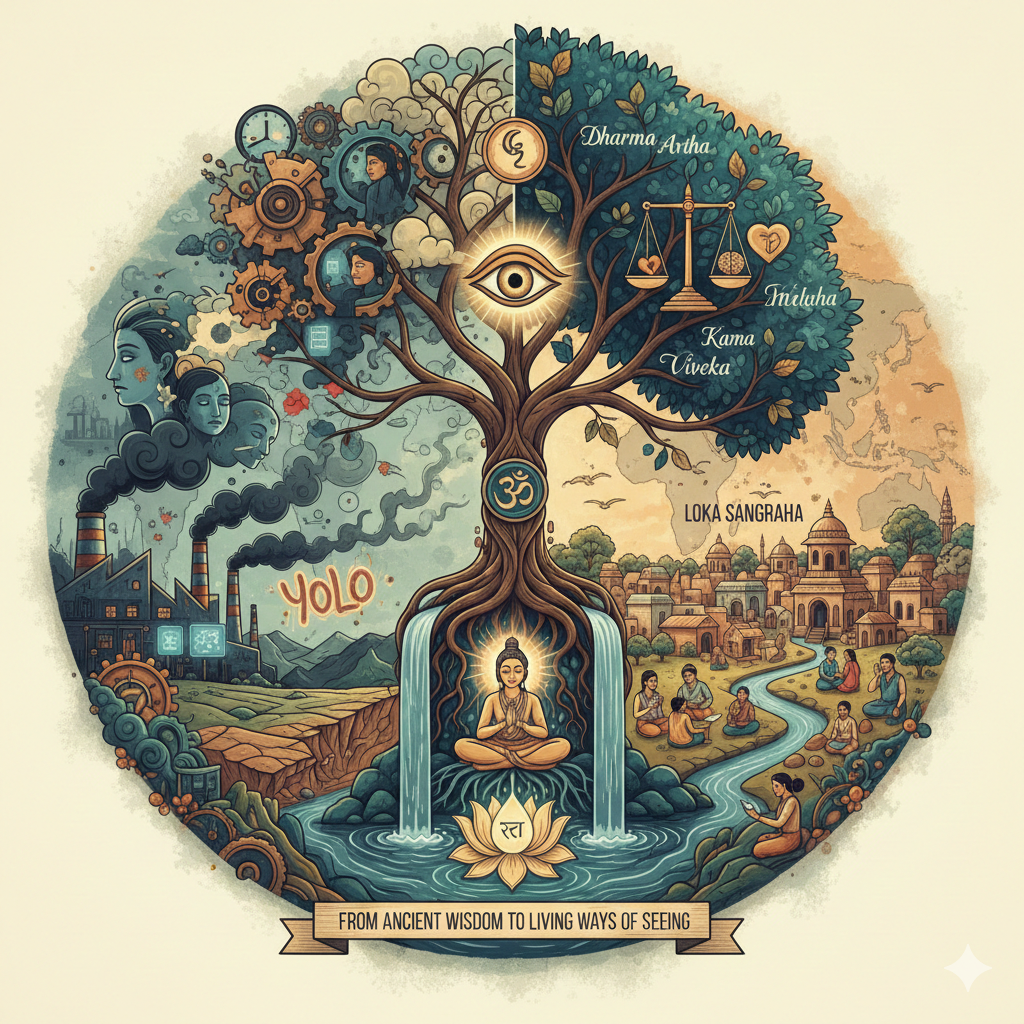
Viewing the World Through Indian Knowledge Systems: From Ancient Wisdom to Living Ways of Seeing, Being, and Healing
By Vinay P Kulkarni
What if everything we thought we knew about success, progress, happiness, and even health was built upon borrowed assumptions—mental constructs we never consciously chose? What if the very framework through which we perceive reality was shaped not by cosmic truth but by historical accidents and colonial legacies?
This is not a philosophical exercise. This is the ground beneath our feet.
The Invisible Architecture of Perception
We rarely question the lenses through which we view the world. Yet these lenses—our mental models—determine everything. They shape what we consider valuable, what we pursue, how we measure progress, and ultimately, who we become. The idea and concept of life itself, the purpose of human existence, the source of truth, the nature of happiness, the relationship between individual and society—all of these rest upon foundational assumptions that most of us have never examined.
Consider just a few of the questions that lie at the heart of every civilization’s worldview: Is happiness an individual pursuit or a collective endeavor? Is wealth accumulation a sign of progress or a symptom of imbalance? Is time linear, marching relentlessly toward some future destination, or cyclical, breathing through the eternal rhythms of creation and dissolution? Is death an ending or a doorway?
The Western paradigm offers one set of answers. Indian Knowledge Systems offer another. And the difference is not merely academic—it is civilizational.
The Dharmic Framework: A Different Operating System
The Bhāratīya worldview rests upon a sophisticated understanding of reality that cannot be reduced to religious belief or cultural practice. It is, at its core, a comprehensive framework for perceiving, engaging with, and transforming existence itself.
Where modern frameworks separate the secular from the sacred, the material from the spiritual, the individual from the collective, Dharmic thinking recognizes these as inseparable dimensions of a unified whole. Dharma is not religion in the Western sense—it is the cosmic law that governs all existence and derives from the natural order (set of governing principles) that sustains life at every level, from the movement of galaxies to the beating of a human heart.
This distinction matters profoundly. When we speak of rule-based ethics versus consciousness-based ethics, we are pointing to two fundamentally different orientations toward moral life. Rule-based systems create external frameworks of do’s and don’ts, policed by authority and enforced through punishment. Consciousness-based ethics emerge from an awakened awareness of interconnection—when we truly see that the boundary between self and other is illusory, compassion becomes not a duty but a natural expression of being.
Our current sustainability Crisis
We are in this situation because through many colonial and other processes the whole world followed the lead of the west and started operating in the “Artha-Kama” plane and totally forgot about Dharma – The Harmonizing Principle and Moksha – The Elevating and Liberating Principle. Unlimited desires and Limited natural resources. This is the result of unstable minds leading weak minds to chase a model of sustainability that is inherently unsustainable. That inner conflict spills out into the world. One planet is not enough. More planets are needed to satiate the untenable greed of a humanity operating without control or responsibility. There is an urgent need for powerful political and business leaders to work on their own antahkarana. Chitta Shuddhi is the need of the hour. Let Viveka dawn and prevail.
Purifying the Chitta: The Inner Technology
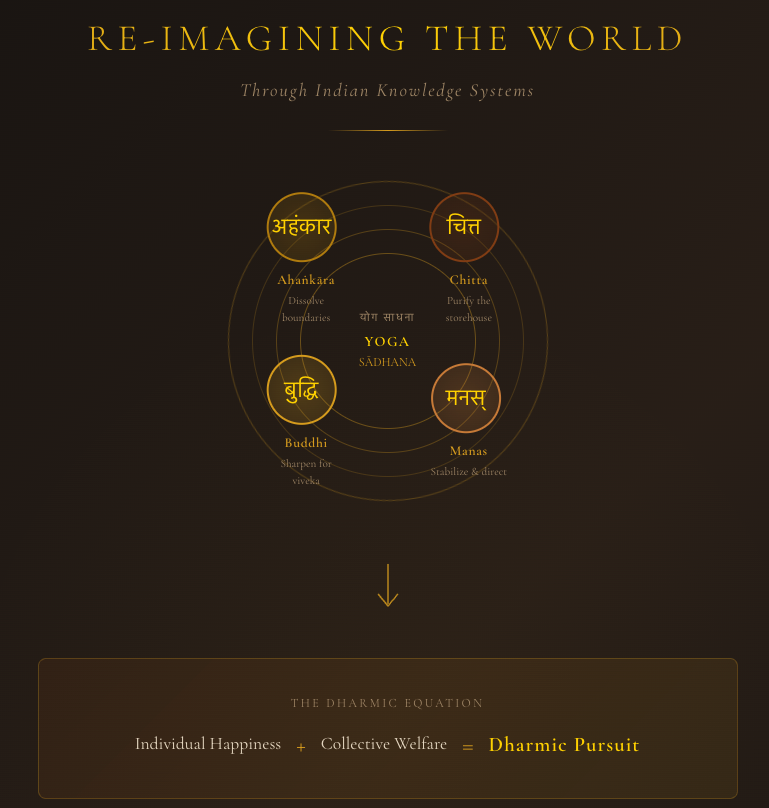
Patañjali’s definition resonates across millennia: Yogaḥ citta vṛtti nirodhaḥ—yoga is the cessation of the fluctuations of the mind-stuff. But this is not mere psychological technique. It is the recognition that all external transformation begins with inner purification.
The antaḥkaraṇa—our inner instrument—comprises four distinct faculties: manas (the processing mind that receives sensory input), buddhi (the discriminating intellect that evaluates and decides), ahaṅkāra (the sense of individual identity that claims ownership), and chitta (the storehouse of impressions and memories that colors all perception).
Each of these requires specific attention. Stabilize and direct the manas so that attention flows consciously rather than being hijacked by every passing stimulus. Sharpen and train the buddhi for viveka—the capacity to discriminate between the eternal and the ephemeral, the real and the apparent. Dissolve the ahaṅkāra through practices that expand identity beyond the narrow confines of the individual body-mind to embrace unity consciousness. And most fundamentally, purify the chitta—for it is the accumulated impressions stored here that create the gravitational pull of past conditioning.
This is yoga sādhana. Not the physical postures that have become synonymous with yoga in contemporary fitness culture, but the complete technology of inner transformation that our ṛṣis developed and refined over millennia.
Individual and Collective: The False Dichotomy
One of the most insidious mental constructs of modernity is the opposition between individual freedom and collective welfare—as if what benefits me must somehow diminish you, as if life were a zero-sum game played out across scarce resources.
The Dharmic understanding reveals this as an illusion born of limited perception. Individual happiness is, in truth, a collective pursuit. When we recognize our fundamental interconnection, we understand that a polluted environment sickens all bodies, that widespread suffering disturbs all minds, that collective unconsciousness dims every individual awareness. The pursuit of purely personal happiness within a suffering world is like trying to create a pocket of pure air within a burning building.
Equally, collective welfare is an individual pursuit. The great ones—Ādi Śaṅkara, Vyāsa, Vasiṣṭha, Ramaṇa, Vivekānanda, Aurobindo—did not distinguish between their own liberation and the upliftment of humanity. They understood that the highest expression of individual evolution is the capacity to serve loka saṅgraha—the welfare of all beings.
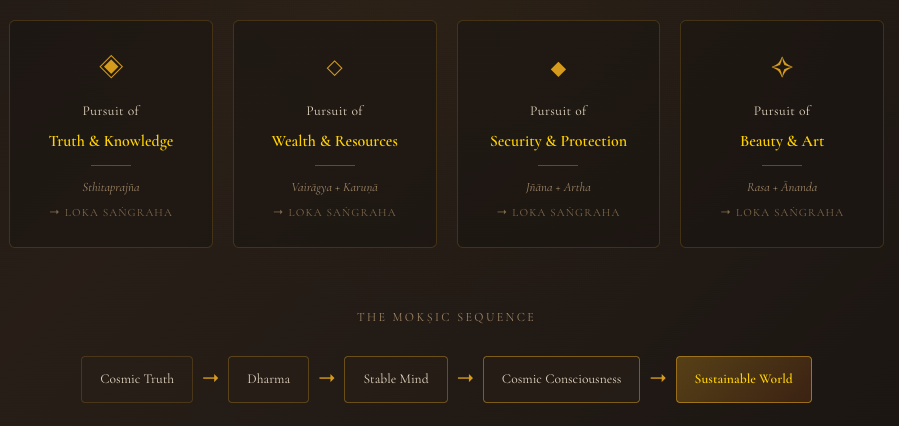
This is the profound mathematics of Dharmic life: Individual Happiness + Collective Welfare = Dharmic Pursuit. The pursuit of truth and knowledge leads to the state of the sthitaprajña—one of stable wisdom—naturally oriented toward universal good. The pursuit of wealth, tempered by vairāgya (dispassion) and karuṇā (compassion), becomes not accumulation but circulation for collective flourishing. The pursuit of security transforms into the protection of jñāna (knowledge) and artha (resources) for future generations. The pursuit of beauty becomes the creation of rasa and ānanda—aesthetic delight that elevates consciousness.
Decolonizing the Mind: The Essential First Step
Before we can build anything new, we must see clearly what already occupies the space. The task of decolonization is not primarily political or economic—it is, at its root, a matter of consciousness. We must learn to identify the borrowed mental constructs that masquerade as common sense, the imported assumptions that we have mistaken for universal truth.
This requires a particular kind of attention. What surprises you? What delights you? What depresses you, elevates you, destabilizes you? These emotional responses are doorways into the unconscious architecture of your worldview. Every strong reaction reveals an assumption, a belief, a conditioning that you have taken for granted. Ask why. Keep asking until you reach the bedrock of borrowed beliefs.
Then comes the harder work: dismantling unnatural, illogical, and alien mental constructs regarding health, wealth, happiness, success, progress, and growth. Not replacing one ideology with another, but developing a mind capable of thinking independently—a mind grounded in ṛta, the cosmic truth, and aligned with the natural order that sustains all existence.
The goal is not to become Bharatiya in any superficial sense—to change costumes while keeping the same mental furniture. The goal is to develop a Bharatiya shastric dṛṣṭi—a way of seeing rooted in the profound understanding of prakṛti and puruṣa, of the manifest and the unmanifest, of the eternal dance between consciousness and energy that creates, sustains, and transforms all worlds.
The Panchakosha Paradigm
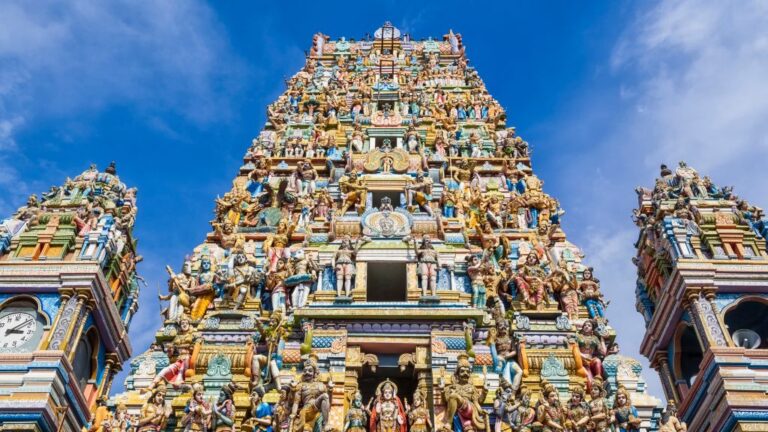
When we look at our cultural assets we can slot each one of them into one of the five koshas. We will find that our cultral assets, which include rituals, customs, traditions and processes were designed to slowly lead us from the Annamaya to the Anandamaya kosha, be it the food we ate, how it was prepared, the temples we built, the murtis we worshipped, the houses we lived in, the clothes we wore, the professions we chose, the cities we designed – every aspect of life was carefully crafted such that even the lowliest creature amongst us would be slowly truding towards the mokshic ideal, day by day, hour by hour and task by task. Such compassion. Such Karuna. So much love for everyone!
Mokṣic Design: The Wheat and the Chaff
Here lies perhaps the most radical insight of Dharmic thinking: true material prosperity cannot be achieved through material goals alone. The pursuit of material success, disconnected from spiritual evolution, inevitably leads to imbalance, exploitation, and ultimate collapse. We see this playing out across the contemporary world—environmental devastation, social fragmentation, epidemic loneliness, and a pervasive sense of meaninglessness despite unprecedented material abundance.
The ancient understanding reverses our modern assumptions. Design based on mokṣic goals—liberation, expanded consciousness, unity with the cosmic order—naturally generates material well-being as a byproduct. This is not wishful thinking but cosmic law. When we align with the fundamental frequencies of reality, when our actions emerge from dharmic consciousness rather than egocentric grasping, resources flow, communities flourish, and even the earth responds with abundance.
No wheat without chaff, as the saying goes. The chaff is not waste to be eliminated but an integral part of the process. True material growth and progress require a model based on spiritual goals. Knowing this, our ancestors invented various forms of yoga, vidyā, śilpa, and kalā—paths of discipline, knowledge, craft, and art that simultaneously served material needs and spiritual evolution. Every potter, every weaver, every farmer understood their work as sādhana, their profession as a doorway to the divine.
How did the cow get into the ditch?
The first exercise we need to do after donning decolonized lenses is to understand how we got into this position in the first place. Evaluate our mental models and see what needs to be thrown out. What is valuable and what is not. Then we need to make sure our cow does not get into the ditch again. For that we need to make sure our future generations are free of these colonial lenses.
Envisioning a Sustainable World from First Principles
Truth based on cosmic order. Dharma based on cosmic truth. Stable mind nurtured by dharmic imperatives. Stable mind combined with cosmic consciousness creating sustainable growth and evolution for all beings.
This is the sequence. This is the only sequence that has ever worked, the only foundation that can support lasting civilization. Every attempt to build sustainable systems upon unstable foundations—whether materialist ideologies or superficial reforms—eventually collapses under the weight of its own contradictions.
Stability rooted in cosmic order and truth is the basis of sustainable growth and evolution for humankind. Not stability imposed through control, not order maintained through fear, but the natural stability that emerges when individual consciousness aligns with cosmic consciousness, when human systems reflect rather than violate natural law.
Testing Our Decolonized Vision
Once we begin to see through dharmic eyes, the contemporary world appears very different. Physical health crises, mental health epidemics, societal conflicts, geopolitical tensions, environmental pollution, overcrowding of cities, traffic problems, deforestation, resource scarcity, youth alienation in the face of technology and social media—all of these reveal themselves not as separate problems requiring separate solutions but as symptoms of a single fundamental disease: disconnection from cosmic order.
Each of these challenges becomes an opportunity to test our developing vision, to create new solutions that emerge not from the same consciousness that created the problems but from the expanded awareness that sees connections, patterns, and possibilities invisible to the fragmented modern mind.
This is the invitation. Not merely to study Indian Knowledge Systems as historical curiosities or philosophical abstractions, but to inhabit them as living ways of seeing, being, and healing. To allow these ancient frameworks to reshape our perception, reorient our priorities, and reconnect us with the cosmic rhythms from which modern life has so profoundly disconnected us.
The world does not need more solutions generated from the same consciousness that created our current crises. The world needs minds that have been transformed, visions that have been clarified, hearts that have been purified. It needs human beings who have done the inner work necessary to perceive reality without the distorting filters of borrowed assumptions and colonial conditioning.
This is the path forward. This is the re-imagining that our times demand. Not a return to some idealized past, but a conscious recovery of timeless principles—adapted, applied, and embodied in response to the unique challenges of our present moment.
The ancient wisdom awaits. It has always been here, patiently waiting for minds ready to receive it, hearts open to its transformative power. The question is not whether these teachings are relevant—their relevance grows more apparent with each passing crisis. The question is whether we are willing to do the difficult inner work required to receive them, embody them, and transmit them to a world desperately in need of a new—or rather, very ancient—way of seeing.
Vinay P Kulkarni is the Founder & CEO of ALCHMI Strategy Consulting, E-com Elephant E-Commerce Tech Services, and Vedikzen Ventures Pvt. Ltd., which houses Indic civilizational initiatives including The Upadesha Academy, Darshana Books & Gifts, Samvada Bistro, and the Shastra Research Lab.



One Comment